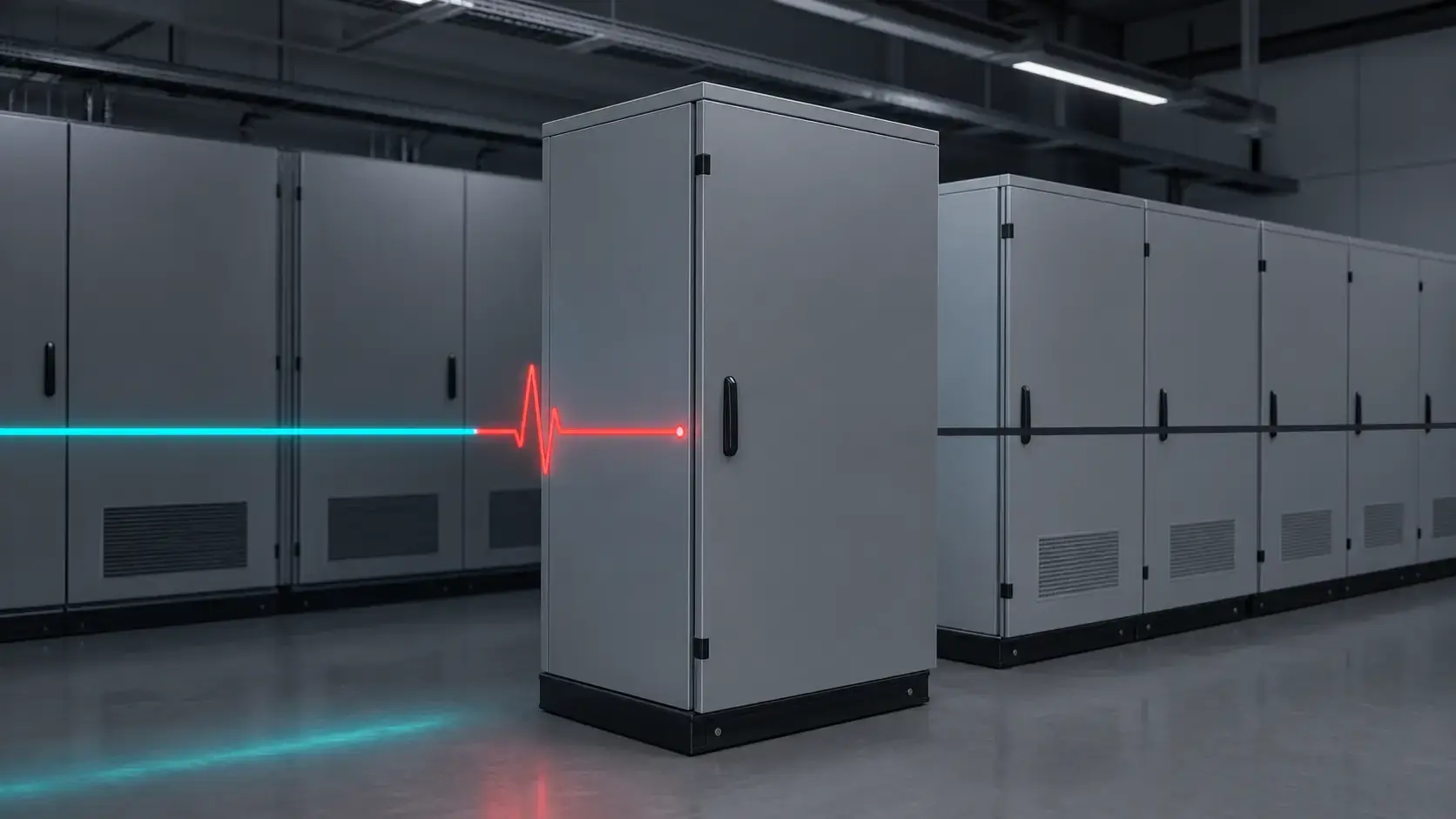
Siemens has expanded its low-voltage direct-current portfolio with the SENTRON 3QD2 semiconductor circuit breaker. Unlike an electromechanical breaker that opens physical contacts, the new device uses semiconductor switching and protection algorithms to interrupt DC faults in the microsecond range.
What Siemens Has Announced
Siemens introduced the SENTRON 3QD2 in April 2026 as part of a wider DC protection and switching portfolio. The company positions it for data centres, industrial production, battery storage and other infrastructure where fast DC fault isolation matters.
The Siemens LVDC product page lists ratings of up to 1,000 V DC and 250 A. It describes the breaker as bidirectional and parameterizable, with integrated measurement of load current and voltage. Siemens also states that diagnostic data can be supplied to higher-level systems through Modbus TCP and PROFINET.
In June, Siemens and Infineon separately confirmed that the 3QD2 uses silicon-carbide power modules from Infineon. The two companies presented the collaboration as a way to improve switching performance, power density and reliability in demanding DC systems.
Why DC Fault Interruption Is Different
Alternating current naturally passes through zero every cycle, which helps extinguish an arc when mechanical contacts open. Direct current has no periodic zero crossing. Fault interruption therefore needs a device and system design suited to the available DC voltage, fault current, stored energy and grounding arrangement.
Siemens says the 3QD2 detects faults in nanoseconds and completes semiconductor shutdown in microseconds without opening mechanical contacts. The company describes this as up to 1,000 times faster than conventional switching. These are manufacturer performance claims for the product architecture, not a universal comparison with every DC protective device.
Five Questions Buyers Should Put in the RFQ
- What is the exact DC system voltage? State the nominal voltage, maximum operating voltage, polarity and permitted transient conditions rather than writing only “LVDC.”
- What fault current must be interrupted? Provide the prospective short-circuit current, source type, cable impedance and contribution from batteries, converters or parallel feeders.
- Is bidirectional current flow required? Confirm normal and fault-current direction for storage, regenerative loads and interconnected DC buses.
- Which protection settings and communications are needed? Define parameter access, coordination requirements, event records, Modbus TCP or PROFINET integration and cybersecurity ownership.
- How will heat be managed? Ask for power-loss data, enclosure derating, ventilation or cooling requirements and the permitted ambient-temperature range for the selected configuration.

Do Not Treat “Faster” as a Complete Specification
Fast interruption can reduce the energy released into a fault, but breaker speed alone does not prove that a complete installation is safe or selective. Buyers still need verified ratings, protection coordination, conductor sizing, insulation design, enclosure conditions and a clear response when communications or auxiliary power are lost.
The downstream equipment also matters. Converters, batteries and capacitive DC links can behave differently during a fault. A useful supplier review should therefore include the breaker, the protected load, upstream sources and the control logic as one system—not as unrelated purchase items.
Where the Product May Change Panel Design
Siemens says the 3QD2 combines protection, switching, monitoring and energy-management functions in one device. That functional density may reduce the number of separate components in a panel, but it also changes the engineering package buyers need to review.
Panel builders should request the approved mounting arrangement, clearance requirements, connection method, thermal data, communication architecture and commissioning procedure. Maintenance teams will also need a defined method for parameter backup, firmware or configuration control and replacement-unit setup.
What the Announcement Does Not Establish
The public Siemens pages do not provide a complete application-specific coordination study, installed cost comparison or universal energy-saving figure for every project. The cited peak-demand and material-saving examples relate to particular DC system concepts and should not be transferred automatically to another installation.
Before specifying the device, buyers should obtain the current technical documentation for the exact orderable configuration and confirm applicable standards, approvals and regional availability with Siemens or an authorized channel.
Takeaway
The SENTRON 3QD2 shows how semiconductor switching is moving into low-voltage DC protection. For procurement teams, the main question is not simply whether microsecond interruption is faster. It is whether the selected breaker, settings, thermal design, communications and DC network characteristics have been engineered and documented as a compatible system.