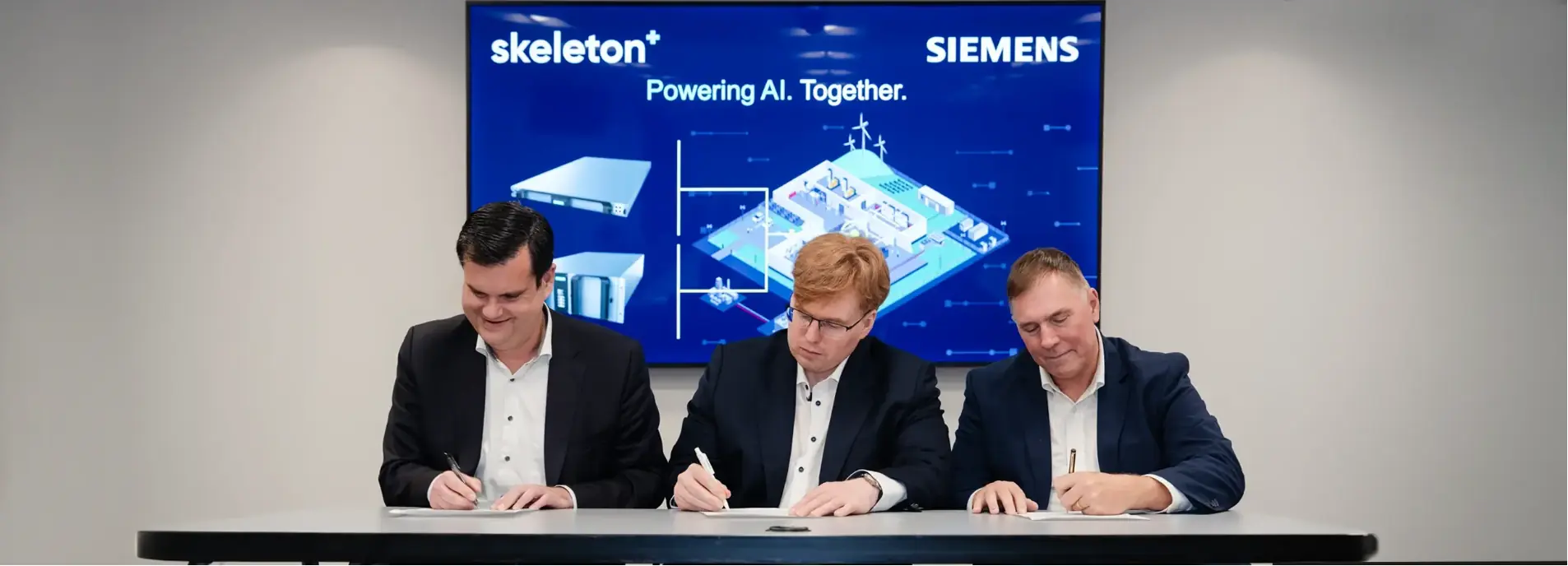
Siemens has announced a strategic investment in Skeleton Technologies and an exclusive global partnership for the data-center market. Siemens plans to integrate Skeleton’s high-power supercapacitor systems into an electrical-infrastructure portfolio spanning the utility connection, facility distribution and the AI rack.
The announcement targets a specific power-quality problem created by large AI clusters: thousands of processors can change operating state within milliseconds, producing repeated megawatt-scale load swings. Supercapacitors are intended to absorb and release power quickly so those transients are less disruptive to upstream equipment and the grid.
What Siemens and Skeleton announced
Under the partnership, Siemens will have exclusive rights to sell and scale Skeleton’s products in the data-center market. The companies say they will combine Siemens’ electrical-infrastructure portfolio and global sales reach with Skeleton’s supercapacitor cells, power electronics and controls.
The relationship is not new. Siemens says it has supported Skeleton as a technology partner since 2022 and has been an investor since 2023. The latest agreement deepens that relationship and focuses it on hyperscale data centers and AI factories.
The transaction remains subject to customary completion formalities. Neither company disclosed the investment amount in the Siemens release, and no orderable Siemens product family, rating table or delivery schedule was published with the announcement.
Why AI workloads create a different power problem
Conventional facility planning often concentrates on total capacity, redundancy and backup duration. AI computing introduces another variable: the speed and repetition of load changes. Coordinated GPU workloads can move between low and high power states in milliseconds, while the combined change across a cluster can reach megawatt scale in seconds.
Rapid swings can increase stress on power-conversion equipment and complicate utility-facing demand. The challenge is therefore not only supplying enough energy over time, but also controlling how quickly power demand changes at the rack, room and facility connection.
What a supercapacitor contributes
A supercapacitor is optimized for high power and rapid charge-discharge cycling rather than long-duration energy storage. In this application it acts as a short-term buffer: it absorbs power when compute demand drops suddenly and supplies power when demand rises, reducing the rate of change seen by upstream systems.
That role differs from a generator or battery UPS designed to carry a load through a longer outage. Supercapacitors may complement those systems, but the partnership announcement does not establish that they replace every battery, UPS or standby-generation function.
Where the technology may fit
Siemens says the offering is intended for the electrical path from the grid connection to the AI rack. The company also states that the technology can be deployed in existing AC architectures and retrofit projects while providing a pathway toward future 800 V DC systems.
Actual placement will determine which problem the equipment addresses. A rack-adjacent system can respond close to the workload, while a centralized installation may coordinate larger power blocks. Buyers will need project-specific single-line diagrams, fault studies, control interfaces and physical layouts before selecting either architecture.
Claims that require project-level validation
Skeleton says its systems can help reduce utility-side disturbances, improve energy efficiency and unlock more usable computing capacity. Its own announcement also cites up to 40% energy savings and double-digit GPU-performance improvement.
Those figures are company claims and were not accompanied in the releases by a standardized test boundary, reference architecture or independently verified comparison. They should not be applied as universal design values. Results may depend on workload profile, existing power-conversion losses, control strategy, system location and the baseline used for comparison.
What designers and buyers should verify
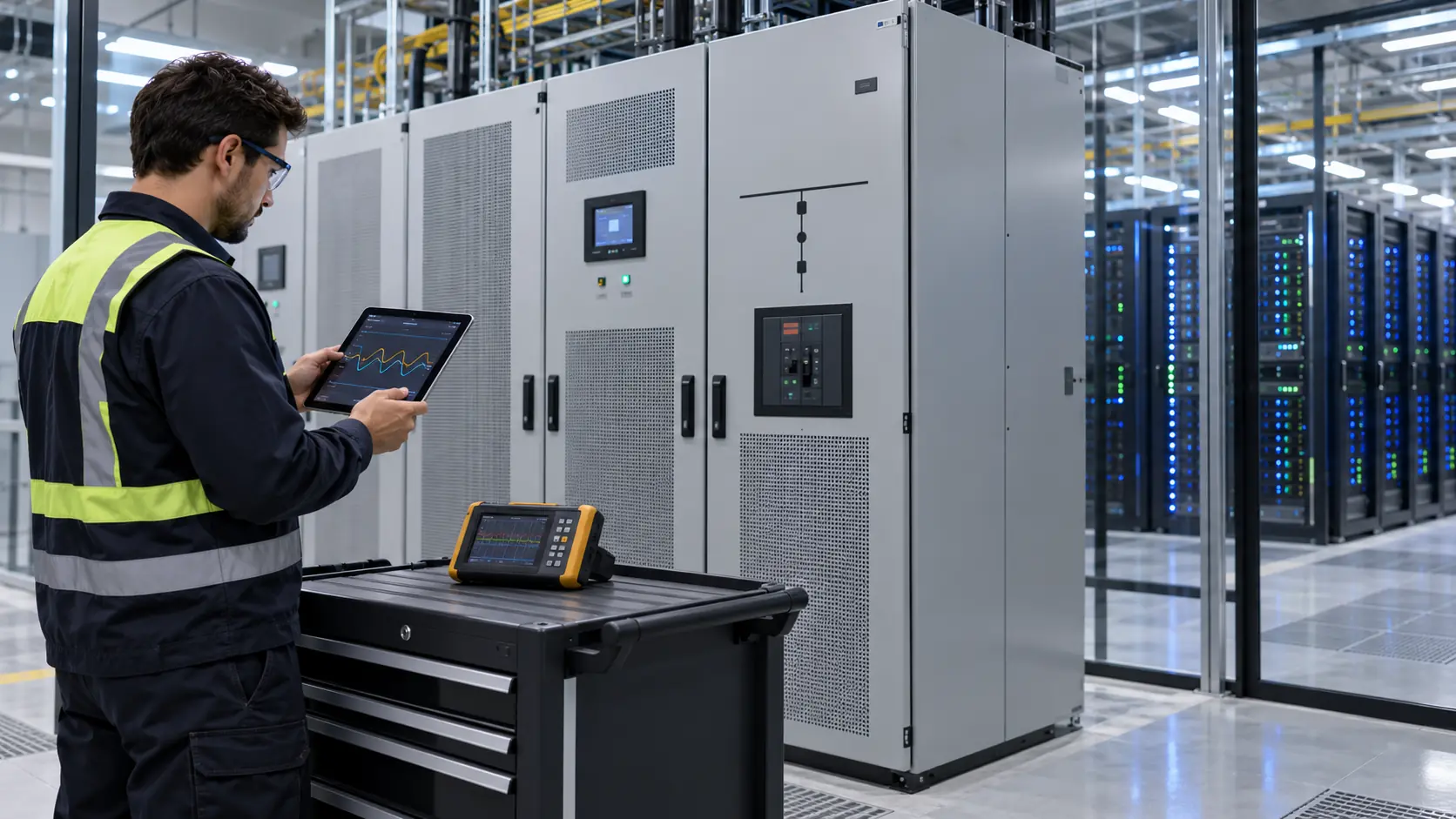
- Define the disturbance: record load-step magnitude, duration, repetition rate and the point where mitigation is required.
- Separate power from energy: verify peak kW or MW, usable energy, response time and the required ride-through duration.
- Map the architecture: establish whether the equipment sits at rack, row, room, bus or utility-interface level.
- Coordinate protection: review available fault current, isolation, earthing, pre-charge, discharge and emergency shutdown.
- Check thermal limits: confirm performance during repeated cycling and under the site’s cooling conditions.
- Integrate controls: define communication protocols, time synchronization, power-management logic and fallback behaviour.
- Request evidence: obtain test methods and operating data that match the proposed workload rather than relying on portfolio-level claims.
Retrofit does not mean plug-and-play
The ability to work with existing AC distribution could make the technology relevant to facilities that cannot wait for a complete electrical redesign. However, a retrofit still requires space, structural loading, ventilation, cable routes, protection changes, controls integration and an installation sequence that protects live operations.
Operators should also examine whether smoothing a local load changes UPS loading, generator response, transformer utilization, power-factor behaviour or utility metering. The correct study boundary extends beyond the supercapacitor enclosure.
Manufacturing and supply-chain implications
Skeleton’s parallel announcement says the new investment will support US manufacturing expansion and research activity in Silicon Valley. The company plans more than $200 million in operational scale-up and R&D, including domestic cell manufacturing and a US value chain from cells to complete systems.
That plan indicates an effort to move production closer to large North American AI-infrastructure customers. It is still a forward-looking expansion plan; buyers should confirm qualification status, factory location, regional content, lead times and service coverage for the specific product offered.
What the announcement does not establish
The releases do not publish a Siemens-branded model number, system capacity, voltage range, footprint, efficiency curve, warranty, certification package, price or general-availability date. They also do not demonstrate that every AI data center needs a supercapacitor system.
The partnership is strategically important, but it should currently be treated as a portfolio and commercialization announcement. Tender specifications should wait for product-level documentation and should distinguish confirmed ratings from corporate targets.
Takeaway
Siemens’ investment in Skeleton signals that fast-response energy storage is moving closer to mainstream data-center electrical design. The technology addresses millisecond load swings rather than long-duration backup, potentially reducing the effect of AI workloads on facility and utility infrastructure.
For designers and procurement teams, the next step is not to assume a universal efficiency or capacity gain. It is to translate the actual workload into power, energy, cycling, protection and control requirements, then compare those requirements with the product-level data when Siemens and Skeleton release it.