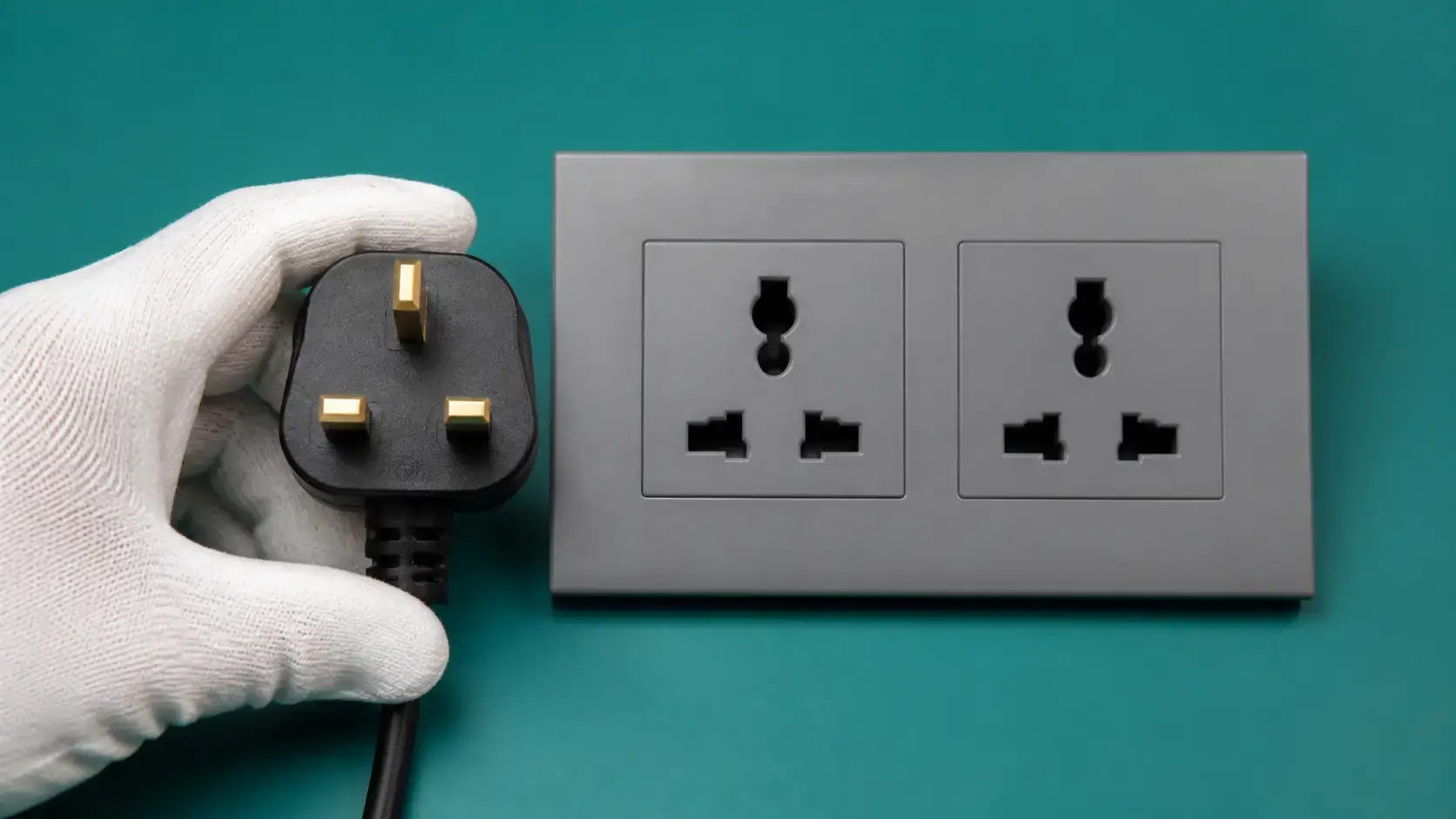
A UK product safety report has flagged a two-gang universal wall socket as a serious electric-shock and fire risk. The product was destroyed after checks found inadequate earthing, weak internal construction and a plug face that did not meet BS 1363 dimensional requirements.
What the UK Safety Report Found
The Office for Product Safety and Standards published the report on August 17, 2026, with an alert date of August 14. It describes a matt-grey two-gang wall socket made in China and supplied in cartons of 100. No model or other product identifier was available.
OPSS classified the risk as serious. The corrective action was destruction of the product. This was a product safety report, not an announced consumer recall.
Three Construction Problems Behind the Risk
The first issue was insufficient earthing. If a fault occurred, accessible metal parts could become live and expose a user to electric shock.
The second issue was the internal build. The report says wires were soldered directly to live and neutral connections. Over time, weak joints can loosen, overheat or arc, increasing the risk of fire.
The third issue was dimensional. The plug face did not meet BS 1363 requirements, so an inserted plug might not make a secure connection with the socket. A poor contact can create local heating even when the exterior looks normal.
Why Universal Socket Faces Need Extra Scrutiny
A universal aperture may be marketed as convenient because it accepts more than one plug format. That does not prove that every plug system is safely supported. Contact geometry, shutters, earthing sequence, pin engagement and temperature performance still need to match the destination market.
For the UK, buyers should not treat a universal face as a substitute for verified BS 1363 construction. The exact socket design, internal contacts and enclosure must be assessed as a complete product.
What Importers Should Check Before Shipment
- Protective earth path: verify the terminal, conductor size, bonding method and continuity to every accessible conductive part.
- Socket geometry: obtain dimensional test results for the exact faceplate, contact carrier and production mould.
- Contact pressure: check that approved plugs are retained securely and that contacts do not deform after repeated insertion cycles.
- Internal terminations: define permitted crimp, screw or welded joints and do not accept uncontrolled solder-only current paths.
- Temperature rise: test the complete two-gang assembly at its declared rating, including both outlets under the required load conditions.
- Shutter operation: confirm that live contacts cannot be accessed by a single pin or foreign object.
- Marking and traceability: lock the model, rating, manufacturer, importer, batch code and packaging description.
- Change control: require approval before changes to contacts, terminals, wire, screws, plastics, moulds or subcontractors.
What to Add to the RFQ
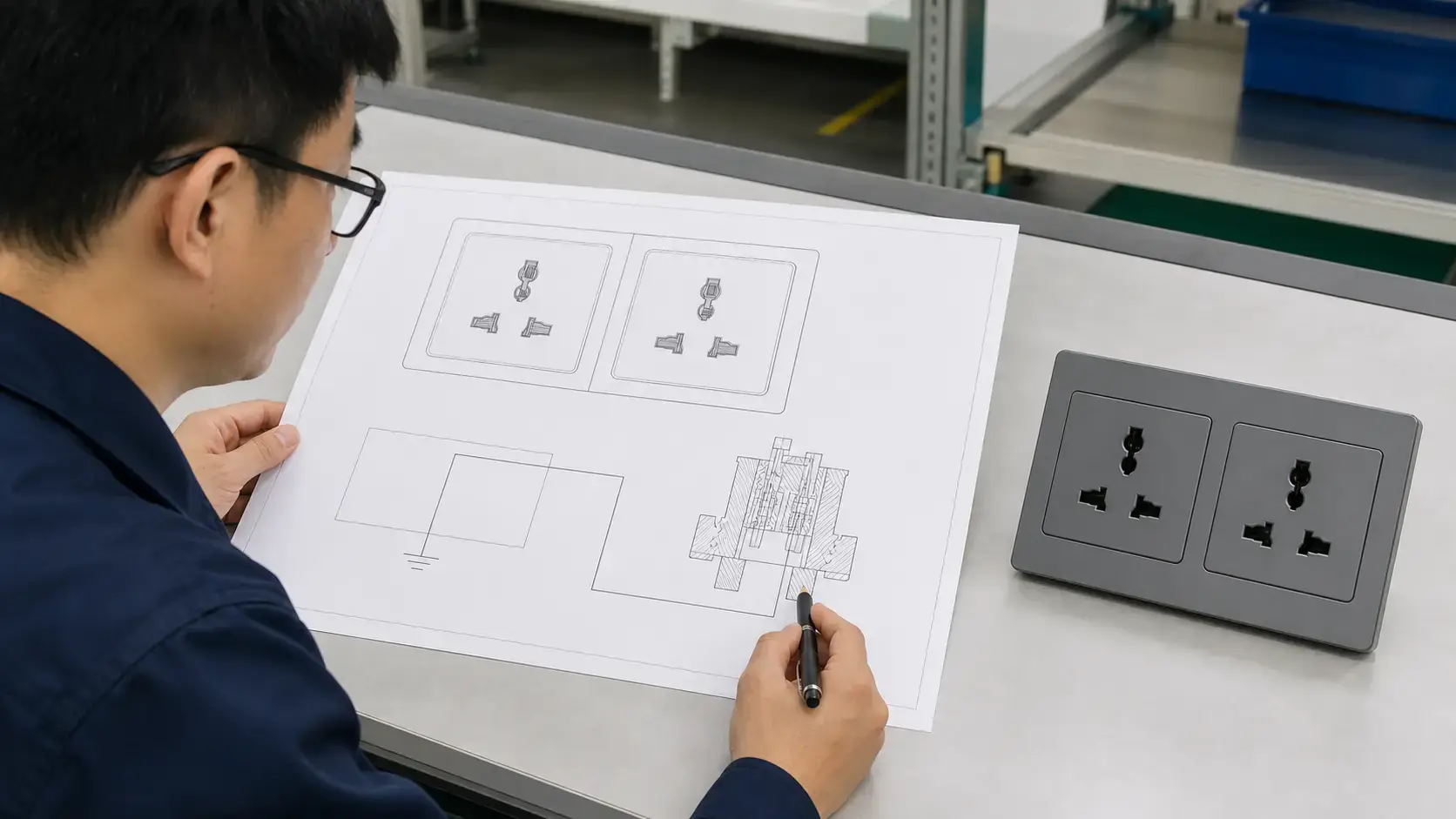
The RFQ should identify the target country, accepted plug system, rated voltage and current, earthing arrangement, shutter design, terminal method, enclosure material and required standard. Ask for a report tied to the exact model and construction, not a visually similar socket.
Packaging also needs control. In this case, the box reportedly used both “Switch And Socket” and “2 Gang 2 Way Switch,” even though the item was described as a wall socket. Conflicting product descriptions weaken traceability and make it harder to match samples, reports and production batches.
Compliance Boundary
OPSS said the product did not meet the Electrical Equipment (Safety) Regulations 2016 or the Plugs and Sockets etc. (Safety) Regulations 1994. The public report identifies BS 1363 dimensional non-compliance but does not provide a full clause-by-clause test report.
Importers should therefore use the notice as a failure-mode warning, not as a complete testing specification. The conformity route and applicable standard set should be confirmed for the exact product and market.
Takeaway
A wall socket can look finished while still failing at the earth path, internal joints and plug interface. Buyers should verify all three before approving production. Start with the exact sample, then lock the construction, dimensional evidence and batch controls into the purchase specification.