The UK Office for Product Safety and Standards published a product safety report on September 11, 2026, covering a ROMADA New Energy portable EV charger and cable. The report classifies the product as presenting a serious risk of electric shock. The affected import was rejected at the UK border on September 10.
The notice identifies model K02-1.8 13A 5, described as an EV charger with an attached wall plug and carry case. OPSS says poor-quality internal connections could result in the loss of protective earthing and allow the product to become live during use. It also reports missing required accreditation markings on the supplied plug.
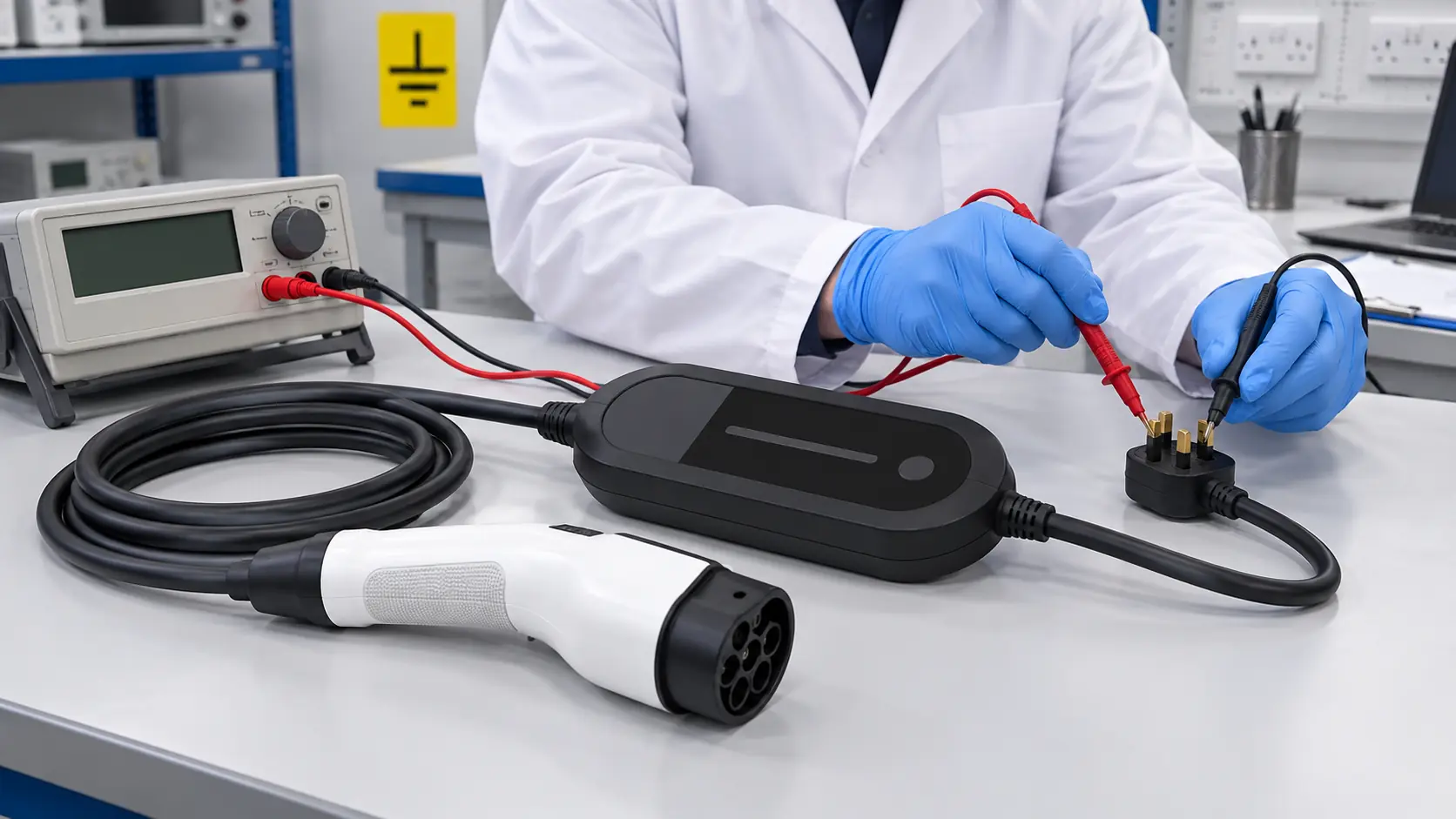
Which product is covered?
The report names the brand as ROMADA and gives the full model reference K02-1.8 13A 5. It also lists four product-carton identifiers: B04000000001409021663, WI49803276, M0100000000010472175 and No. 51. The country of origin is recorded as China.
These identifiers should be used together. A portable EV charging lead can resemble many other products sold under different names, so appearance alone is not enough to establish whether a unit matches the report. Importers and marketplace operators should compare the model, carton information, supplier records and product photographs in the official notice.
The corrective action applies to the shipment examined by the authorities: the import was rejected at the border. The public report does not state that a consumer recall has been initiated, give a UK sales period or identify a retailer. It should therefore not be presented as a recall of every ROMADA-branded charger worldwide.
What OPSS found
OPSS attributes the serious electric-shock risk to poor-quality internal connections. The notice also states that the internal wires were all the same length. According to the authority, the construction could allow protective earthing to be lost, after which accessible parts could become live during use.
Protective earthing is a critical fault-protection measure. Its purpose is not normal current carrying; it provides a controlled path that supports protective-device operation if a fault energizes exposed conductive parts. A product whose earth continuity can be lost cannot be assessed merely by confirming that it powers a vehicle.
The report additionally says the wall plug lacks required accreditation markings and that improvements are needed to documentation, markings and instructions. It records non-compliance with the Electrical Equipment (Safety) Regulations 2016 and the Plugs and Sockets etc. (Safety) Regulations 1994.
Why functional testing is not enough
A charger may appear to operate normally even when its construction or protective conductors are inadequate. Basic energization confirms only a limited function at that moment. It does not establish earth continuity under mechanical stress, the quality of internal terminations, plug compliance, insulation performance or the adequacy of instructions.
Portable EV charging equipment is exposed to repeated handling, coiling, transport and connection. That makes strain relief, conductor routing, termination security and enclosure integrity important parts of product evaluation. The OPSS report does not publish detailed test readings or a full laboratory method, so no additional failure mechanism should be inferred beyond the findings stated in the notice.
Owners should not open or modify portable EV charging equipment to investigate an internal defect. If a product appears to match the identifiers in the notice, use the official report and contact the supplier or relevant market-surveillance channel for guidance.
Checks for importers, distributors and marketplaces
- Match the identity: record the brand, complete model number and carton identifiers rather than relying on a listing title.
- Trace the supply chain: retain manufacturer, exporter, importer and batch documentation for every shipment.
- Verify the plug: confirm the supplied plug and fuse arrangement have the required UK approvals, construction and markings.
- Review protective earthing: require competent test evidence for earth continuity, connection integrity and relevant mechanical stresses.
- Check the complete product: assess the control box, cable, vehicle connector, mains plug and accessories as one supplied system.
- Review instructions: ensure warnings, ratings, operating limits and supplier information are complete and legible.
- Control online listings: link marketplace records to the actual model and shipment, including products sold under alternate listing names.
- Hold uncertain stock: do not release matching or poorly documented units until their identity and compliance status are resolved.
What procurement teams should request
A supplier declaration alone should not replace product-level evidence. For a portable charger intended for the UK, the procurement file should identify the exact model and hardware version, applicable standards, conformity-assessment basis, plug approval, test reports, English instructions and the responsible UK economic operator where required.
Documentation should correspond to the complete delivered product. A certificate for a similar control box, cable or plug does not automatically cover the assembled charger. Changes to the plug, cable length, internal connections, enclosure or electronics may affect the evidence needed for the final configuration.
Where products are sourced through online marketplaces or trading companies, buyers should also check that the legal manufacturer and importer details remain traceable after the listing changes or disappears.
Takeaway
The ROMADA report is a narrowly defined border rejection, but it highlights a broader purchasing lesson. Portable EV chargers need more than a familiar-looking UK plug and successful power-up test. Exact product identity, durable protective earthing, compliant plug construction, traceable conformity evidence and complete instructions must all be verified before a shipment reaches users.