LIBAIK offers wall switches and sockets for importers, distributors, private-label brands and project buyers sourcing wiring accessories from China. Our range brings together four distinct wall switch and socket series: V6 for European minimalism and structural differentiation, V12 for decorative Middle Eastern styling, V7 for a slim contemporary designer look, and L11 for classic wholesale and engineering applications.
Products are manufactured by Zhejiang LIBAIK Electric Co., Ltd.; export and contracting services are provided by D&M Electrical Co., Limited. This page helps you compare our ranges and prepare the product and supply questions for your enquiry.
Choosing a range is about more than matching a socket format or finding the lowest quoted price. Your customers may be buying a familiar everyday design, a decorative collection for a showroom, or a coordinated finish for a hotel. Start with the role the range will play in your business, then review the exact models, samples and ordering requirements.
On this page
Compare LIBAIK Wall Switch and Socket Series
Wall switches and sockets are our core product line. The four series give buyers different design and channel options; they should not be treated as interchangeable products with different names.
| Series | Distinctive character | Buying or display role |
|---|---|---|
| V6 | European minimalist styling and a flat-off mechanism: a neat surface that is easier to wipe, designed to help limit dust entry. | A quality-focused range for buyers who want restrained design and structural differentiation. |
| V12 | A more decorative square design with a prominent frame and optional electroplated finishes. | A main selling range for Middle Eastern wholesale channels, retail displays and sample boards. |
| V7 | An approximately 6 mm slim faceplate profile and screwless appearance. | A modern designer range for premium displays and design-led residential, hospitality and office projects. |
| L11 | A mature, classic design with a practical modular range. | An established-style starting point for volume wholesale, engineering orders and budget-conscious assortments. |
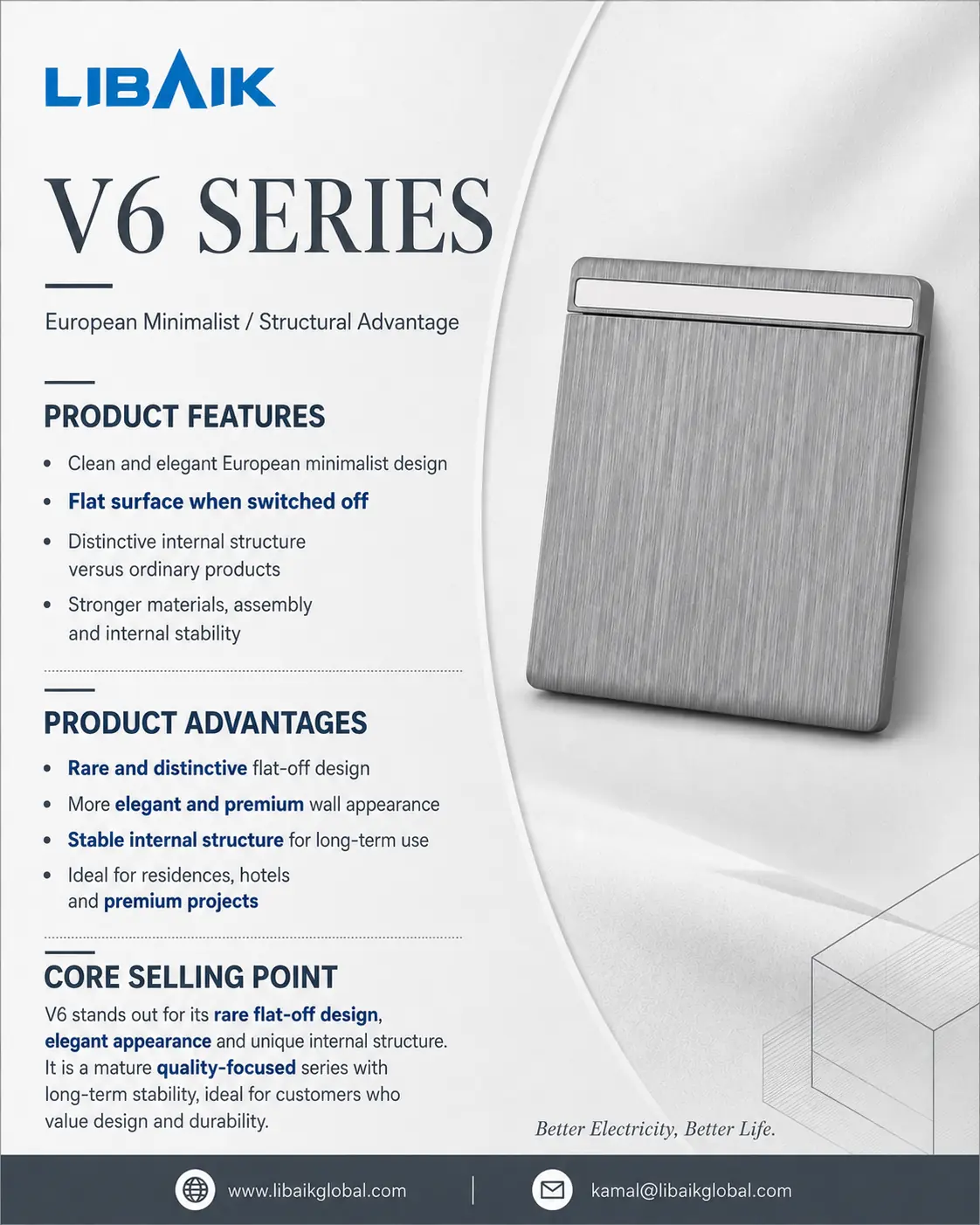 View V6 product card
V6 — European minimalist design with a flat surface when switched off.
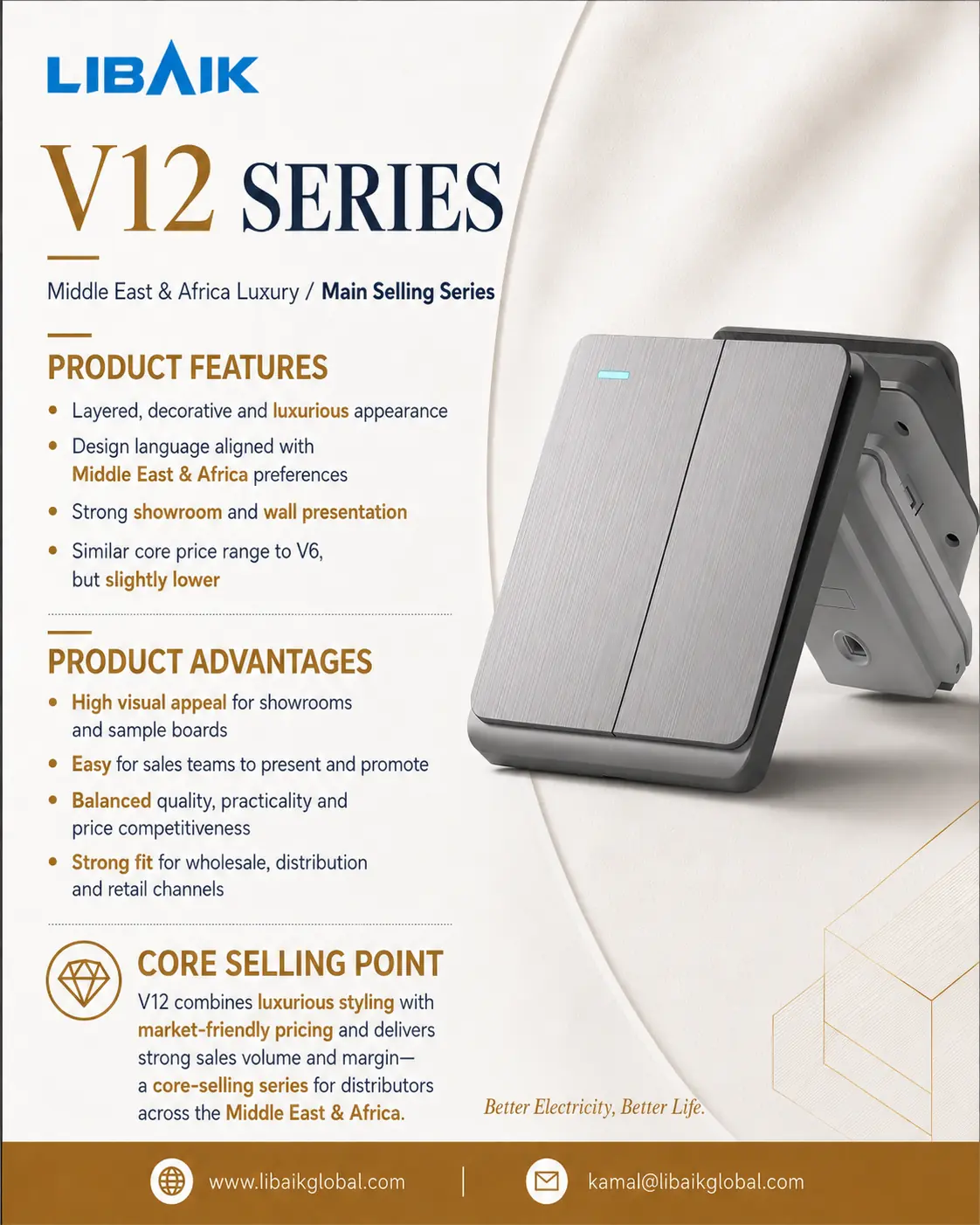 View V12 product card
V12 — Layered decorative styling for showroom and wholesale presentation.
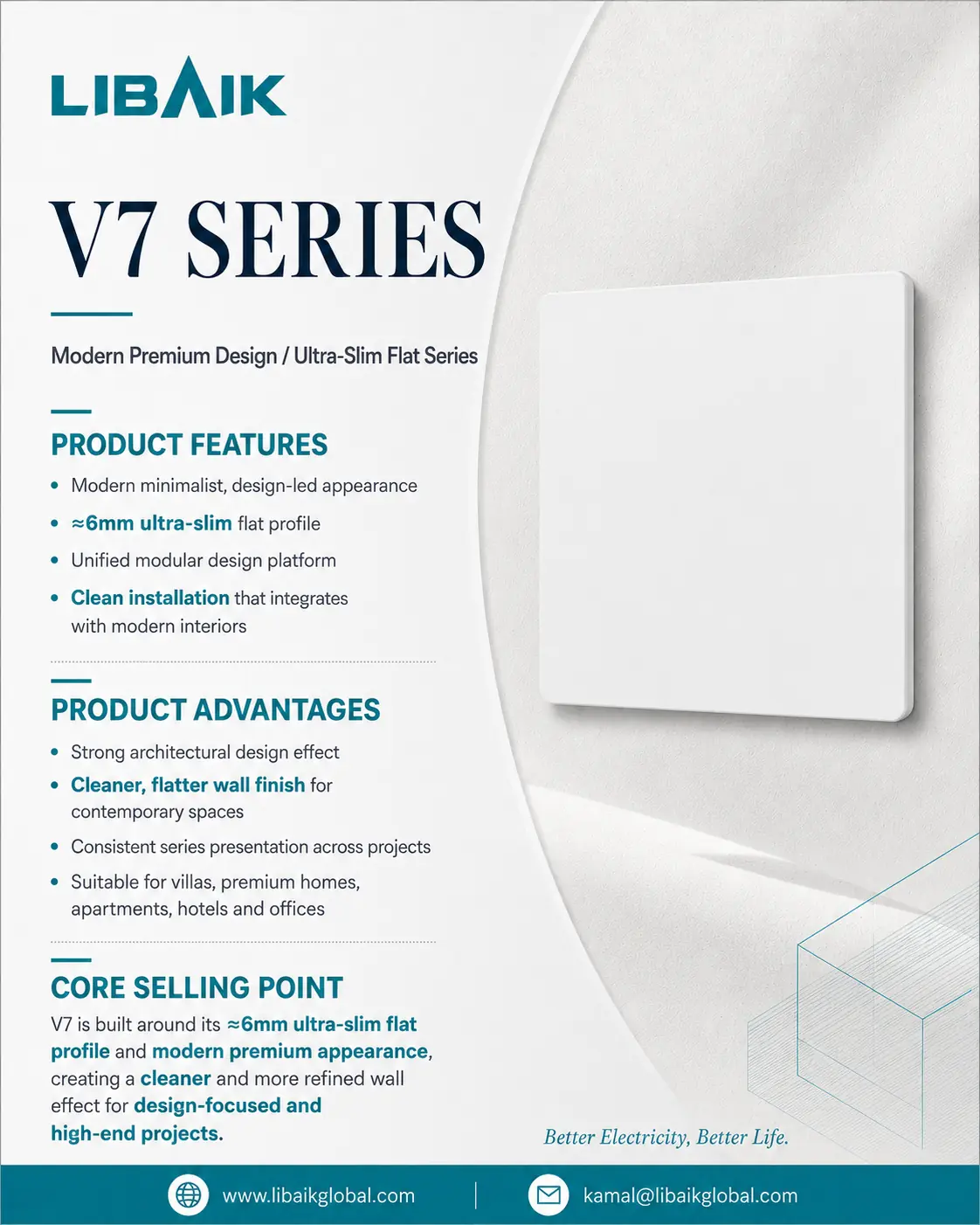 View V7 product card
V7 — Modern flat design with an approximately 6 mm visible profile.
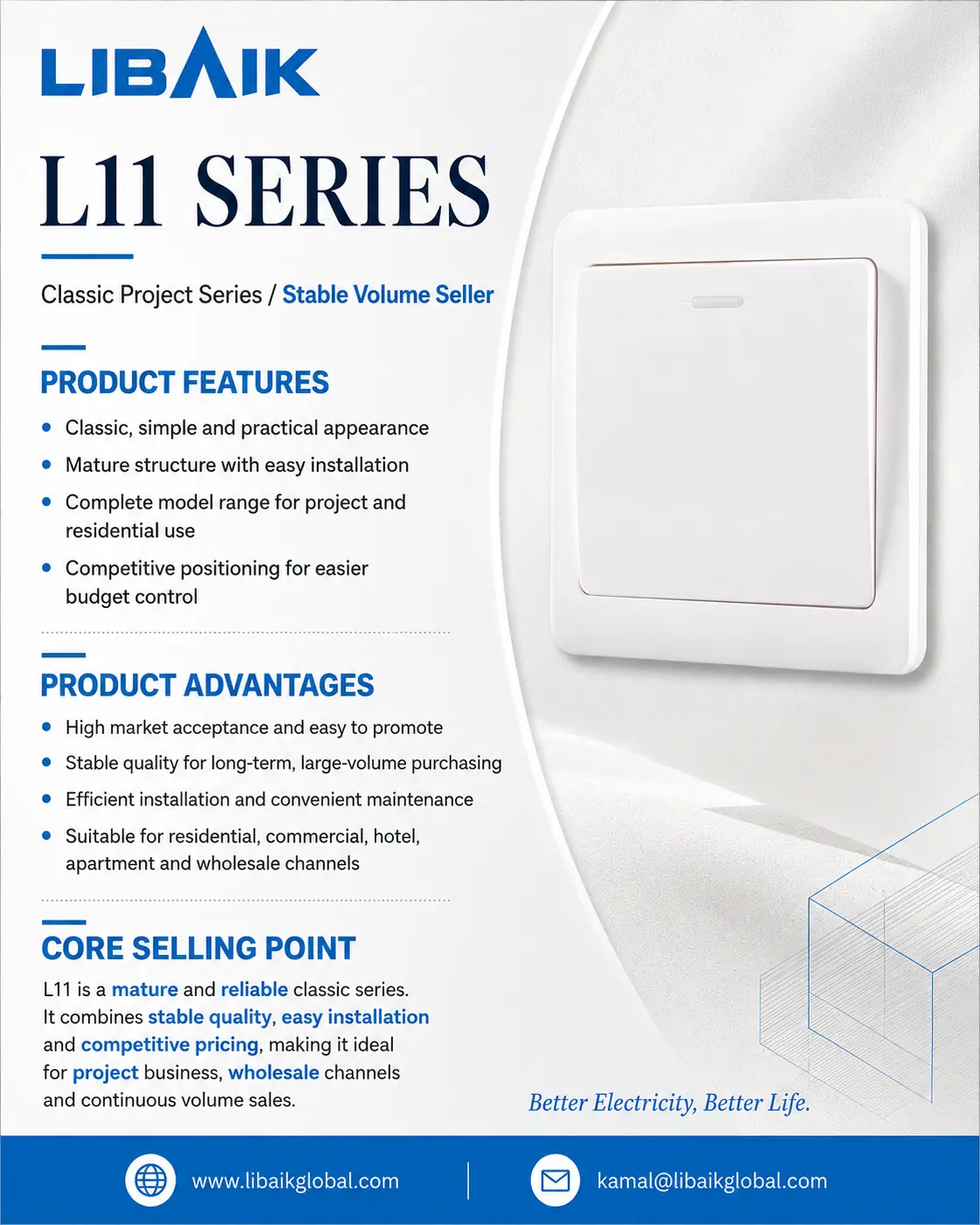 View L11 product card
L11 — Classic practical styling for project and wholesale assortments.
Already have a product shortlist? See what to send for an enquiry.
V6: European Minimalism with a Distinctive Structure
V6 is the range to explore when your customers prefer a clean, understated appearance rather than a strongly decorative frame. Its flush-when-off design and subtle accent bar give the faceplate a recognisable identity without relying on a heavy ornamental look.
When the switch is off, its operating surface sits flat. This gives V6 a tidy appearance and a surface that is easier to wipe during routine cleaning. The flat-off mechanism is also designed to help limit dust entering the switch interior, supporting durability as well as appearance. These are practical reasons to consider V6 for customers who care about everyday upkeep, not just the look of a new sample.
On a sample board, switch the V6 rocker off and view it from the front and side, then compare its operation with the range you currently stock. For an application with a specified dust-protection or service-life requirement, check the selected model's documentation separately; the flat-off design alone does not establish an IP rating or a rated number of operating cycles.
V6 is positioned slightly above V12 in price because of its distinct internal structure and associated cost. The actual price comparison depends on the selected models, finishes and order requirements. Explore the V6 Series.
V12: Decorative Styling for Middle Eastern and African Channels
V12 has a stronger visual presence, with a classic square form, a decorative frame and optional electroplated finishes. It is the range to consider when the faceplate itself is part of the interior decoration and needs to stand out on a showroom board.
LIBAIK positions V12 as a main selling range for Middle Eastern and African wholesale and retail channels, with a layered decorative appearance. Its display value comes from giving customers a visible design choice: compare frame finishes, show matching functions together and build a coherent presentation around the range. For project buyers, it offers a more decorative direction than V6's restrained European style.
V6 and V12 are both high-quality LIBAIK ranges, with different design, structure and commercial roles. Choose according to your channel and customers, then confirm the exact finish and ordering terms. Explore the V12 Series.
V7: A Slim, Screwless Designer Range
V7 combines an approximately 6 mm slim faceplate profile with a screwless appearance for a clean, modern wall finish. Its role is a designer collection for buyers who want their showroom, project or private-label presentation to convey a contemporary, premium identity.
Consider V7 for design-led hotels, apartments, villas and offices, or as a showcase range alongside your main wholesale collection. The product page lists PC and glass faceplate options; review the selected version with the surrounding finishes rather than assuming that every image represents the same material or configuration.
The slim faceplate measurement describes the visible profile, not a promise about the installation depth or suitability for every wall box. Check the dimensions and installation arrangement for the exact model during sample selection. Explore the V7 Series.
L11: A Classic Range for Wholesale and Engineering Orders
L11 is LIBAIK's classic mass-market engineering series. Its familiar styling and practical modular range make it a useful starting point for buyers building an everyday assortment, supplying repeated project requirements or serving price-sensitive channels.
The commercial role differs from V7: L11 centres on a mature, recognisable design for broad use, while V7 centres on designer presentation. A wholesaler can review L11 as a core assortment and consider a design-led series for customers seeking a different appearance. Compare these roles with the designs and functions your own customers already buy.
Prepare a list of the frequently ordered functions, finishes and quantities first. That provides a more useful basis for an L11 quotation than asking for a single price for the entire series. Explore the L11 Series.
Build a Wiring Accessories Range Around Your Customers
A distributor does not have to give every series the same role. One possible assortment combines a main selling collection with a premium display range: V12 may be the decorative main line for a Middle Eastern showroom, with V7 presented for design-led requests. V6 provides a distinct minimalist alternative; L11 addresses classic wholesale and engineering needs. Use local demand, sample reviews and model-specific quotations to decide the final assortment.
For functions such as USB charging, ask which modules are available in the chosen series. Do not assume that every function, finish or configuration is offered across all four ranges. A coordinated item list is especially useful for projects where switches and sockets need a consistent appearance.
Make the Sample Comparison Useful
Compare the same function and a similar finish across your shortlisted series. A single switch in one range and a multi-function socket in another will not give you a fair price or appearance comparison. For the design review:
- V6: examine the flat-off surface from the front and side, including how accessible it is for routine wiping.
- V12: compare the layered frame with your showroom finishes and display matching switches and sockets together.
- V7: review the slim profile on a sample wall or board; use the selected model drawing separately to check installation fit.
- L11: lay out the everyday functions your customers repeatedly order and check whether the planned assortment covers them.
Keep a short sample record: model, function, finish, sample reference, accepted details and open questions. This turns a preference such as “we like the silver one” into a selection that can be quoted and checked again when the order arrives.
Power Track and Extension Sockets as Complementary Lines
Alongside the core wall accessory ranges, the LIBAIK Power Track System uses a track with movable socket adapters for layouts where the position of power access matters. It can support demonstrations for suitable kitchen, office, counter or commercial interior applications. It is a complementary flexible-power option, not an automatic replacement for fixed wall sockets.
The UK Extension Socket range provides another category to discuss alongside fixed wiring accessories. Specify the outlet arrangement, cable requirements and intended use separately. For either line, confirm the selected configuration and installation requirements rather than transferring a wall socket specification to a different product type.
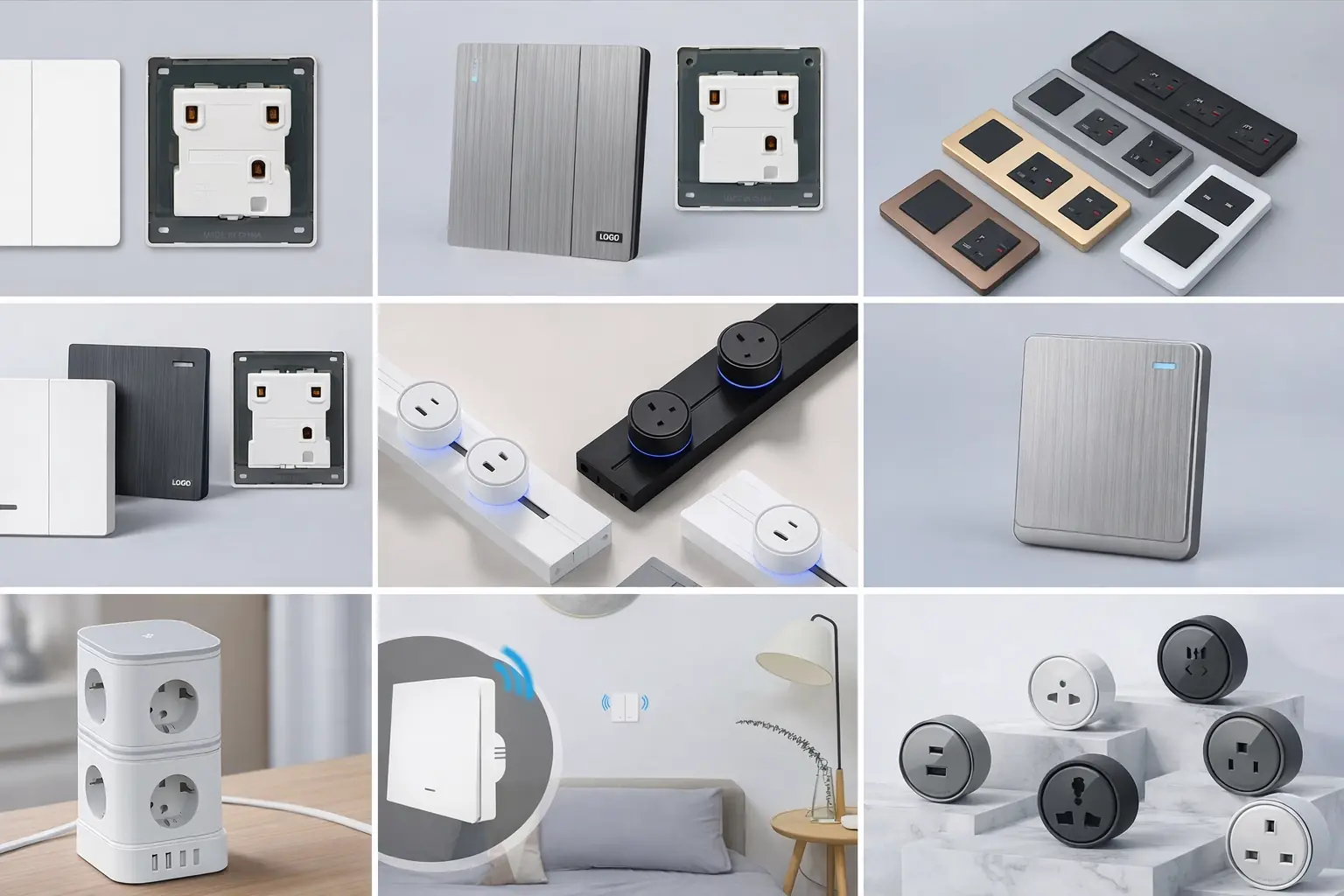 Explore the product families, then confirm the specific models and configurations needed for your order.
Tell Us How You Plan to Buy
Your buying route changes what needs to be decided first:
- Distribution: identify the core functions and finishes your channel needs, then separate the everyday assortment from any premium display range.
- Projects: start with the item schedule or bill of quantities, installation drawings and finish references. Group matching functions by room or area.
- Private label: identify the base product and the changes you want to make. A logo or packaging change has a different approval scope from a new structure.
The OEM and ODM guide helps you define a customisation request. The enquiry checklist below brings the information for each route together.
Look Beyond the Sample and Unit Price
For a distributor or contractor, the purchase continues to matter after the cartons arrive. A replacement can mean another site visit, a delayed handover or a difficult conversation with your own customer. Put the quoted price beside the product specification, inspection arrangements and responsibility for resolving discrepancies.
Two similar-looking faceplates do not tell you whether the products use the same components or represent the same order specification. Before comparing prices, identify the model, functions, finish, packaging and supporting documents included in each quotation. If a price changes, ask what has changed with it. This makes the trade-off visible instead of leaving it to be discovered after delivery.
A Customer's Experience: A Component Change Discovered After Delivery
A customer in Cyprus told us why he moved his sourcing to LIBAIK. According to his account, the socket samples from his previous supplier used copper connecting pieces, and the IEC test report supplied during approval also described copper pieces. After the order was confirmed, the supplier changed those parts to an iron alloy without notifying him, reportedly following a rise in copper prices.
The customer said his team did not notice the change at delivery. A downstream dealer discovered it later, when dismantling a product to film a promotional video. The supplier described the replacement as a “new material” with the same performance as copper. The customer told us that his complaint remained unresolved and that he subsequently changed suppliers and began buying from LIBAIK.
This is the customer's account; we have not independently verified the former supplier's report or tested the two versions. The point for a buyer is concrete: a component substitution needs disclosure, supporting evidence and approval before it becomes part of the order. A supplier's statement that a new material performs the same does not, on its own, establish equivalence.
When approving an order, record the connecting-piece material alongside the model and sample reference. Agree that proposed substitutions require written notice and your approval, and include an appropriate check of the delivered version in the inspection plan. If a change is proposed, review whether the supplied test evidence still covers that version before accepting it.
Materials: Ask Which Part, Not Just Which Material
The socket connecting piece in the customer's account is a specific component. A description such as “copper contacts” should not be extended to every terminal or connecting piece, just as “PC housing” does not describe the whole product. Name the component and its specified material together. That gives the supplier a precise question to answer and gives your inspection team something definite to compare.
How to Review Sample-to-Bulk Consistency
An approved sample tells you what you accepted. It does not, by itself, explain how the supplier will keep later units aligned with that reference. Ask how the product is identified through production, where it is checked and which records can be connected to your shipment.
 LIBAIK workshop: injection moulding equipment. Product and batch checks are separate from this workshop overview.
| Stage to discuss | What to request or compare | Buyer decision it supports |
|---|---|---|
| Housing and moulding | The approved housing version, relevant dimensions and how fit is checked against the selected model. | Whether the inspected units correspond to the physical configuration you approved. |
| Metal components | The component identification, specified material and dimensions, and the records available for checking them. | Whether a material description applies to the actual component in your order. |
| Assembly | The assembly checks applicable to the model, their acceptance criteria and how discrepancies are handled. | Whether “quality checked” has a defined meaning for the version being supplied. |
| Product testing | The model and configuration tested, test conditions, results and the document's relationship to the ordered goods. | Whether the evidence supports the product claim being made. |
| Packing and shipment | The model labels, finish, quantities, packing version and inspection reference for the shipment. | Whether the goods can be reconciled with the quotation and approved sample. |
Use this table to agree the inspection scope: which checks cover individual units, which use samples, and how a failed check is resolved. The resulting plan should identify both the goods being checked and the criteria for accepting them.
Keep One Reference for Approval, Inspection and Reordering
Build on the sample record made during selection. Add the approved component specification, packaging or artwork version and the inspection reference. For a project, attach the relevant item-schedule line. Reuse that reference for the next order and record any approved changes instead of relying on “the same series as last time”. The factory verification checklist provides a fuller supplier review.
Match Product Documents to the Destination and Configuration
Review the documents against the exact product you intend to buy. Match the model and variant in the report with the quotation, identify the issuer and the scope of the evidence, and resolve any difference before order approval. In the Cyprus customer's account, the concern was a change after approval: a report describing the original version does not by itself establish the performance of the substituted version.
Also provide the destination and installation conditions, including any requirements from the project's technical team. This separates two questions: whether the evidence covers the supplied version, and whether that version meets the requirements of your intended use.
 Testing-room equipment. Match the applicable report and results to the model and version being ordered.
Agree OEM Scope, Delivery Milestones and Responsibility
Separate changes to the logo or packaging from changes to the product itself. For branding, agree the artwork, placement, finish and approval sample. For a new structure or tooling request, establish the development scope, sample review and product-document review before treating it as a production-ready item.
Build the quotation around those agreed deliverables. Identify the included items, any separate development or tooling charges, approval steps and the basis for the production schedule. This helps avoid comparing an existing product with a fully customised version as though they were the same offer.
Clarify What Starts the Production Schedule
Ask which approvals and commercial conditions must be complete before the quoted lead time starts. Distinguish sample preparation, artwork or tooling approval, production readiness and shipment arrangements. Record who needs to act at each stage, especially where your own project deadline depends on a decision that is still open.
Know Who Resolves a Difference at Delivery
Establish who is responsible for manufacturing, final inspection, export coordination and resolving a mismatch with the approved order. A manufacturer or an export partner should be able to explain its role. Agree how a discrepancy will be reported and which sample, specification or inspection record will be used to review it.
Prepare a Product or Quotation Request
You do not need a complete technical brief to start a conversation. Send what you already know and identify the items you still need help selecting:
- Destination country and whether the order is for distribution, a project or private label.
- Preferred series or product photos, with the functions you need.
- Estimated quantity by item and any finish or packaging requirements.
- Required delivery timing and any documents needed for your approval process.
For a formal comparison between quotations, the wall switch and socket RFQ checklist can help you organise the included items and open questions.
Frequently Asked Questions
Can I mix models and finishes in one enquiry?
Yes—present each model and finish as a separate line, with its estimated quantity. Ask for the applicable minimum quantities at that level; do not assume that the total order quantity satisfies the minimum for every variation.
Does approving the product sample also approve the packaging?
Only if the approval explicitly includes that packaging version. For a private-label order, identify the product sample, logo artwork, labels and carton design separately so an accepted product is not mistaken for approval of unfinished packaging.
Discuss Your Switch and Socket Requirements
Share your market, product shortlist and estimated quantities with LIBAIK. Include photos or an item schedule if you have them.