Two wall switch or socket quotations may appear comparable while covering different technical and commercial scopes. The differences can be hidden in surface treatment, conductive materials, OEM work, documentation, packaging, inspection, or delivery responsibilities.
A reliable comparison should use:
Comparable Cost = Product Basket + Option Adders + Documentation + Inspection + Packaging + Delivery Scope
This guide provides two working tools: a Technical Specification Schedule that places suppliers on the same technical basis and a Supplier Quotation Comparison Matrix that identifies excluded, extra-cost, and unconfirmed items before supplier shortlisting. Buyers who are still building their initial supplier pool can first review how professional buyers compare top switch and socket manufacturers in China.
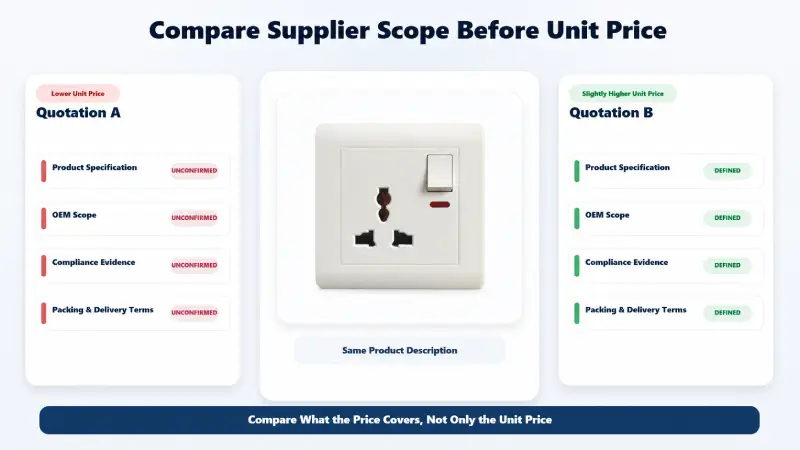
Wall Switch and Socket RFQ Comparison Template
Contents
- Why similar quotations can hide a specification gap
- Build one RFQ baseline and technical schedule
- Compare product, OEM and one-time costs
- Confirm model evidence and destination requirements
- Normalize packing, inspection and delivery inputs
- Build the final comparison matrix
- Move from quotation to verification
- Frequently asked questions
Why a Small Price Difference Can Hide a Specification Gap
In one LIBAIK comparison involving electroplated V12-series products, the unit-price difference was approximately 1%–2%. The product materials and other specifications were the same, but the salt-spray requirements were different.
One quotation was based on a 24–48-hour requirement. LIBAIK offered a 72-hour neutral salt spray (NSS) test requirement, with the following acceptance criteria after exposure:
- No blistering
- No rust
- No discoloration
- All electrical functions passing
The buyer selected LIBAIK’s electroplating specification because the stronger salt-spray requirement justified the small price difference.
| Comparison item | Alternative quotation | LIBAIK quotation | Buyer check |
|---|---|---|---|
| Product series | V12 | V12 | Same |
| Product materials | Same declared scope | Same declared scope | Same |
| Finish | Electroplated | Electroplated | Appears comparable |
| Test method | NSS | NSS | Same method |
| Test duration | 24–48 hours | 72 hours | Different requirement |
| Acceptance criteria | Must be confirmed | No blistering, rust, or discoloration; electrical functions pass | Different evidence scope |
| Unit-price difference | Baseline | Approximately 1%–2% higher | Compare performance, not finish name |
“Electroplated finish” is therefore not a complete RFQ specification. The buyer should also define the test method, duration, acceptance criteria, and required evidence. A blank field should be treated as unconfirmed, not included at no cost.
Define One RFQ Baseline Before Requesting Prices
A usable wall switch socket RFQ checklist must define the exact product and purchasing scope before suppliers calculate prices.
| RFQ field | Buyer should define |
|---|---|
| Product | Exact SKU, configuration, function, and rating |
| Installation | Mounting method, back box, frame, and accessories |
| Appearance | Faceplate material, color, finish, and profile |
| Destination | Country and customer or project requirements |
| Quantity | Sample, pilot, initial order, and annual forecast |
| Price tiers | Quantities to be quoted by every supplier |
| Product mix | Expected share by SKU, color, finish, and function |
| Options | USB, USB-C, neon, premium finishes, and accessories |
A white standard socket, matt black version, slim-profile model, and USB-equipped version should have separate quotation rows. They should not share one undefined price.
The RFQ should also name the destination country rather than stating only “Middle East.” UAE, Saudi Arabia, Qatar, Oman, and Iraq orders may involve different customer specifications, markings, documents, or project approval requirements.
Attach a Technical Specification Schedule
Product photos and short descriptions do not establish a common quotation basis. The RFQ should separate the buyer’s requirement, the supplier’s declaration, the required evidence, and the cost status.
The following LIBAIK V6 product shows the level of detail needed.
Product configuration: V6 Series 13A 1-Gang Switched Multi Socket with Neon and 2 USB Ports
| Specification field | Confirmed product data |
|---|---|
| Socket rating | 13A, 250V, 50/60Hz |
| USB input | AC 110–250V, 50/60Hz |
| Terminal material | Brass |
| Socket contacts | Phosphor bronze |
| Moving contact | Red copper |
| Earth contact sleeve | Red copper |
| Main conductive-part thickness | 0.5 mm |
| Terminal structure | Direct screw-clamping |
| Terminal capacity | 2 × 2.5 mm² conductors |
| Earth-terminal configuration | Single earth terminal |
| Conductor stripping length | 11 mm |
| Rear-body dimensions | 53.4 × 56.8 × 31.5 mm |
| Recommended back box | 72 × 72 × 48 mm |
| Mounting-hole distance | 60 mm |
| Faceplate and rear-body material | Flame-retardant PC |
These figures provide a quotation and drawing reference, but they do not replace installation confirmation. Cable quantity, conductor bending space, mounting-hole position, wall finish, and actual back box dimensions still need to match the site condition.
For every quoted product, the schedule should also request evidence for component materials, critical thicknesses, surface treatment, internal connections, terminal capacity, stripping length, tightening torque, earth-terminal configuration, and rear-housing dimensions. Requirements such as tunnel terminals, dual earth terminals, or a particular conductor capacity should be included only when the ordered product or project requires them.
Electronic functions require a separate line. For USB or USB-C products, buyers should define the module input and output, charging protocol, document scope, and whether changing the module requires written approval.
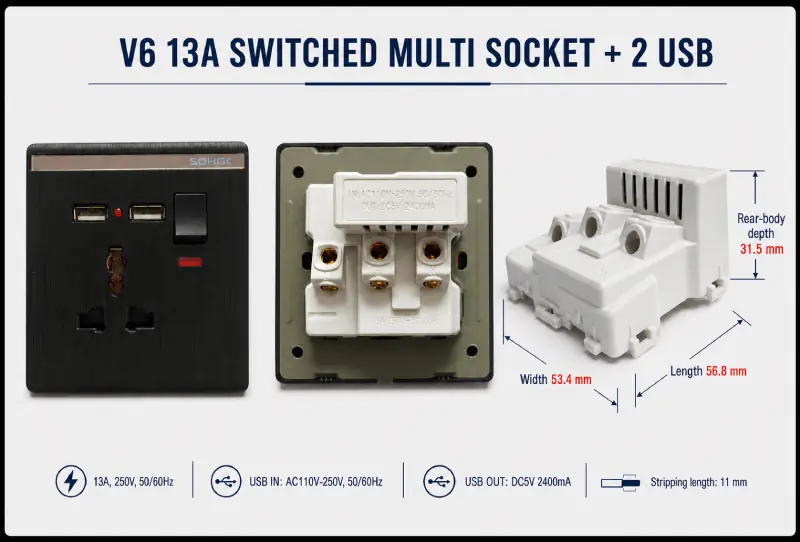
V6 Product-Level RFQ Specification Example
Compare the Full Product and OEM Cost Structure
A low quotation for a white base model does not show the cost of the complete range an importer intends to purchase. Each supplier should quote the same finishes, functions, accessories, and OEM deliverables.
Build an Option Price Ladder
| Quotation line | Required price information |
|---|---|
| White standard finish | Base price |
| Matt black or other finish | Finish adder and included process |
| Slim-profile version | Structural or tooling adder |
| USB/USB-C version | Module, testing, and documentation adder |
| Back box and accessories | Exact matching-item price |
| Spare faceplates or components | Price and MOQ |
Use:
Option Adder = Option Price − Base Price
Adder Rate = Option Adder ÷ Base Price
There is no universal acceptable markup for premium finishes, USB modules, or slim-profile products. The increase depends on process, quantity, tooling, packaging, electronic specifications, and documentation.
For a mixed order, calculate:
Weighted Cost = Σ (SKU Price × Expected SKU Share)
This shows whether a low base-model price is offset by higher charges on the products that make up most of the order.
Define the OEM Scope
In one LIBAIK OEM quotation, the customized scope included the product logo, packaging, instructions, and labels. These items were included in the product price.
The printing plate was treated as a one-time charge that could be waived or credited when an agreed order-volume condition was reached. Because such conditions vary, the quotation should state the applicable threshold and credit method rather than relying on a verbal promise.
MOQ may also change with customized colors or packaging. Each quotation should therefore identify:
- Standard-product MOQ
- Custom-color and custom-packaging MOQ
- Mixed-SKU conditions
- Printing, tooling, and sample charges
- Whether each charge is refundable, creditable, or non-refundable
- Number of artwork and sample revisions included
Before bulk production, the LIBAIK OEM approval scope included:
Physical samples
- Logo appearance sample
- Functional samples for the complete series
- Complete packaging sample
- Assembly sample
Controlled documents
- Final printing artwork
- Product specification drawings
- Material and electrical parameters
- OEM branding agreement
- Quality acceptance standard
The quotation should assign responsibility for preparing and approving each item and identify which approved version becomes the production reference. These approved references should then feed into OEM wall socket version control so later orders do not drift from the quoted configuration.
Make Compliance Evidence a Priced RFQ Deliverable
“Compliant with” does not prove that a certificate covers the ordered product or that document preparation is included in the quotation. Reports, certificates, drawings, and submittal support should be listed as separate deliverables.
A real LIBAIK inquiry for the Iraqi market involved a V12-series product. The buyer requested a CB certificate, while the available supplier file contained a test report rather than the requested certificate.
The parties did not treat these documents as equivalent. They agreed to begin with a small trial order and apply for the CB certificate before moving to larger-volume orders. The future application cost would be shared by both parties.
This was a commercial arrangement for that inquiry only. It should not be interpreted as a universal Iraqi requirement or as evidence that every V12 product already holds CB certification.
For each SKU, ask whether the quotation includes support for the destination-specific route, such as SABER in Saudi Arabia, ECAS in the UAE, KUCAS/TABEK in Kuwait, or G-Mark/GCTS where applicable. The importer must confirm applicability by product model, function, and current destination requirements.
The RFQ should distinguish between:
- Product designed to a stated standard
- Test report available
- Certificate available
- Certificate covering the ordered model
- New application or model extension required
- Material Submittal support included
- Additional testing or document fees
| Evidence field | Supplier must confirm |
|---|---|
| Ordered product | Exact model and functions |
| Destination | Country and customer or project requirement |
| Requested evidence | Report, certificate, drawing, or declaration |
| Available evidence | Exact document currently available |
| Coverage | Models and functions listed in the document |
| Missing work | New test, application, extension, or document |
| Cost owner | Supplier, buyer, or shared |
| Completion point | Before sample, pilot order, production, or shipment |
This prevents the cost and timing of a missing certificate or model extension from appearing only after the buyer has accepted the product price. After quotation gaps are closed, buyers can use a China wall switch and socket supplier audit checklist to verify the declared model, documents, factory, and controlled production evidence.
Convert Packaging Data into Cost per Saleable Unit
Packaging affects freight, loading efficiency, surface condition, and the number of saleable products received. Model-specific packing data should be included in the RFQ.
The following example relates to a different V6 product from the technical example above: LIBAIK’s KWV6-G22 V6 Series 2-Gang 2-Way Switch.
| Packing field | Confirmed data |
|---|---|
| Unit net weight | 121.8 g |
| Inner-box quantity | 10 pcs |
| Master-carton quantity | 100 pcs |
| Master-carton volume | 0.033462 m³ |
| Carton contents weight | 12.7 kg |
| Master-carton gross weight | 14.43 kg |
| Unit protection | Each product individually sealed in a protective bag |
The 121.8 g figure represents the net weight of one product. The declared 12.7 kg carton contents weight includes 100 products, inner boxes, protective bags, and installation screws. The 14.43 kg figure is the complete master-carton gross weight.
This distinction matters when buyers compare freight calculations. Product-only weight, contents weight, accessories, packing materials, and gross shipping weight should not be entered as though they use the same measurement basis.
Individual protective bags add manufacturing and packing cost. The quotation should state whether this protection is included in the unit price, especially when the ordered faceplate finish is sensitive to scratches.
For each SKU, request:
- Unit net weight
- Inner-box and master-carton quantity
- Master-carton dimensions and volume
- Contents weight and gross weight
- Protective film, bag, sleeve, or separator
- Pallet or non-pallet arrangement
- Loading quantity and loading plan
Use:
Freight per Unit = Total Shipment Cost ÷ Saleable Units Loaded
Container-loading claims should be supported by carton dimensions, weight limits, pallet arrangements, and a loading plan. Carton volume alone is not enough to confirm the actual quantity that can be shipped.
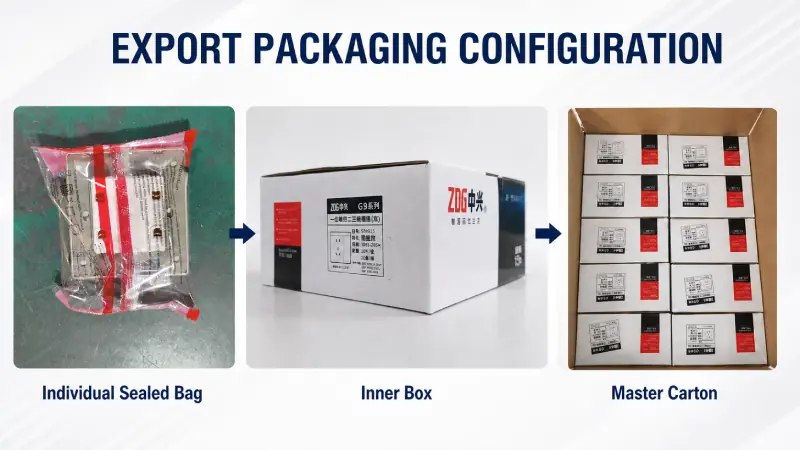
KWV6-G22 Export Packing Configuration
Put Inspection and Acceptance Costs into the Quotation
Inspection responsibilities should be defined before the order rather than negotiated after a defect is found.
| Inspection stage | RFQ confirmation |
|---|---|
| First article | Required checks, records, and approval party |
| During production | Frequency and responsible party |
| Pre-shipment | Scope, timing, report, and fee |
| Loading | Required photographs and records |
| Third-party inspection | Agency, booking party, and cost owner |
Acceptance conditions should cover the risks relevant to the order, including function, appearance, color, logo, labeling, packaging, quantity, and critical dimensions.
There is no universal AQL or sampling level for every switch and socket order. The inspection method should reflect the product risk, order size, destination, and customer or project requirements.
The quotation or purchase agreement should also assign responsibility for sorting, rework, replacement, reinspection, shipment holds, and resulting delays.
Normalize Commercial Terms and Incoterms
Suppliers should complete the same commercial fields:
- Currency and price unit
- MOQ and quantity tiers
- Payment terms
- Quotation validity
- Sample and production lead times
- Starting point for the production lead time
- Included and excluded charges
- Inspection and packaging costs
- Delivery scope
Production lead time should state whether it begins after deposit, artwork approval, sample confirmation, or receipt of buyer-supplied materials.
The trade term should include the Incoterms version, exact rule, and named factory, port, or delivery point. “FOB China” is incomplete because it does not identify the port or precise cost boundary. The quotation should also list origin, transport, document, and destination charges that are excluded.
The quotation or purchase agreement should also assign responsibility for sorting, rework, replacement, reinspection, shipment holds, and resulting delays. Once production begins, a sample-to-bulk consistency checklist can verify that the approved sample, inspection criteria, packaging, and shipment remain aligned.
Build the Final Supplier Quotation Comparison Matrix
Transfer every supplier response into one standard matrix before ranking prices.
| Comparison field | Buyer baseline | Supplier A | Supplier B | Supplier C | Status or gap |
|---|---|---|---|---|---|
| Exact SKU and configuration | |||||
| Technical specification | |||||
| Base-model price and currency | |||||
| Quantity tier | |||||
| Finish and function adders | |||||
| OEM scope | |||||
| One-time charges | |||||
| Model-level evidence | |||||
| Documentation cost | |||||
| Packing and loading data | |||||
| Inspection scope and cost | |||||
| Incoterms and named place | |||||
| Lead time and starting point | |||||
| Payment terms | |||||
| Exclusions |
Calculate:
Normalized Cost = Weighted Product Basket + Amortized One-Time Charges + Documentation + Inspection + Packaging/Freight per Unit
Normalized cost is order- and shipment-specific. Recalculate it for each MOQ or quantity tier and each shipping mode, such as courier, LCL, or FCL. One-time charge allocation, minimum freight charges, container utilization, volume limits, and weight limits can all change the cost per unit.
Mark each response as Included, Excluded, Extra Charge, Not Applicable, or Unconfirmed. An empty cell is not a zero-cost item. Critical specification, evidence, packaging, inspection, and delivery gaps should be closed before suppliers are ranked.
Keep the completed comparison matrix as a controlled buyer document alongside each supplier's original quotation.
What Happens After the Quotation Shortlist
A normalized quotation creates a commercially comparable shortlist; it does not approve the supplier. Buyers can then use a switch and socket sourcing in China factory verification checklist to confirm the production entity and quoted capability.
Shortlisted suppliers should then move into factory verification, supplier audit, sample approval, sample-to-bulk consistency checks, and repeat-order version control. The approved samples, drawings, artwork, packaging files, electrical parameters, and quality acceptance standard should become the controlled production references.
Frequently Asked Questions
How can buyers compare quotations with different specifications?
Pause the price comparison. Send every supplier the same Technical Specification Schedule and require all missing fields to be completed before evaluating unit prices.
Should salt-spray duration appear in an RFQ?
When corrosion resistance is relevant, specify the test method, exposure time, acceptance criteria, and required evidence. Do not accept “electroplated finish” as the complete requirement.
Are logo, packaging, instructions, and labels included in the unit price?
Do not assume they are included. Require the supplier to mark each OEM item as included, extra-cost, refundable, creditable, or subject to an MOQ.
Does a test report mean that a CB certificate is available?
No. Request the exact document, issuing body, model coverage, additional application cost, responsible party, and completion date before accepting the documentation scope.
How should packaging data be compared?
Request product net weight, contents weight, gross weight, carton dimensions, volume, protective packaging, and loading quantity using the same definitions. Calculate freight only after inconsistent or missing fields are closed.
Should every RFQ specify the same AQL?
No. Define a sampling and acceptance plan for the specific product, order size, destination, and project risk before production begins.
Conclusion
A useful wall switch socket RFQ checklist places suppliers on the same technical and commercial basis before prices are compared. Buyers should align the exact product, option adders, OEM scope, model-level evidence, packaging, inspection, payment, and delivery responsibilities.
Real quotation value comes from what the price covers, not from the unit-price figure alone. Once missing fields are closed, buyers can compare normalized cost and move qualified suppliers into technical and production verification. Buyers who also need a broader view of production, OEM, and export capability can review LIBAIK’s electrical switch and socket manufacturer in China guide.
Preparing a new sourcing project? Send LIBAIK your SKU list, destination, quantities, OEM scope, and delivery term to request a quotation built on one comparable baseline.
Reference Sources
- ICC Incoterms 2020 for trade-term cost, risk and responsibility allocation.
- ISO 2859-1:2026 for AQL-indexed acceptance sampling plans.
- Saudi SABER Platform for product-conformity workflow checks where applicable.
- UAE MoIAT ECAS Conformity Service for regulated-product conformity checks where applicable.
- Kuwait PAI KUCAS/TABEK Platform for Kuwait conformity workflow checks where applicable.
- GSO low-voltage equipment and G-Mark guidance for GCC conformity context where applicable.