A perfect sample does not prove that a supplier can repeat the same quality across a 50,000-piece wall switch and socket order. It only proves that the supplier can prepare one good unit under controlled conditions.
Bulk production is different. It depends on material batches, mold condition, line workers, assembly discipline, packing control, and whether the approved version is still being followed when production starts.
This sample-to-bulk consistency checklist is written for importers, distributors, engineering buyers, and retailers who need to verify wall switch socket quality consistency before shipment. The focus is simple: turn sample approval into measurable inspection points, so buyers can detect version drift before goods leave the factory.
Contents
- Why Approved Samples Still Fail in Bulk Orders
- Acceptance Red Lines Before Mass Production
- Golden Sample and CDF Lock
- First-Article Inspection: Catch Problems Before Full Production
- Middle East-Specific Consistency Checks
- Pre-Shipment AQL and Bulk Inspection Strategy
- Final Sample-to-Bulk Consistency Checklist
- FAQ: Sample-to-Bulk Consistency for Wall Switch and Socket Buyers
- Review Basis
- Conclusion: Consistency Is the Real Supplier Test
Why Approved Samples Still Fail in Bulk Orders
Sample approval is often treated as the end of product confirmation. In reality, it should be the starting point for production control.
The sample trap: engineer-made sample vs line-made bulk goods
A sample may be assembled by an engineer using selected PC material, clean terminals, accurate markings, and careful packing. Bulk goods are made under speed, cost, and line-efficiency pressure. That is where looser socket grip, lighter copper parts, weaker surface finish, changed carton labels, or unclear terminal markings start to appear.
What version drift means for buyers
Version drift means the mass-production product is not exactly the same as the approved sample. The difference may be small from the front view, but important in use: a 0.7 mm copper part becomes 0.6 mm, an embossed mark becomes laser marking, a USB module supplier changes, or a reinforced carton is replaced with a thinner carton.
Why “minor changes” are not minor
Factories may call these adjustments minor. Buyers carry the risk. A material change can become a heat complaint. A marking change can raise project or market-compliance questions. A color shift can cause distributor disputes when new stock is placed beside previous shipments.
For repeat orders, the risk is even higher. Trust makes buyers check less, while raw material prices, production teams, molds, and subcontracted components may all change quietly over time. Buyers managing OEM projects can use a dedicated OEM wall socket version drift checklist to control ECN approval, component substitution, old-new compatibility, and batch traceability.
Acceptance Red Lines Before Mass Production
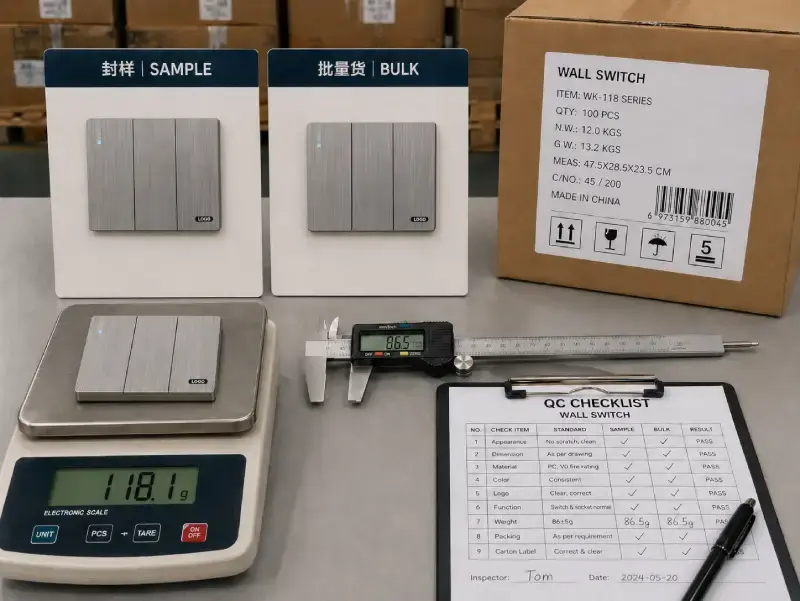
If the PI only says “same as sample,” the QC inspector has no measurable basis to stop a 112 g socket that used to weigh 118 g, or a printed approval mark that was embossed on the approved sample. The approved sample should be translated into measurable acceptance lines before mass production starts.
Unit weight tolerance
Unit weight is a fast way to detect hidden changes. If the approved unit weighs 118 g but the bulk unit drops to 112 g, the buyer should check copper thickness, PC housing, terminals, screws, internal structure, and packing accessories. For stricter orders, a ±2% unit weight tolerance can be written into the PI or inspection instruction.
Marking method
Marking method should not change without approval. If the sample uses molded, embossed, engraved, laser, or printed marks for the model number, rating, terminal symbol, brand logo, or approval mark, bulk goods should follow the same method.
Temperature rise baseline
Temperature rise should be recorded during sample approval under agreed load and test conditions. If bulk goods run hotter than the approved sample, check copper thickness, contact material, terminal grip, and internal resistance points.
Material and thickness control
Critical materials should be locked before production: copper strips, moving contacts, terminals, PC flame-retardant material, plating layer, USB module, capacitor grade, and indicator neon. A supplier should not change these items without a revised sample and written approval.
Sample-to-Bulk Acceptance Red Lines for Buyers
| Check Point | Approved Sample Record | Bulk Acceptance Line | Hold Shipment If |
|---|---|---|---|
| Unit weight | Golden sample weight | Within agreed tolerance, such as ±2% | Weight drops without explanation |
| Marking method | Molded, embossed, engraved, laser, or printed | Same method as approved sample | Embossing changes to weak printing or unapproved laser marking |
| Temperature rise | Sample test baseline | No abnormal increase under the same conditions | Batch runs hotter than the approved baseline |
| Copper thickness | Recorded part thickness | Same as approved BOM or CDF | 0.7 mm becomes 0.6 mm |
| PC material | Approved grade and flame-retardant level | Same locked material | Material changes without approval |
| USB module | Approved output and module supplier | Same output, supplier, and label basis | 20W PD/QC becomes a lower-output module |
Golden Sample and CDF Lock
Photos can show appearance, but they cannot prove weight, socket grip, switch feel, copper thickness, terminal tightness, or material strength. A sealed golden sample gives the buyer a physical baseline when the second, third, or fourth order starts to drift.
The golden sample and the CDF solve different problems. The golden sample locks what the buyer can see and feel: color, finish, weight, markings, socket grip, switch feel, packaging, and labels. The CDF or BOM locks what the buyer cannot easily see: contacts, terminals, springs, flame-retardant material, USB module, capacitors, plating supplier, and internal current-carrying parts.
A complete golden sample file should include the sealed sample, signed approval label, front/back/terminal/packaging photos, model code, version code, BOM or CDF, unit weight, color reference, marking method, packaging artwork, and test baseline.
Any change to critical components, supplier, mold, marking method, artwork, packaging, or production process should require written notice before production and re-sample approval. For strict repeat orders, buyers may require 30 days’ written notice before changing a locked supplier or component.
CDF Lock and Change-Control Checklist
| Critical Item | What Must Be Locked | Buyer Evidence Required |
|---|---|---|
| Contacts | Material, thickness, plating, contact force | Updated CDF, material photos, test record |
| Terminals | Material, screw type, structure, torque basis | CDF and terminal torque check record |
| PC housing | Grade, flame-retardant level, color, mold version | Material declaration and re-sample if changed |
| USB module | Output, supplier, capacitor grade, label | BOM, module label photo, output test result |
| Marking method | Embossing, engraving, laser, printing, position | Close-up sample photos and artwork approval |
| Packaging label | Model, barcode, market label, batch code | Final carton proof and packing photos |
First-Article Inspection: Catch Problems Before Full Production
First-article inspection checks the first pieces from actual production, not sample-room preparation. This is where buyers can catch wrong materials, wrong markings, loose socket grip, changed USB modules, or incorrect packaging before thousands of units are packed.
This step matters because it verifies whether the approved materials, marking artwork, mold condition, USB module, and packaging version have entered the real production line. It is the practical bridge between sample approval and the supplier’s mass-production quality control process.
Request photos from the actual production line, not catalog images. The photo set should include front panel, rear body, terminal area, marking close-up, USB module label, inner box, carton label, and any visible copper or contact area.
Do not release full production until these points are checked:
- Appearance: color, gloss, finish, logo clarity, panel flatness, scratches, burrs, and assembly gaps
- Marking: model number, rating, approval mark, terminal marking, origin marking, and marking method
- Terminal area: screws, terminals, L/N/E markings, terminal grip, and rear-body structure
- Functional feel: switch feel, socket grip, terminal screw torque, USB output, and neon indicator
- Packaging: inner box, carton label, barcode, market label, batch code, and accessory set
Middle East-Specific Consistency Checks
The checklist above applies to most export markets. Middle East and GCC orders need extra attention because heat, premium finishes, sea freight humidity, and label requirements can turn small version changes into expensive complaints.
USB socket consistency
Once USB-C, PD/QC, or fast-charging modules are added, the product is no longer only plastic and copper. The buyer must also control USB module supplier, capacitor rating, output label, EMC evidence, thermal performance, and whether the quoted version matches the produced version.
For products with USB or USB-C charging, buyers should confirm whether IEC 62368-1-related documentation, CB reports, EMC evidence, or local conformity documents are needed for the destination market. If the approved sample uses 20W PD/QC, bulk goods should not silently change to a lower-output module.
In hot indoor environments, capacitor quality matters. If the approved sample uses 105°C capacitors, mass production should not switch to lower-temperature components without written approval and updated test evidence.
Matte black and metallic finish consistency
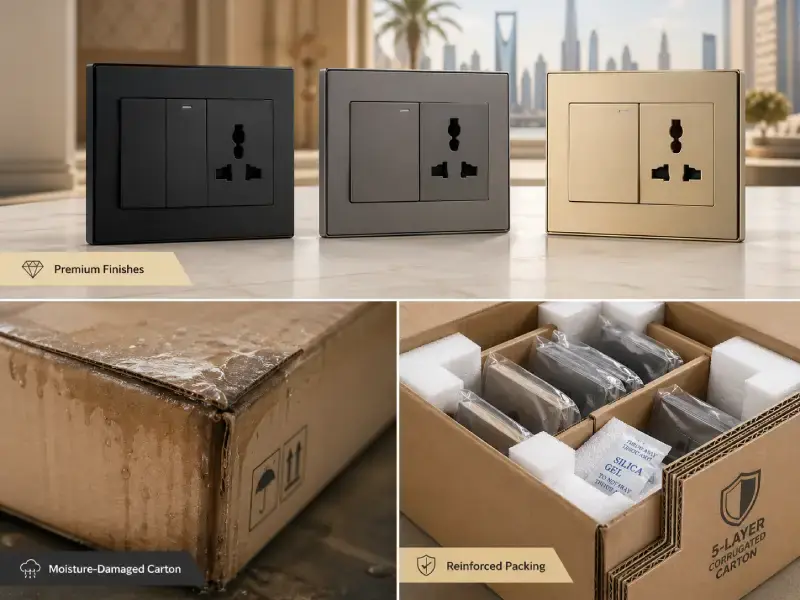
Premium finishes such as matte black, graphite, champagne, gold, brushed metal, and ultra-slim frames can improve margin, but they also reduce tolerance for batch differences. A small color shift that might pass on a commodity white switch can become a retail rejection on a premium series.
Matte black and graphite finishes require tighter control of coating supplier, gloss level, color depth, fingerprint resistance, packing film, and edge protection. Metallic finishes require control of plating thickness, clear coat, PVD process, oxidation resistance, and surface treatment, especially in coastal markets.
Packaging and container rain
Wall switch and socket cartons may leave the factory in good shape but arrive after weeks of heat and humidity. Condensation inside the container, often called container rain, can soften corrugated cartons and reduce stacking strength. The result may be scratched panels, crushed inner boxes, deformed cartons, and retail stock that distributors refuse.
If the approved packing uses five-layer reinforced cartons, inner separation, protective film, desiccants, palletizing, or a carton weight limit, bulk packing should not switch to a thinner carton to save cost.
Saudi and GCC label consistency
For Saudi and GCC shipments, labels are part of product identity and distribution control. Buyers should confirm Arabic safety warnings where required, instruction language, importer information, batch code, product model, country-of-origin marking, and market label position before carton printing.
For BS1363-related products or GCC shipments, the approval and label logic should also match the product category. Buyers who need a deeper marking-focused review can use the BS1363 approval and marking checklist for GCC buyers as a supporting reference.
Middle East Bulk Consistency Risks Buyers Should Not Ignore
- USB module changed without safety, EMC, or BOM review
- 20W PD/QC module changed to lower-output version
- 105°C capacitor downgraded to lower-temperature component
- Matte black or graphite finish arrives grey, glossy, scratched, or fingerprint-prone
- Gold, champagne, or brushed metal finish oxidizes or develops black spots in coastal markets
- Coating supplier, plating thickness, clear coat, PVD process, or surface treatment changes without approval
- Reinforced carton changes to thinner carton before shipment
- Carton becomes soft after moisture exposure and causes panel scratches or crushed inner boxes
- Origin marking, Arabic warning, importer label, batch code, or market label uses old artwork
- High-profit differentiated models lose retail value because bulk finish or packaging does not match the sample
Pre-Shipment AQL and Bulk Inspection Strategy
AQL only works if the defect rules are agreed before goods are packed. Without written defect definitions, the factory may call a visible issue acceptable while the importer has to explain it to distributors, consultants, or retailers.
AQL should be written into the purchase contract, PI, or inspection instruction. There is no single level for every order. For stricter project or import orders, buyers may request AQL 0.65 for critical defects and AQL 1.0 for major defects, if both parties accept it before production.
Use this defect logic before inspection starts:
- Critical defects: wrong rating, unsafe wiring, failed function, wrong material, missing approval marking, or a USB module different from the approved sample
- Major defects: visible color mismatch, weak socket grip, poor switch feel, wrong carton label, missing accessory, surface damage, or incorrect marking method
- Minor defects: small cosmetic marks within agreed tolerance that do not affect function, packaging, or customer acceptance
- Repeated defects: the same issue appearing across multiple cartons should trigger expanded sampling and root-cause correction
If visual defects, label errors, or functional issues appear, the handling method should already be clear: sorting, rework, replacement, credit note, shipment hold, or written buyer approval. “We will compensate in the next order” is not enough for importers carrying local brand risk.
Final Sample-to-Bulk Consistency Checklist
Use this checklist as a QC template before shipment. Attach it to the PI, inspection instruction, or QC report. If a key item fails, hold shipment, request sorting, or require rework before loading.
Final Sample-to-Bulk Consistency Checklist
| Area | What to Compare | Acceptance Line | Required Evidence | Shipment Decision |
|---|---|---|---|---|
| Unit weight | Golden sample vs bulk unit | Within agreed tolerance, such as ±2% | Weight record | Approve or investigate |
| Marking method | Sample vs bulk marking | No marking-method change without approval | Close-up photos | Hold if changed |
| Copper parts | Sample thickness vs bulk thickness | Same as approved BOM or CDF | Thickness record or CDF | Hold if downgraded |
| Temperature rise | Sample baseline vs bulk result | No abnormal increase under same conditions | Test record | Hold if abnormal |
| USB module | Approved output vs bulk module | Same module, output, capacitor grade, and label basis | BOM, label photo, test evidence | Hold if changed |
| Finish | White, matte black, graphite, gold, brushed metal | Match golden sample and approved surface process | First-article photos, color reference | Sort or rework |
| Coastal durability | Plating, screws, terminals, decorative surface | Same plating or coating specification | Salt-spray or corrosion evidence if required | Hold if changed |
| Packaging strength | Carton grade, inner protection, desiccant, palletizing | Same approved packing method | Carton proof and packing photos | Repack or hold |
| Origin and market label | Made in China, Arabic warning, importer label, batch code | Same approved label layout and durable marking method | Product and carton photos | Reprint or hold |
| AQL result | Inspection result vs agreed level | Pass agreed AQL plan | Inspection report | Ship, rework, or reject |
FAQ: Sample-to-Bulk Consistency for Wall Switch and Socket Buyers
What is a sample-to-bulk consistency checklist?
A sample-to-bulk consistency checklist is a buyer-side inspection tool used to compare the approved sample with mass-production goods. It covers unit weight, markings, CDF, material thickness, function, packaging, surface finish, label consistency, and AQL results.
How can buyers prevent version drift in wall switch and socket orders?
Lock the golden sample, CDF, marking artwork, BOM, packaging artwork, test baseline, finish reference, and label layout before production. Any change to material, mold, supplier, USB module, surface process, or label should require written approval and re-sampling.
What should buyers check on USB socket versions?
Check output rating, module supplier, capacitor grade, labeling, BOM, and whether the USB configuration is covered by the applicable approval file or additional test documentation. For USB-C or fast-charging modules, IEC 62368-1-related safety evidence and EMC documentation may also need review depending on the market.
Why does finish consistency matter in Middle East markets?
Premium finishes such as matte black, graphite, champagne, gold, or brushed metal can increase product value, but they expose batch differences faster. In coastal markets, weak plating or coating may lead to oxidation spots, color change, or customer complaints.
Why should buyers check packaging consistency?
Heavy wall switch and socket cartons may face container condensation during sea freight. If cartons absorb moisture, compression strength can drop sharply, increasing the chance of carton collapse, panel scratches, and product abrasion.
How should buyers evaluate supplier reliability before repeat orders?
Buyers should review whether the supplier can keep material, marking, BOM, packaging, and inspection discipline stable across repeated shipments. A broader supplier-screening framework is covered in our guide on how to choose a reliable electrical wall switch and socket manufacturer.
Review Basis
The checklist above is intended as a practical buyer-side review tool. Depending on product type and destination market, buyers may also refer to relevant standards, conformity programs, or market-access guidance, including:
- IEC 62368-1 for safety considerations related to audio/video, information, and communication technology equipment: https://webstore.iec.ch/en/publication/27412
- ISO 2233:2000 for conditioning complete, filled transport packages before testing: https://www.iso.org/standard/32409.html
- BSI BS 1363 series for 13A plugs, socket-outlets, adaptors, and connection units: https://www.bsigroup.com/en-IE/products-and-services/standards/bs-1363-13a-plugs-socket-outlets-adaptors-and-connection-units/
- GSO Conformity Tracking System: https://www.gso.org.sa/en/conformity/conformity-tracking-system/
- Saudi Arabia labeling and marking requirements: https://www.trade.gov/country-commercial-guides/saudi-arabia-labelingmarking-requirements
Conclusion: Consistency Is the Real Supplier Test
Sample approval is only the first step. The real supplier test is whether the factory can keep the same materials, markings, molds, modules, packaging, and QC baseline across mass production and repeat orders.
For wall switch and socket buyers, consistency protects customs clearance, project delivery, distributor trust, retail presentation, and local brand reputation.
A reliable supplier should provide a clear evidence package before shipment: golden sample records, locked CDF, first-article photos, inspection reports, AQL results, and agreed defect-handling terms.
A practical sample-to-bulk consistency checklist turns quality promises into buyer-verifiable evidence before the shipment leaves the factory.