Choosing a reliable electrical wall switch and socket manufacturer is not about finding the supplier with the nicest brochure or the quickest first reply. For most buyers, the real question is simpler: when orders repeat, specifications change, or market feedback appears, will this factory still be stable, clear, and dependable?
This page is a buyer-side screening guide. It focuses on how experienced importers, distributors, and project buyers judge manufacturer reliability in practice. If you want the broader capability overview first, start with our guide to an electrical switch and socket manufacturer in China.
Most sourcing problems do not show up in the first sample or even the first shipment. They appear later, after installation, after channel feedback, or after a second or third order. That is why a reliable manufacturer is not just one that can ship once. It is one that can stay consistent over time. Buyers who want to see the mistakes that usually break that consistency can also review our guide to common sourcing mistakes.
Contents
- Why Reliability Matters More Than Price
- Manufacturer or Trading Company: What Buyers Should Confirm Early
- What Real Manufacturing Capability Looks Like
- Quality Control: How Reliable Factories Actually Work
- Materials, Components, and Technical Ownership
- Standards and Compliance: Where Buyers Often Make Wrong Assumptions
- OEM, Customization, and Boundary Control
- How to Judge Long-Term Reliability, Not Just the First Order
- Evidence Package Buyers Should Request Before Supplier Approval
- Practical Questions to Ask Before You Decide
- FAQ: How to Choose a Reliable Electrical Wall Switch and Socket Manufacturer
Why Reliability Matters More Than Price
Wall switches and sockets are part of a building's permanent electrical system. When they fail, the real cost is usually much bigger than product replacement. It may include labor, reinstallation, project delays, after-sales disputes, and damage to the reputation of the distributor, contractor, or brand behind the product.
That is why experienced buyers do not judge factories by unit price alone. A lower price can reduce first-order cost, but if the manufacturer cannot control quality, structure, and consistency, the long-term cost can be far higher.
| Short-term view | Long-term view |
|---|---|
| Lower unit cost | More stable repeat orders and fewer market problems |
| Fast quotation response | Clear technical answers and better issue handling later |
| Acceptable first sample | Consistent bulk shipments over time |
Manufacturer or Trading Company: What Buyers Should Confirm Early
One of the first things buyers should confirm is whether they are dealing with a real manufacturer, a factory-plus-trader, or mainly a trading company. This is not about the business license label alone. It is about who actually controls production decisions when problems, changes, or special requests appear.
A factory-based manufacturer should be able to explain how products are made, which parts are controlled in-house, how quality issues are handled, and what changes are realistic. If the supplier can only repeat catalogue language but cannot explain production logic, that is a warning sign.
This is also where broader supplier screening starts to matter. If you want a more process-driven checklist for screening and comparing suppliers before deeper factory review, our commercial wiring accessories supplier guide walks through that first stage in more detail.
What Real Manufacturing Capability Looks Like
Real manufacturing capability is not defined by how many machines appear in a factory video or showroom. It is defined by what parts of the process are actually controlled, how stable the product platform is, and whether the same specification can be repeated across later orders.
- control over key materials and components
- stable internal structures instead of constant redesign
- repeatable production logic across multiple batches
- clear ownership of quality problems when they happen
Factories that keep launching new-looking products without enough validation may appear innovative, but in wiring accessories, frequent change often creates instability. Reliable manufacturers usually improve through refinement, not constant reinvention.
Quality Control: How Reliable Factories Actually Work
Reliable factories do not treat quality as one final inspection before shipment. They treat it as a system that runs through the whole production chain. That usually includes incoming material checks, inspection of outsourced components, in-process checks during assembly, and final inspection before packing.
What matters is not whether the factory says quality is important. What matters is whether it can explain how quality is controlled at each stage and what happens when something goes wrong. If the answer is vague, the system is usually weak.
If you want the production side explained in more detail, including how process control and inspection support bulk consistency, the next page is our guide to wall switch and socket manufacturing process and quality control.
Materials, Components, and Technical Ownership
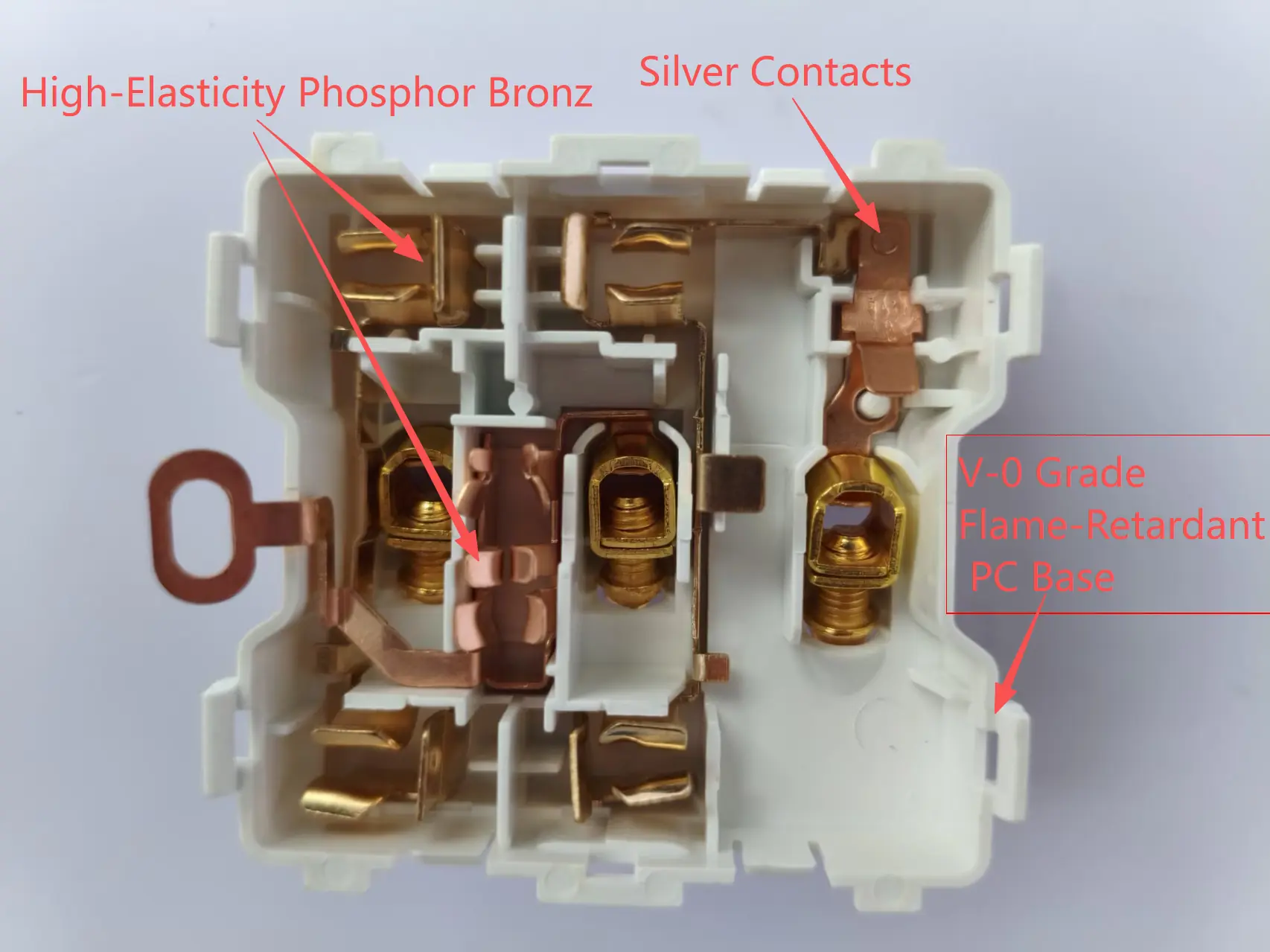
Material choice affects long-term performance, but the buyer's real job is not to memorize every specification sheet. The more useful question is whether the manufacturer understands why certain materials and structures are being used.
- What housing material is used, and why?
- How are conductive components chosen for their actual function?
- How are switching contacts designed to manage load over time?
Answers such as "standard material" or "export quality" do not tell the buyer much. Clear functional explanations usually show that the factory has real technical ownership rather than only sales language.
Standards and Compliance: Where Buyers Often Make Wrong Assumptions
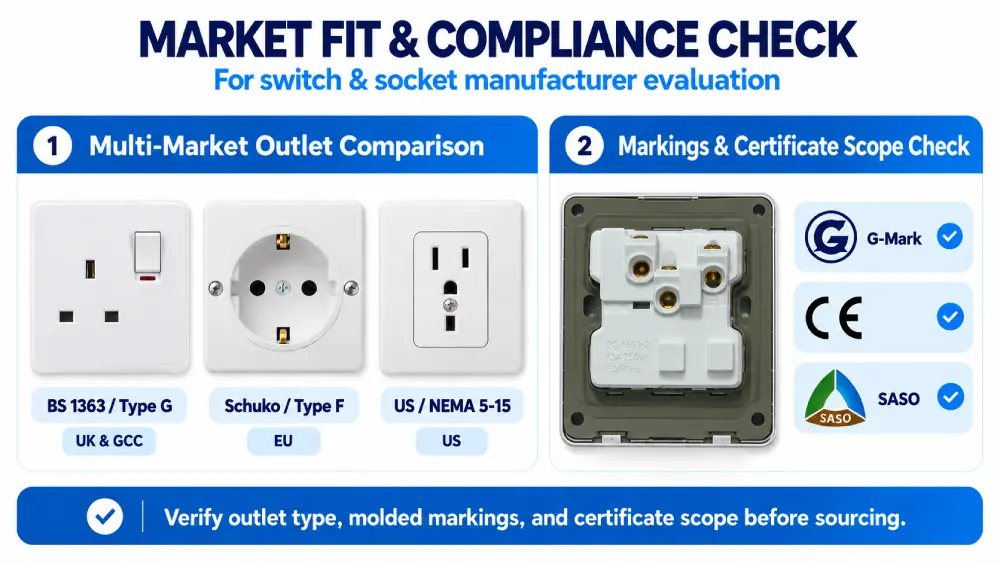
Standards are one of the most common sources of misunderstanding in international electrical trade. Different markets use different compliance paths, and not every certificate means the same thing. Many costly sourcing mistakes begin when buyers assume that one label covers every market or that different compliance marks can be treated as interchangeable.
CE, for example, may indicate alignment with certain European directives, but it does not automatically replace every local requirement or installation rule. Reliable manufacturers usually explain clearly what their products are designed for and what they are not designed for. That kind of boundary-setting is a good sign, not a weakness.
OEM, Customization, and Boundary Control
OEM and customization can be useful, but they also create risk when the boundaries are unclear. In most cases, customization works best when it stays around appearance, module combination, branding, or packaging. Problems usually begin when buyers push for changes that touch the core internal structure, safety-critical dimensions, or proven contact and terminal designs.
In electrical products, too much structural customization can raise certification difficulty and reduce long-term stability. That is why many experienced buyers prefer mature platforms with controlled customization instead of fully new structures. If you want the full breakdown of how OEM and ODM decisions should be handled, the next step is our OEM and ODM manufacturing guide.
How to Judge Long-Term Reliability, Not Just the First Order
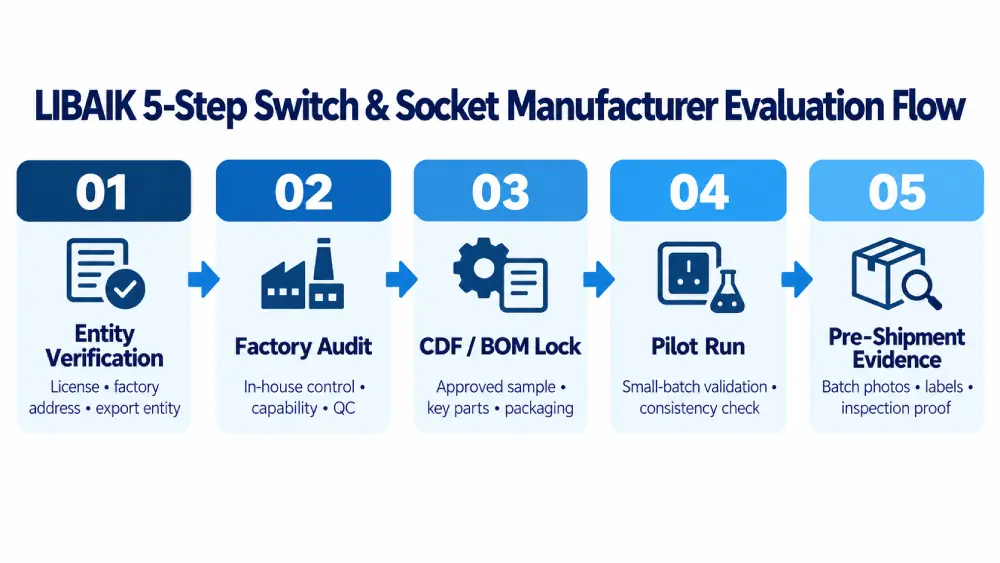
The first order rarely tells the full story. Long-term reliability becomes visible through consistency across multiple shipments, willingness to discuss risks openly, and how the factory responds when something goes wrong. Before annual volume or repeat orders are discussed, buyers should also verify factory evidence before placing volume orders, including production control, component traceability, certification scope, and pre-shipment evidence.
Suppliers who avoid difficult questions or say "everything is no problem" too quickly often create trouble later. In contrast, factories that explain limitations and trade-offs clearly are usually more predictable partners. Reliability is not about being perfect. It is about controlling variation well enough that later orders stay manageable.
Evidence Package Buyers Should Request Before Supplier Approval
After a supplier passes the first conversation, buyers should move from general trust to documented evidence. A reliable manufacturer should not only answer questions verbally; it should provide proof that the quoted product, approved sample, production batch, and shipment documents are connected.
This evidence package does not need to be complicated, but it should be specific enough to prevent later arguments about materials, labels, certification scope, or sample-to-bulk changes.
| Buyer Check | Evidence to Request | Reliability Risk Controlled |
|---|---|---|
| Factory identity | Business license, factory address, export entity, and production photos for the quoted series | Supplier presents itself as a factory but has limited production control |
| Product consistency | Approved sample photos, model code, BOM or critical component list, and packaging proof | Bulk goods drift from the approved sample after the order is placed |
| Material control | Housing material grade, conductor/contact material, terminal structure, and locked component records | Hidden material substitution during repeat orders |
| Compliance scope | Certificate, model list, test report photos, rating marks, and destination-market label requirements | Certificate exists but does not cover the quoted model or market version |
| Pre-shipment confidence | Batch photos, inspection records, carton labels, packing list, and sample-comparison evidence | Buyer pays balance before confirming what is actually being shipped |
If a supplier resists basic evidence before volume orders, the buyer should slow down the cooperation. The issue is not paperwork for its own sake. The issue is whether the manufacturer can turn reliability claims into verifiable control points.
Practical Questions to Ask Before You Decide
Before deciding on long-term cooperation, buyers should ask practical questions that reveal how the factory thinks and how it handles pressure.
- How are specification changes handled after initial production?
- What happens if market feedback requires adjustment?
- How stable are key materials and components over time?
- Who takes responsibility if regulatory interpretations differ?
The value of these questions is not only in the answer itself. It is in the way the supplier answers. Clear, realistic answers usually tell you more than polished sales language.
FAQ: How to Choose a Reliable Electrical Wall Switch and Socket Manufacturer
What is the first thing I should verify when a new factory contacts me?
Verify whether the company really controls production. Ask what is made in-house, what is outsourced, and who owns quality decisions if a problem appears later.
Can a trading company still be acceptable?
Yes, but only if the buyer understands the structure clearly. The risk increases when a trading company presents itself like a full factory while having limited control over production changes, quality issues, or repeat-order consistency.
Why do reliable factories sometimes answer more cautiously?
Because they understand where the real risks are. A factory that explains limits, trade-offs, and standard boundaries clearly is often safer than one that agrees to everything too quickly.
What is a warning sign during manufacturer review?
Vague answers about materials, quality control, standards, or responsibility. If the supplier cannot explain how it controls production, it will be much harder to trust it when problems appear later.
How should I judge reliability after the first order?
Look at later shipments, issue handling, and whether the same specification stays stable over time. Long-term reliability is proven through repeat performance, not one acceptable first batch.
What evidence should I request before approving a wall switch and socket supplier?
Request factory identity evidence, approved sample records, BOM or critical component details, certificate scope, packaging artwork, and pre-shipment photos or inspection records. These documents help confirm that the supplier can connect quotation, sample, production, and shipment into one controlled process.
Conclusion
Choosing a reliable electrical wall switch and socket manufacturer is not about finding the most impressive presentation. It is about choosing a partner whose production logic, boundaries, quality control, and communication reduce uncertainty over time. For buyers managing long-term distribution or project supply, that kind of predictability usually matters much more than the first attractive quotation.