When buyers search for a commercial wiring accessories supplier, they are usually not looking for every low-voltage product under one roof. Most are trying to find a supplier that can handle switch and socket orders with stable quality, clear documents, reliable delivery, and enough factory control to support repeat business.
This page is a supplier-intent support guide, not a new wiring-accessories topic. It stays inside the current manufacturer line and uses switches and sockets as the main example. If you want the broader factory-capability view first, start with our guide to choosing an electrical switch and socket manufacturer in China.
Experienced buyers compare not only product appearance and pricing, but also whether the supplier can keep specifications, packing logic, and delivery discipline stable across later orders. If you want the buyer-side mistake patterns behind that evaluation process, our wall switch and socket sourcing mistakes guide breaks those risks down more directly.
Contents
- Why Commercial Buyers Search for a Wiring Accessories Supplier
- First-Round Supplier Screening: What Should Be Checked Immediately
- Quotation Comparison: How to Avoid Comparing Different Products as If They Were the Same
- Sample Evaluation and File Checking Before Factory Approval
- Factory Verification: What a Serious Buyer Should Confirm On Site
- Product-Channel Fit: Why the Same Supplier Does Not Fit Every Market Equally
- Price Validation, Hidden Costs, and Red Flags
- How This Supplier Guide Connects to Manufacturer and OEM Decisions
- FAQ: Commercial Wiring Accessories Supplier Guide
Why Commercial Buyers Search for a Wiring Accessories Supplier
When buyers use phrases like commercial wiring accessories supplier or wiring accessories supplier, they usually mean a supplier that can provide switch and socket lines with enough range, documents, and consistency for wholesale, retail, project, or OEM business.
So the first question is simple: what kind of company is this? Is it a real factory, a factory-plus-trader, or mainly an order coordinator? Can it keep one approved product version stable from quote to sample to shipment? If not, the word supplier does not mean much. If you want a broader buyer-side comparison of commonly referenced switch and socket manufacturers with operations in China before narrowing the field, see our top switch and socket manufacturers in China comparison guide.
First-Round Supplier Screening: What Should Be Checked Immediately
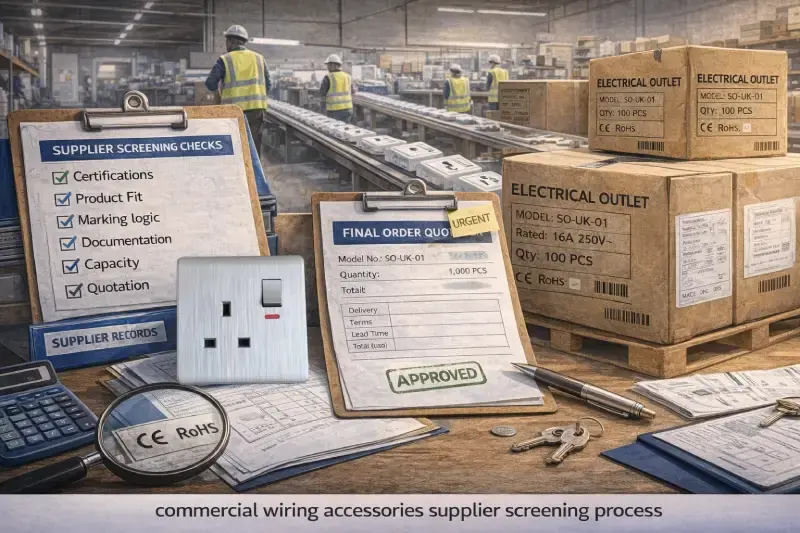
The first round should remove suppliers that clearly do not fit your order model. Ask for company registration details, factory location, main catalog, production capacity for key switch and socket lines, delivery history for similar orders, and a clear explanation of what is made in-house and what is outsourced.
- ask for the main series, not only a large mixed catalog
- check whether claimed capacity matches the visible product focus
- watch whether communication is specific or always broad and evasive
- treat unverifiable production claims as an early commercial risk signal
A supplier that answers clearly about plant location, main product lines, tooling scope, and delivery history is already stronger than one that keeps everything vague. If you want a deeper factory-screening framework after this first pass, continue to our guide on how to choose a reliable electrical wall switch and socket manufacturer.
Quotation Comparison: How to Avoid Comparing Different Products as If They Were the Same
Many quote comparisons go wrong because buyers think they are comparing the same product across several suppliers, but they are not. Model code, accessories, packaging level, technical files, export markings, and shipping terms all need to match before the unit price means anything.
| Check point | What must align | What often goes wrong | Commercial result |
|---|---|---|---|
| Model identity | One fixed switch or socket version | One code covers several variations | Price looks lower because the scope is weaker |
| Accessories | Screws, plates, inserts, or related pack-ins | Missing accessories are discovered later | Real landed cost rises after comparison is finished |
| Packaging | Inner pack, carton quantity, label method | Retail-ready and project-ready packs get mixed together | Channel fit weakens or repacking cost appears later |
| Technical files | Datasheet, drawings, and product wording | File set does not match the quoted commercial version | Sample approval and import review become slower |
Good buyers lock the commercial version first and compare price second. If you do it the other way around, the cheapest quote often looks better than it really is.
Sample Evaluation and File Checking Before Factory Approval
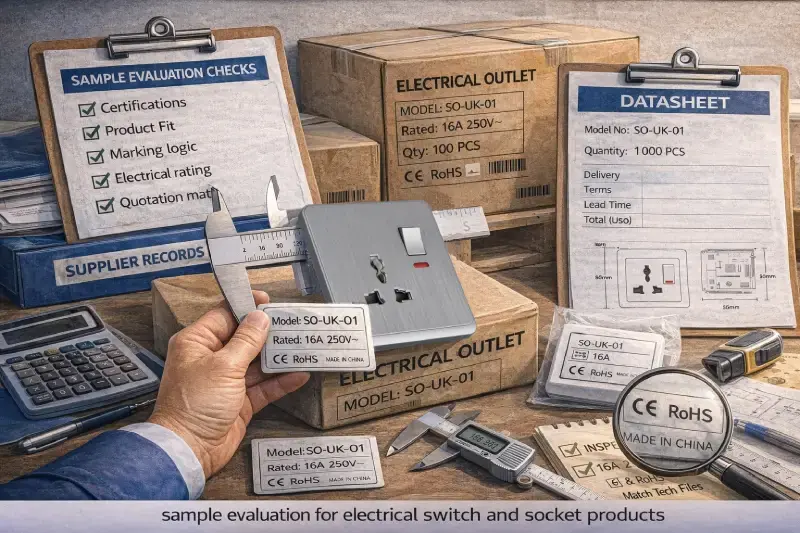
Sample review is not just about whether the product looks fine in hand. It should confirm that size, material feel, visible marking, packaging, and electrical ratings still match the promised commercial version. For switch and socket sourcing, a sample only means something when it is checked against the quote and the file set at the same time.
This is also where supplier discipline becomes obvious. A supplier whose samples, drawings, and file wording all match is much easier to trust than one that uses samples as a visual teaser while the technical details stay loose. If you want the production-control side of sample-to-batch consistency, our overview of wall switch and socket manufacturing process and quality control is the next step.
| Sample check | What buyers should verify | Why it matters |
|---|---|---|
| Dimensions and fit | Faceplate size, depth, assembly logic | Dimension drift quickly creates market and installation problems |
| Material consistency | Plastic feel, metal parts, visible finish | Weak samples often point to weak bulk stability later |
| Labeling and rating | Marking clarity, voltage/current wording | Loose marking usually means broader file inconsistency |
| Packaging match | Inner pack, labels, carton logic | Channel positioning and landed cost both depend on packaging accuracy |
Factory Verification: What a Serious Buyer Should Confirm On Site
Factory verification is where sales language meets reality. Buyers should not stop at asking whether a workshop exists. They should look at production flow, sample room logic, warehouse labels, packaging discipline, and whether the visible product range really matches what was promised in the quote.
On site, the main question is not whether the factory looks busy. It is whether the production system looks controlled. Machines, workers, stock, sample boards, batch labels, and packaging stations should all point to one clear product-management system, not a loose mix of unrelated items.
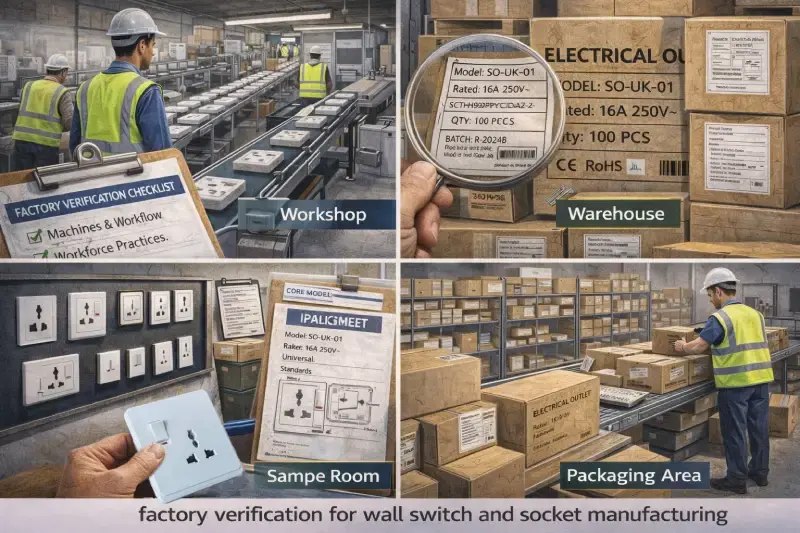
- check whether sample room products match the quoted commercial range
- confirm batch labels and warehouse logic instead of only front-office presentation
- look at packaging discipline, not just raw production capacity
- watch for gaps between claimed product focus and what is visibly managed on site
Product-Channel Fit: Why the Same Supplier Does Not Fit Every Market Equally
A supplier may be competent and still not fit every country and channel equally well. The same switch and socket line can work very differently in wholesale, retail, engineering, or smaller customized orders. Buyers should map products to real channel behavior instead of treating all export markets as one big commercial block.
For example, a model that works well in UAE retail may still be weak for an Egypt project order if the file set and configuration control are not strong enough. A supplier that handles Saudi repeat wholesale orders well may still struggle with smaller customized orders from Bahrain or Kuwait if its packaging and communication process are too rigid. The product may be acceptable in both cases, but the supplier fit is different.
| Market or channel pattern | What buyers should check | Why it changes supplier choice |
|---|---|---|
| UAE and Saudi wholesale or retail channels | Fast-moving series, packaging clarity, finish consistency, easier reordering | The supplier must support stable repeat ordering, not only one acceptable sample |
| Egypt and Morocco project-style orders | Configuration control, documentation, batch consistency | Project work is less tolerant of file drift and shipment mismatch |
| Bahrain and Kuwait smaller customized orders | Flexibility in pack structure, lower-volume responsiveness, clearer communication | The supplier must manage smaller commercial variation without losing control |
| Mixed distributor business | Ability to keep one commercial version stable across later replenishment | Repeat-order reliability matters more than the first quote alone |
So product-channel fit is part of supplier review, not a later sales problem. A supplier that cannot keep model identity, pack logic, and market positioning aligned across channels is weaker commercially, even if the base product itself is acceptable.
Price Validation, Hidden Costs, and Red Flags
Before deciding whether a quote is competitive, first check whether it is complete. Missing accessories, weaker packaging, unclear shipping terms, or missing technical support can make a cheaper quote more expensive once import or distribution starts. That is why price has to be read together with model definition and file clarity.
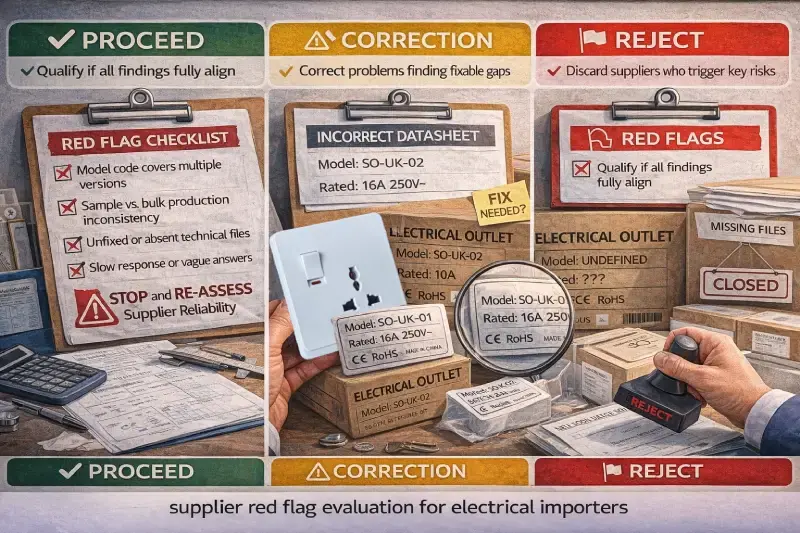
Red flags usually show up as a pattern, not one isolated detail. One code covering several versions, sample differences explained too casually, slow or vague replies, and missing file support all point to risk before production even starts. Buyers who ignore those signs often end up doing rework that should have been done during screening.
| Red flag | What it usually means | Buyer action |
|---|---|---|
| One model code covers several versions | Commercial definition is still loose | Freeze the model basis before any price decision |
| Sample and file mismatch | Technical control is weaker than the quotation suggests | Request correction before moving to factory approval |
| Missing accessories or unclear carton logic | Quotation is not fully comparable | Rebuild the comparison table instead of negotiating too early |
| Slow or evasive communication | Later issue handling will probably be harder | Treat it as part of supplier risk, not just a sales-style issue |
How This Supplier Guide Connects to Manufacturer and OEM Decisions
This guide helps buyers cut down the shortlist. It does not answer every sourcing question by itself. Once a supplier passes screening, quote alignment, sample review, and factory verification, the next question is usually simple: can this factory support a broader long-term relationship, and can it handle OEM or ODM work without turning a stable product into a risky one?
That is why this page sits under the existing manufacturer line. This page helps buyers screen suppliers. The main manufacturer guide handles the broader factory-capability view, while the OEM and ODM manufacturing guide handles private-label and customization decisions. In real sourcing, supplier review usually comes first, but manufacturer and OEM review determine whether the business can scale safely.
FAQ: Commercial Wiring Accessories Supplier Guide
What should I ask a wiring accessories supplier in the first email?
Ask for five things first: company registration details, factory location, main switch and socket catalog, production capacity for the core models, and recent shipment history for similar orders. If the reply is vague even on those basics, that is already a warning sign.
How can I tell whether the supplier is a real factory or mostly a trader?
Do not judge by the website alone. Check whether the company can clearly explain what is made in-house, show a real production site, match the quoted models to visible factory capability, and answer practical questions about tooling, output, and packaging. A trader can still be useful, but you should know that you are dealing with one and not assume full factory control.
Why can two suppliers quote the same model at very different prices?
Because the quotes are often not truly for the same commercial version. One may exclude accessories, use weaker packaging, leave technical files vague, or describe a broader model code that covers several variations. Always lock the exact version before comparing price.
What should I check on the sample before I spend time on a factory visit?
Check the dimensions, visible marking, material feel, packaging, and whether the sample matches the quotation and file set. If the sample is already unclear or inconsistent, a factory visit usually confirms more problems instead of solving them.
When should I stop and remove a supplier from the shortlist?
Stop when you see a pattern of weak control: one code covering many versions, sample and file mismatch, repeated vague answers, unclear factory role, or obvious gaps between the quoted range and what the supplier can really manage. It is better to cut the list early than carry a weak supplier into sampling and negotiation.
When is it worth moving from supplier screening into OEM or ODM discussion?
Only after the basic sourcing logic is clear. The supplier should have shown a stable product definition, matching sample and files, real factory control, and consistent communication. OEM and ODM discussions are much safer once the base relationship is already under control.
Conclusion
A commercial wiring accessories supplier should be judged by more than catalog breadth or quotation speed. For switch and socket sourcing, the stronger supplier is the one that can keep model definition, file support, sample quality, factory control, and channel fit aligned from the first screening round to repeat orders. When those parts stay aligned, the buying decision becomes clearer, safer, and easier to repeat.