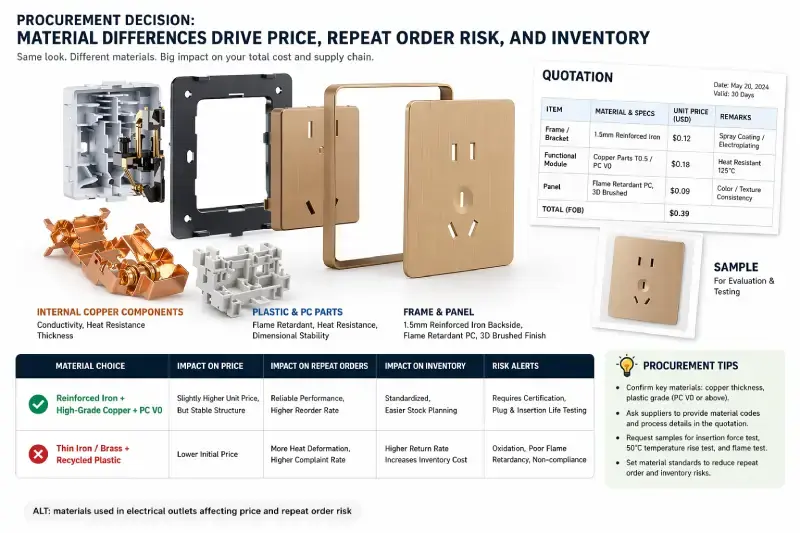
When buyers review materials used in electrical outlets, they usually are already comparing offers inside a broader buyer-side discussion of standard electrical outlet types, standards, and specifications. The real question is not what silver, brass, or PC means in theory. It is why one quote is cheaper, why one sample feels stronger, and why one repeat order becomes unstable.
The risk is simple: the material word stays the same while the product behind it changes. If thickness, structure, grade, or plating logic are still loose, buyers are not comparing one fixed outlet version against another. They are only comparing better-sounding material language.
Based on repeat-order review, quotation comparison, and OEM troubleshooting experience in export wiring-device projects, the most expensive failures usually do not begin with one obvious defect. They begin when material wording is approved before the underlying version rule is fixed.
Contents
- Why Material Claims Look Clear Before the Product Definition Is Clear
- Which Material Points Buyers Should Check First
- Brass vs Silver Outlet Contacts: What Actually Changes the Buying Decision
- How Buyers Should Verify Supplier Material Claims
- How Outlet Materials Affect Price, Stock, and Complaint Risk
- Buyer Decision Framework: Lock, Verify, or Stop
- FAQ About Electrical Outlet Materials
- Conclusion
Why Material Claims Look Clear Before the Product Definition Is Clear
Material words help buyers sort offers quickly. If two outlets share a similar front design and rating, words such as silver, brass, or PC seem to explain product level immediately.
The problem is that those words often look clearer than the product definition behind them. A silver-contact claim may sound stronger than brass. A PC claim may sound safer than a broad plastic description. But if thickness, structure, grade, plating system, or part scope are still loose, the buyer is not comparing one fixed product against another. The quote only looks ready for comparison.
Which Material Points Buyers Should Check First
Contact and terminal materials
Start with the current-carrying metal parts: contact pieces, terminal pieces, and related clamping parts. This is where many of the biggest hidden cost and performance differences sit.
| Material point | What buyers need fixed | Why it matters |
|---|---|---|
| Contact metal | Exact metal type | A broad “silver contact” claim is still too loose for real comparison |
| Thickness | Thickness fixed in the quoted model | Thickness changes cost, pressure feel, and long-term stability |
| Structure | Terminal and contact structure clearly defined | Different structures can change thermal behavior even when the metal name stays the same |
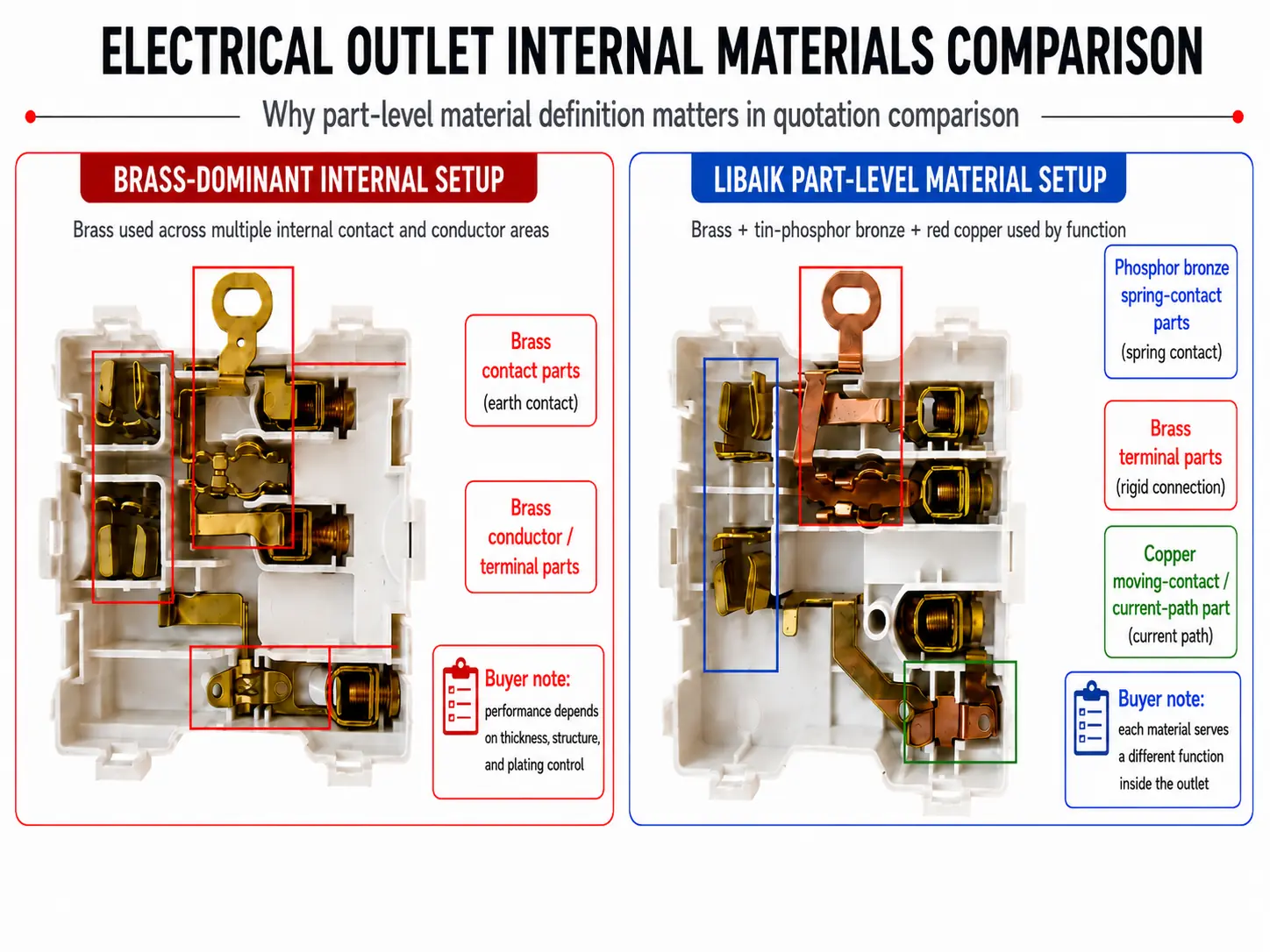
A stronger specification maps material to function. In a high-durability outlet, the receiving spring side is often specified in phosphor bronze because that part must recover after repeated insertion and keep contact pressure over time. The terminal base or other rigid side can remain brass, because that side needs rigidity, conductivity, and cost control more than spring recovery. If a supplier cannot explain that distinction and only offers a vague “silver contact” claim, the material description is still too loose for comparison.
Panel and housing materials
The second priority is the plastic structure: panel, housing, and other molded parts that affect heat behavior, rigidity, finish stability, and perceived product grade.
In outlet sourcing, buyers often focus on the difference between PC and ABS because the difference is not only cosmetic. If you need the deeper housing-side explanation, our guide to high-grade polycarbonate versus ABS in switch housings gives the cleaner next step. In general, flame-retardant PC is more often associated with better heat resistance, rigidity, and surface stability in higher-grade housings. ABS may still appear in lower-cost applications, but the two should not be treated as interchangeable unless the supplier defines exactly where each material is used.
Two outlets may look equally clean at sample stage, while the lower housing grade starts showing earlier through weaker rigidity, cheaper surface feel, or faster visible aging.
Small internal parts buyers often overlook
Smaller hardware also matters: screws, terminal hardware, and mounting-related metal parts. These parts do not usually change the front appearance, but they change installation feel, corrosion resistance, and repeat-order consistency. A socket can still look identical from the front while weaker screw or terminal hardware changes installer confidence immediately.
Brass vs Silver Outlet Contacts: What Actually Changes the Buying Decision
Why buyers ask for silver contacts
Buyers ask for silver contacts because silver sounds more conductive, more premium, and more durable at the contact surface. In procurement, it often gets treated as a shortcut for higher quality.
That shortcut is weak. A supplier can say silver contact, silver point, or premium contact surface without defining where the silver is used, how it is applied, what the base metal is, or whether that setup is fixed for the quoted model.
Why brass is still widely used
Brass remains common in outlet contacts and terminals because it offers a practical balance of conductivity, structural strength, forming stability, and cost. Brass is not automatically the lower-grade choice. A well-controlled brass design is often safer than a vague silver-contact claim.
| What buyers should clarify | Why it matters |
|---|---|
| contact metal | Without a fixed metal basis, better-sounding wording does not create a real comparison standard |
| contact thickness | Thickness directly changes cost logic and long-term feel |
| terminal structure | Two similar-looking contacts may not behave the same under load |
| whether those points are fixed to one model code | If not fixed, repeat orders are still exposed to material drift |
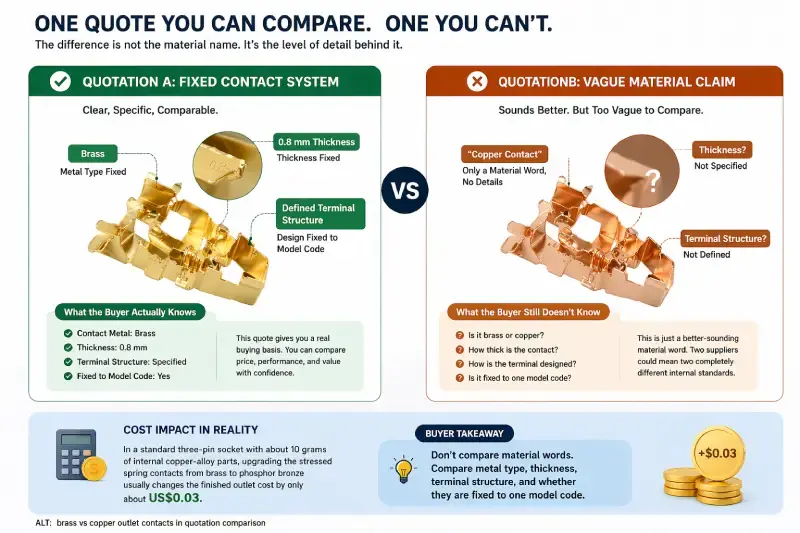
If one supplier quotes 0.8 mm brass with a fixed terminal design and another only says silver contact, the two offers are not comparable. The first quote defines a buying basis. The second only provides a stronger-sounding material word.
In wiring devices, the cost difference is usually smaller than suppliers imply. Taking a standard three-pin socket as an example, with roughly 10 grams of internal copper-alloy parts, upgrading the stressed spring contacts from brass to phosphor bronze changes the finished outlet cost by about US$0.03. That is enough to change BOM logic, but not enough to justify a dramatic price jump by itself. If a supplier uses a material change to push the outlet price much higher, the buyer should ask what else has changed in the conductor-material design and overheating risk.
From a technical-review standpoint, buyers should not rely on a sales term alone. They should ask what the base metal is, whether the contact surface uses silver plating or a silver point, how that setup is recorded in the BOM, and which declared standard, test file, or internal approval record supports it.
How Buyers Should Verify Supplier Material Claims
Trap questions that expose weak control
Ask:
- “For this model, what is the brass thickness in terminals and contacts, and is it fixed?”
- “If we change brass thickness or terminal type, will you assign a new model code?”
- “Is this sample exactly the same BOM and material setup as your actual mass-production process and quality-control setup?”
- “Is the housing flame-retardant PC, ABS, or another material, and is that fixed in the quotation?”
- “If I reorder after six months, how do you guarantee the same material and structure?”
These questions test whether the supplier is controlling one repeatable product or only controlling sales language.
What material details must match
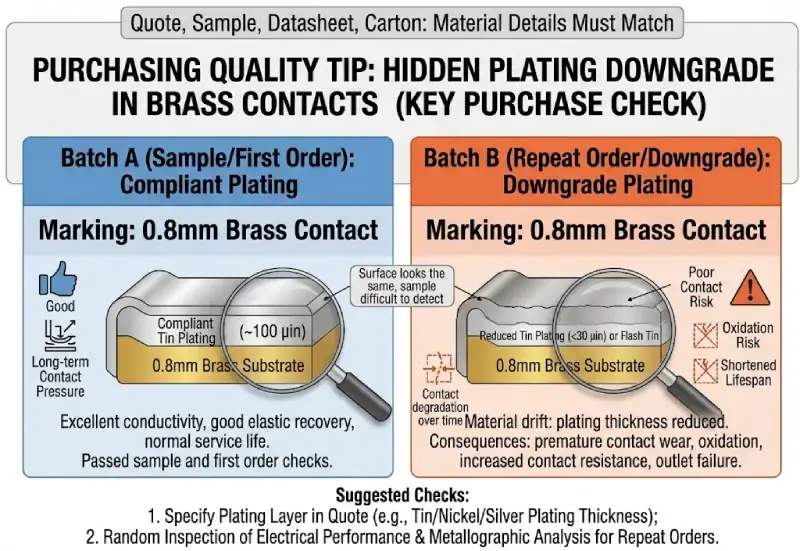
Quotation wording, sample marking, datasheet description, and carton information should all point to the same model.
- On the quotation: model code, rating, product type, and any material wording that affects product level
- On the sample: visible marking and actual build
- On the datasheet: model code, rating, structure description, and material wording if it affects grade
- On the carton: model code, product name, rating, and supply logic
If those references do not stay aligned, the material claim is not really fixed.
Where material drift usually hides
Material drift usually hides in undefined contact thickness, simplified terminal structure, broad housing descriptions, small internal hardware, and plating systems that look similar at sample stage but age differently in the field.
Another hidden change sits in the plating system. Two batches may both be described as using 0.8 mm brass contacts, yet still behave very differently over time if the plating stack changes. In one cost-down pattern, the supplier keeps the brass base and nominal thickness unchanged but reduces the tin plating from about 100 μin to 30 μin, or even uses only flash tin plating. The sample may still look fine, and the first order may still pass normal checks. The risk appears later, when the thinner plating wears away faster, oxidation builds on the contact surface, and the socket starts showing poor contact or no response at all.
When a material change becomes a new version
Cosmetic changes can often stay under the same version if they do not affect structure, rating, or material grade. A change should trigger a new version when it affects contact thickness, terminal type, housing material grade, internal conductor setup, or any point that changes cost logic, performance, or product level.
If the datasheet, carton, or sample marking does not show one fixed model code, the material claim has nothing stable to attach to. At that point, silver contact, brass terminal, phosphor bronze spring, or flame-retardant PC may still be sales wording rather than a controlled product record.
How Outlet Materials Affect Price, Stock, and Complaint Risk
How material weakness creates false price advantage
A lower quotation should not be treated as a better deal unless the supplier can explain exactly where the cost difference comes from. Until that difference is defined clearly, the lower quote should be treated as a different outlet level, not a better buy.
If metal thickness looks unchanged, part of the cost difference may still be hiding in a thinner or simplified plating system that is harder to detect at sample stage.
Which material setups are safer for stock
A version is safer for open stock when the model code is fixed, the key material points stay unchanged, the packaging logic does not vary by customer, and the same version can be sold across multiple customers.
Once the material setup becomes customer-specific, language-specific, or price-adjustable, the product is harder to mix safely in shared stock and is usually better treated as make-to-order.
Why repeat-order drift damages trust fastest
Repeat-order drift usually appears later, not at sample stage. The next batch arrives with lighter contact feel, weaker terminal confidence, or a finish that no longer looks at the same level. That is worse than one isolated defect because it damages trust in the product itself.
When that risk touches approval language as well as physical materials, buyers should also continue to our guide on what electrical outlet safety standards buyers should check before approval before treating the product as fully defendable.
Buyer Decision Framework: Lock, Verify, or Stop
| Decision | What it means | Buyer action |
|---|---|---|
| Lock | The key material points are already fixed in the model, quotation, sample, and file logic | Treat the material claim as part of one stable buying basis |
| Verify | The material claim exists but is still too broad for real comparison | Push the supplier to define thickness, structure, grade, and version rule before comparing price |
| Stop | The supplier cannot define material change rules or repeat-order control clearly | Do not treat the offer as one repeatable outlet version |
Review basis used in this page: export quotation comparison, sample-to-bulk consistency checks, BOM and version-control review, and material declarations checked against datasheets, approval files, and declared product standards. This page supports buyer review and supplier evaluation. It is not a substitute for market-specific legal or certification advice.
FAQ About Electrical Outlet Materials
Why do similar electrical outlets often have different prices?
Because visible appearance is only part of the product. Internal differences in contact thickness, terminal structure, housing grade, plating logic, and small hardware create the real cost gap.
Are silver contacts always better than brass parts in outlets?
No. A clearly defined brass setup is often safer than a vague silver-contact claim.
Is phosphor bronze always better than brass?
Not automatically. Phosphor bronze is valuable in spring-contact parts because of elastic recovery, but the buyer still needs to know where it is used and whether that setup is fixed.
Why do repeat orders sometimes feel different from the first order?
Because the sample and early batches may not represent long-term material control. Internal changes often appear later if the product definition was never truly fixed.
Conclusion
In outlet sourcing, material names do not control risk. Locked material definition does. The real buying problem is not whether a supplier says silver, brass, phosphor bronze, or flame-retardant PC. It is whether those material words still point to the same product when the quote is compared, the sample is approved, the batch is shipped, and the repeat order arrives.