A standard electrical outlet is a socket designed for a particular electrical system and its applicable requirements. There is no single outlet that is standard everywhere. The plug interface, earthing arrangement, electrical rating and mounting dimensions all affect whether a model is suitable for an installation.
For an importer, distributor or project buyer, the useful starting point is to separate three questions: which plug must fit, what electrical and installation specifications are needed, and what documents support the exact model being offered? This guide explains those terms, the main outlet families, and the materials and manufacturing processes behind them.
|
In this guide |
What Is a Standard Electrical Outlet?
A wall socket connects a compatible appliance plug to a building’s electrical installation. Its insulating body supports the conductive contacts and terminals; an earthed design also provides a protective-earth connection. The visible faceplate is only one part of that assembly.
The word “standard” can mean different things in a catalogue. It may refer to a familiar local format, a manufacturer’s regular model, or a named technical standard. A description such as “standard wall outlet” therefore needs a model number and specification before it can become a useful order description.
Why standardization matters
Defined interfaces and performance requirements allow products to be assessed against a common basis. They help address fit, insulation, protection against electric shock and behaviour during use. A familiar faceplate or a plug that appears to fit cannot establish all of those properties. Our electrical outlet safety standards guide introduces the safety questions behind these requirements.
Residential and commercial use
A hotel room, retail counter and home may use the same socket format but place different demands on the product. Frequent plugging, cleaning, the installation environment and the connected equipment can change the specification. “Commercial grade” alone does not tell you the rating, endurance or protective features: compare the stated characteristics of the proposed models.
Main Types of Standard Electrical Outlets
Plug-type letters are useful for recognizing shapes. Product standards and configuration designations are more precise when identifying an outlet for purchase. The following overview explains the distinction; use our electrical outlet types around the world guide for a broader comparison.
BS 1363 socket outlets
The British BS 1363 family includes plugs, socket outlets, adaptors and connection units. Its parts cover different products: Part 1 concerns 13 A fused plugs, while Part 2 concerns 13 A switched and unswitched socket outlets. The plug and the socket have different functions and separate standard parts. BSI’s BS 1363 series overview identifies these separate parts.
A socket enquiry should identify the switched or unswitched version, its earthing arrangement and shutters. These features describe the product more precisely than a front photograph alone. The BS 1363 wall socket specification guide develops this model-level discussion. For installation planning, see the BS standard wall switch and socket installation guide; actual installation must follow the applicable local rules and product instructions.
Type A, Type B and North American configurations
Type A describes a plug with two parallel flat pins and no earth pin. Type B adds a grounding pin. These descriptions identify the plug interface, not a complete wall-socket specification. Electrical Safety First illustrates the distinction in its United States plug guide.
For purchasing, use the exact receptacle designation and rating. For example, a NEMA 5-15R receptacle is a grounding configuration rated 15 A, 125 V; it is not enough to request an “American socket.” The separate 120 V nominal supply commonly described for the United States should not be substituted for the product’s marked voltage rating. This is a configuration example, not a claim that every North American installation uses the same outlet.
Type C and Type F terminology
Type C commonly identifies the two-round-pin Europlug. Type F identifies the Schuko plug system. Calling a product a “European socket” or “Europlug socket” leaves important details unresolved: the exact mating interface, earthing arrangement and product rating still matter. Electrical Safety First’s Germany plug guide illustrates C and F as plug types, rather than a single specification for all European outlets.
The physical distinction is useful: a Type C Europlug has no protective-earth contact, while a Type F connection uses side earthing contacts. The Type F socket designation is CEE 7/3; CEE 7/4 identifies its plug. NETIO’s Type F reference shows this interface. Two round holes alone are therefore not enough to identify the required socket. Match the complete interface and model rating to the intended installation.
Multi-standard universal outlets
A universal outlet is intended to accept more than one plug format. That makes the claimed compatibility range especially important. A list of plug shapes does not, by itself, show that each combination provides suitable contact engagement, earthing and protection.
Ask which specific plug-and-socket combinations are supported by the product documentation and allowed for the intended use. For the practical comparison with a dedicated local format, see universal socket vs standard outlet.
Electrical Outlet Specifications Explained
A useful specification separates the socket’s interface, electrical characteristics and physical installation. This prevents two quotations from appearing equivalent when they describe different products.
On a small screen, swipe the table horizontally to read all columns.
| Specification | What it changes for the buyer | Useful evidence |
|---|---|---|
| Plug format / socket system | Determines the mating interface and earthing arrangement. Similar-looking openings do not establish compatibility. | Exact configuration, front-view drawing and supported plug types. |
| Rated voltage and current | Identifies the product’s electrical ratings. The country’s nominal supply voltage is a different value. | Model markings and data sheet, matched to the installation and load. |
| Earthing and protective features | Distinguishes the protective-earth connection, shutters and other specified protection. | Configuration description and documents covering those features. |
| Dimensions and mounting | Determines whether the faceplate, fixing points, rear body and wiring space suit the box. | Dimensioned drawing, required back box and terminal/conductor information. |
| Standard and model evidence | Establishes which requirements and assessed configuration the offer refers to. | Quoted model, sample identification, standard part/edition and report or certificate scope. |
| Intended environment | Defines the relevant temperature and exposure limits; “for hot climates” is not a rating. | Model instructions and environmental ratings compared with actual site conditions. |
A real specification example: body depth is not box depth
For LIBAIK’s V6 13A 1-Gang Switched Multi Socket with Neon and 2 USB Ports, compare three separate installation dimensions:
|
|
|
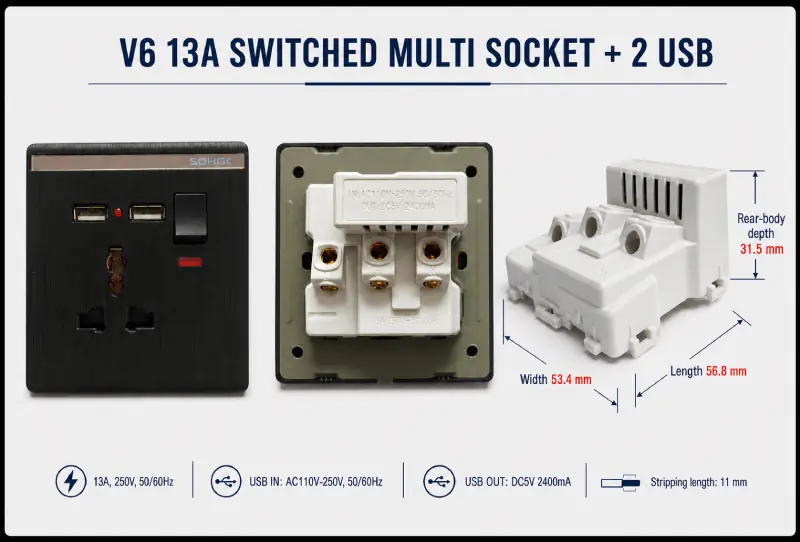 V6 socket dimensions. The drawing labels the rear body; the recommended box and fixing distance are separate specification fields. View the full-size dimension image.
|
A 31.5 mm rear body is not a recommendation for a 31.5 mm-deep box. The terminal positions, conductors, cable entry and usable box space also affect installation. If another offer lists only “13A socket with USB,” it is not yet an equivalent installation specification. Put its body dimensions, recommended box and fixing distance alongside these fields before comparing it as a replacement.
This is one documented V6 configuration, not a dimension rule for every V6 model or a claim that the multi socket is a BS 1363 socket. Use the current drawing and installation instructions for the version being ordered. For commercial range selection beyond these physical checks, continue with how to choose the right electrical outlet for your market.
What customer feedback taught us about wiring space
Customers in Kenya and Saudi Arabia have reported a related issue with our three- and four-gang two-way switches. Once all the conductors were connected, a large or deep base made it difficult to place the assembly into the back box. Their feedback concerned a tight installation, rather than a complete inability to fit the switch. For the affected designs, our response was to make the base smaller and shallower while retaining the product’s quality requirements.
We have also received feedback about USB sockets whose larger rear modules would not fit the available box. In some cases, the box’s stated depth was misleading: a box marked 45 mm could in practice be closer to 38 mm. Our response in those cases was to supply standard-sized back boxes for the required installation. These are examples from customer feedback, not a claim about all boxes or all markets.
The purchasing lesson is to compare the space needed by the wired assembly with the box actually supplied. A bare mechanism sitting inside an empty box does not answer the same question. For multi-gang switches, include the intended wiring arrangement; for USB sockets, include the rear module and terminal positions. The box drawing, actual dimensions and product instructions should agree before the combination is approved.
Materials Used in Standard Electrical Outlets
The conductive parts, insulating body and supporting structure perform different jobs. Material selection matters, but the name of a metal or plastic does not establish the performance of the finished outlet. Compare the material with the component’s function and the complete product design.
Copper, brass and contact construction
Copper offers high conductivity. Brass and other copper alloys provide different combinations of conductivity, strength and formability. The appropriate choice depends on whether the part carries current, grips a plug pin, clamps a conductor or supports another component. A contact also needs to retain its intended shape and pressure during use; conductivity alone does not answer that question.
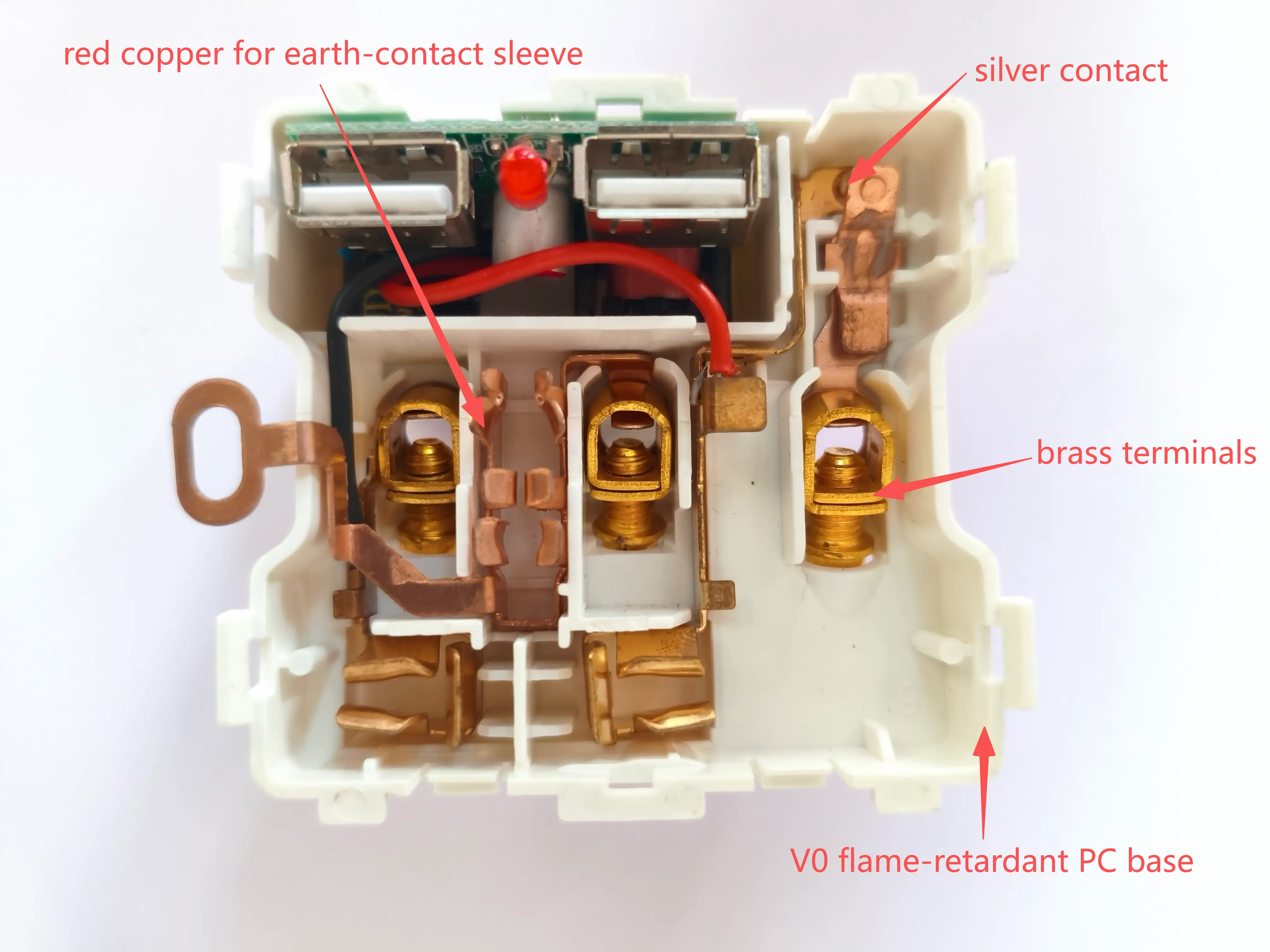
For this V6 configuration, the specification lists brass terminals, phosphor-bronze socket contacts, and red copper for the moving contact and earth-contact sleeve. Those are separate components with separate jobs. Describing the whole assembly simply as a “copper socket” loses information that matters when comparing offers. These material descriptions apply to that documented configuration; they do not prove a test result or describe every V6 model.
 |
Why contact construction matters as well as the alloy
Current crosses the interface between a plug pin and its socket contact. The contact’s shape and spring action help maintain that connection. Reduced contact force can increase contact resistance; for the same current, higher resistance produces more heat. A highly conductive metal alone cannot compensate for a poor connection. MELTRIC’s technical explanation of contact force and resistance describes this relationship; its industrial-product performance figures are not specifications for household sockets.
That is why a meaningful comparison pairs the component specification with the model’s mechanical-operation and temperature-rise evidence. A stiff-feeling sample or a reassuring metal colour cannot provide the same information.
Our guide to materials used in electrical outlets explains how to discuss component materials in quotations. The related copper, brass and overheating discussion provides further context on conductor choices.
Polycarbonate housings and flame-retardant grades
Polycarbonate, often abbreviated to PC, is used for insulating and structural parts in electrical accessories. “PC” is a material family, not a single flame-retardant or temperature rating. The selected resin grade, part geometry and manufacturing process all need to suit the component’s role.
If a quotation claims UL 94 V-0, identify the material grade and the thickness covered by that classification. UL’s plastics flammability guidance explains that the test classification relates to material specimens and thickness. It does not, by itself, certify the complete wall socket. See our polycarbonate material guide for the questions to raise about housing materials.
Temperature and installation conditions
Ambient temperature and heating during operation are different considerations. A temperature-rise result relates to the specified test conditions; it is not a general promise that an outlet can be used at any ambient temperature. For an installation exposed to heat, moisture or dust, provide those conditions and compare them with the exact model’s intended-use information. A stronger-looking housing cannot establish an environmental rating.
How Standard Electrical Outlets Are Manufactured
A typical production route includes moulding insulating components, forming metal parts, assembling the mechanism and carrying out the specified inspections and tests. Understanding these stages helps buyers ask where dimensions, materials and assembly consistency are controlled.
Injection moulding
Moulding produces the housing and internal insulating parts. Tool dimensions and process settings affect the fit between those parts and the mechanism. The appropriate processing temperature depends on the resin grade and process; one generic temperature is not a useful quality benchmark. Ask how the manufacturer checks critical dimensions and identifies the material used for the order.
Metal forming and assembly
Stamping and forming shape terminals and contacts. Assembly brings those parts together with the insulating body and any shutter or switching mechanism. Consistency involves more than a tidy faceplate: component position, fit and fastening all need to follow the approved design. A factory tour can show the production arrangement, while inspection records explain what was checked.
 Assembly-line overview. Model identification and inspection records are needed to connect production checks to a particular order.
Design testing and production checks
Testing may examine protection against electric shock, insulation, heating under load, mechanical operation and resistance to heat or fire, as applicable to the product standard. These are different assessments, not interchangeable badges of quality.
A design test report and a shipment inspection record answer different questions. The report identifies the tested design and conditions. Production records show the checks performed under the factory’s quality plan. Do not assume every finished outlet receives every endurance or destructive test. Ask which checks are routine, which use samples and which belong to design qualification. Our manufacturing process and quality guide expands on these stages.
Standards, Test Reports and Market Requirements
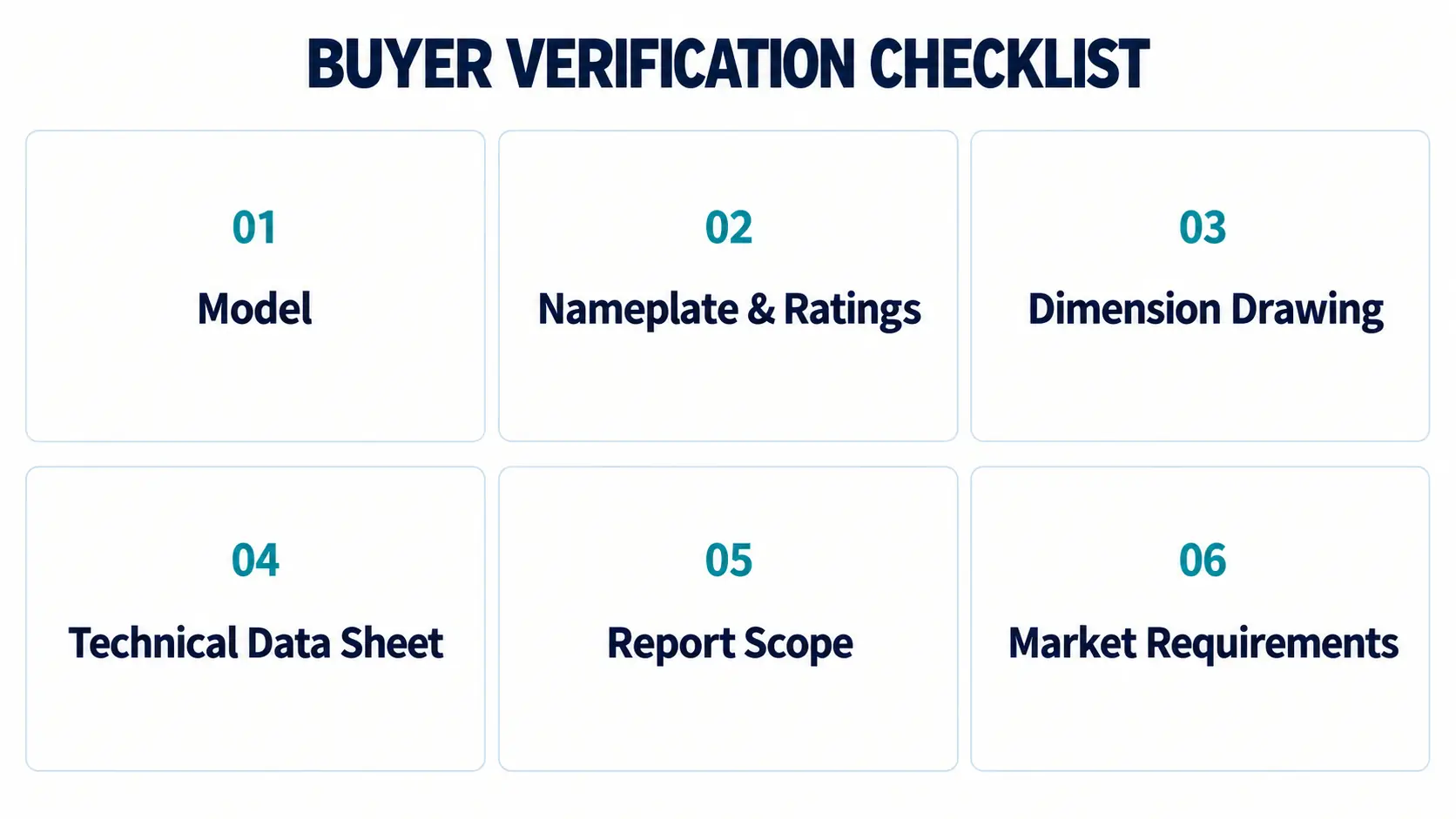
A standard describes requirements. A test report records an assessment of identified samples. A certificate has a defined product scope and issuing scheme. Market access depends on the requirements applicable to the destination and product. Keeping these separate makes a supplier’s documents easier to interpret.
IEC 60884-1
IEC 60884-1:2022 covers AC plugs and fixed or portable socket outlets for household and similar purposes within its stated scope. It includes earthed and unearthed products. Referencing that standard is not the same as showing that the offered model has been assessed to it or is accepted in every market.
Match the model and configuration to the report, including the standard edition and any applicable national requirements. Endurance figures should come with the relevant method and conditions; a single insertion-cycle number is not a universal specification for every outlet.
BS 1363: identify the applicable part
For a 13 A switched or unswitched socket outlet, BS 1363-2 identifies the socket-outlet part of the series. A document covering a plug is not automatically evidence for the matching wall socket. Likewise, a report for one variant should not be assumed to cover another without checking its scope. Our IEC 60884 vs BS 1363 comparison explains the different roles of these references.
CE marking: start with the product’s scope
Do not use “CE certified” as a universal requirement or quality claim for every wall socket. Annex II of Directive 2014/35/EU lists plugs and socket outlets for domestic use among its exclusions. A voltage rating alone therefore does not establish that a domestic socket falls within the Low Voltage Directive.
This is not a blanket exemption from product rules. Added electronic functions can change the assessment, and destination-specific requirements still need to be identified. Ask which legislation applies to the complete product and what documentation supports that conclusion. The European Commission’s LVD guidance is a starting point for understanding scope and conformity assessment.
 |
Moving from Specifications to a Supplier Discussion
By this stage, a useful enquiry has a socket configuration, an installation reference and a document requirement. The supplier discussion can then address how that design is maintained in production and whether the quantity and delivery plan are achievable. This gives both sides a clearer starting point than a photograph and a request for the “best price.”
For OEM or private-label orders, separate logo and packaging changes from changes to the mechanism, materials or electrical functions. They can have different implications for sampling, tooling, documentation and lead time. Ask for those items to be identified in the quotation rather than assuming all customization is the same service.
To compare LIBAIK’s product ranges and discuss sample-to-bulk consistency, visit our electrical switch and socket manufacturer in China guide. To prepare comparable quotations, use the wall switch and socket RFQ checklist.
Ready to discuss an outlet requirement? Send the destination country, intended socket system or reference photos, installation drawing or mounting requirements, approximate quantity and any branding or packaging needs through our contact page. If you do not yet know the exact model, explain the application so the discussion can begin with suitable options.
Frequently Asked Questions
Is there one standard electrical outlet worldwide?
No. “Standard” refers to a particular system or product specification. Start with the required plug interface, then identify the electrical rating, installation dimensions and applicable product requirements.
Which outlet should I specify for a Middle East order?
Name the destination country and project requirements first. If the order calls for BS 1363 sockets, specify the socket variant and applicable documentation. “Middle East standard” is too broad to define one product or approval requirement across different destinations.
Are copper parts always better than brass?
Conductivity is one factor; strength, formability and the part’s function also matter. Compare the specified alloy and construction, and evaluate the complete outlet. Neither a photograph nor a general “copper” claim proves finished-product performance.
Which certifications are needed for export?
There is no single certificate covering every outlet and destination. Identify the product configuration, destination requirements and applicable standard, then check the scope of the relevant reports and certificates. Do not substitute a plug report, a resin classification or a generic CE statement for the socket’s required documentation.
How long does outlet manufacturing take?
Lead time depends on the model, quantity, material availability, production schedule and customization. Ask when the quoted production period starts—for example, after sample and artwork approval—and whether it excludes transport. Use the agreed quotation for the specific order rather than a general website estimate.
What is the minimum order quantity?
Ask for the minimum by model, colour and packaging version. A total order quantity may be split across several variants, each with its own production or packaging requirements. Existing tooling, custom finishes and private-label packaging can lead to different minimums; confirm them against the intended assortment.