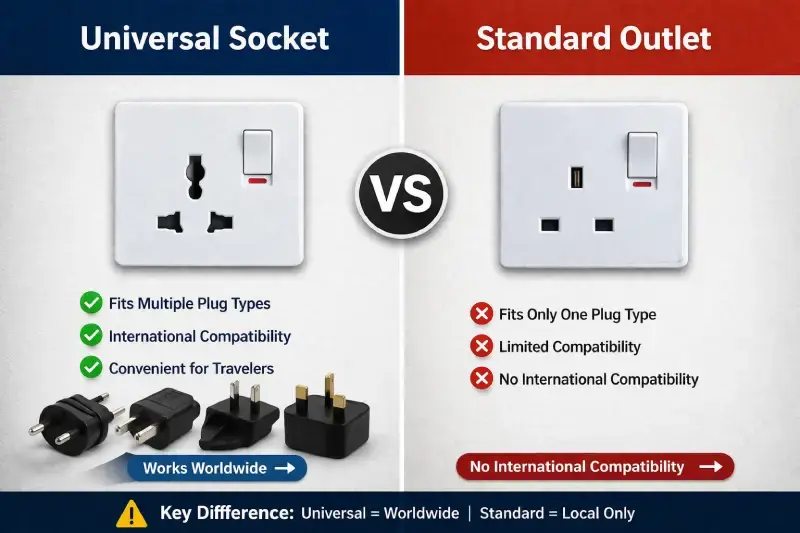
Universal socket vs standard outlet is not just a product-style comparison. For buyers, importers, suppliers, and retailers, it is a decision about market fit, approval risk, safety review, and whether the quoted product can be defended in the destination market after sale.
This page is written as a comparison support guide. Its purpose is to help buyers decide when broad plug acceptance creates more sourcing risk than value. If the reader needs the broader standards context first, the best starting point is the standard electrical outlet guide.
The key issue is not paper flexibility. The key issue is whether that flexibility weakens system matching, complicates document review, or creates avoidable questions around safety, raw-material quality, and destination-market suitability. In real sourcing, this is especially important when a supplier offers a so-called multi-function socket that looks commercially convenient but sits outside a clearly defined standard path.
Contents
- Why Buyers Compare Universal Sockets and Standard Outlets
- What a Universal Socket Actually Means
- What a Standard Outlet Means in Real Market Use
- Universal Socket vs Standard Outlet: The Core Differences Buyers Should Check
- Universal Outlet Safety: What Buyers Should Review Carefully
- When a Standard Outlet Is the Safer Choice
- When Buyers Still Consider Universal Sockets
- How to Evaluate Supplier Claims About Universal and Standard Outlets
- FAQ: Universal Socket vs Standard Outlet for Buyers
- Conclusion
Why Buyers Compare Universal Sockets and Standard Outlets
Why this is a sourcing decision, not just a product-style question
For buyers, this comparison affects approval logic, product positioning, sales-channel suitability, and downstream complaint risk. A product that looks commercially flexible in a catalogue may still create uncertainty once technical review, import review, or market-specific documentation begins.
Why safety and market fit matter more than convenience claims
Convenience language does not guarantee easier distribution. Buyers should focus on contact behavior, earthing logic, visible marking, technical support, and destination-market fit rather than broad claims about flexibility. If the approval question is mainly about safety screening, the next page to read is our electrical outlet safety standards guide.
What a Universal Socket Actually Means
How universal sockets are designed to accept different plug types
A universal socket is designed to accept more than one plug format in a single face. In trade, buyers also see it called a multi-function socket or, more critically, a non-standard socket. The commercial logic is broad plug acceptance rather than alignment with one defined national or regional outlet system.
Why multi-function sockets are often treated as non-standard products
Many multi-function sockets are marketed around flexibility, not around one clearly defined socket standard. In practical sourcing terms, that usually means the product does not sit as neatly inside a standard-specific approval route like BS1363 for British-style systems. Buyers therefore need to distinguish between a product that can physically accept several plugs and a product that has a clear, defensible standard basis for the target market.
Why “universal” does not automatically mean suitable for every market
Universal refers to plug acceptance, not automatic market suitability. A common example is a multi-function socket rated at 13A but designed to accept some 16A-style European plugs. That may look commercially useful, but it also means buyers should review contact design, load logic, and product positioning much more carefully. For broader outlet-system background, see electrical outlet types around the world.
Where buyers typically encounter universal socket products in trade
Buyers usually encounter universal sockets in hotel programs, export catalogues, OEM quotations, and mixed-market offers where one faceplate is expected to serve travelers or multiple plug types. That commercial visibility is exactly why supplier wording should be reviewed carefully rather than accepted at face value.
- common examples include hotel bedside panels, serviced-apartment guest rooms, meeting rooms, and other guest-facing convenience positions
- they are less convincing when a project is a fixed-market residential or commercial installation that should follow one known outlet system
- the more fixed the market and installation logic are, the weaker the commercial case for a non-standard socket usually becomes
What a Standard Outlet Means in Real Market Use
How a standard outlet is tied to a defined plug and socket system
A standard outlet is designed for one defined plug and socket system rather than broad multi-plug use. Its logic is tied more directly to a known market standard, a clearer use environment, and a more predictable installation expectation. A British-style outlet can be reviewed against BS1363. Other region-specific outlets can be reviewed against their own clearer market path and supporting documentation logic.
Why standard outlets are easier to match with destination-market expectations
Standard outlets are usually easier to match with destination-market expectations because the product format, system fit, and document logic are clearer. Buyers do not need to defend broad flexibility when the market actually expects one defined outlet type. In Europe, for example, even though buyers may talk loosely about "CE," the real advantage is that the outlet is still tied to a clearer market-specific product logic than a non-standard multi-function socket.
Why standardization reduces interpretation risk in buyer review
Standardization reduces interpretation risk because the product can be reviewed against a more defined system. That makes the purchase decision easier to support internally and easier to explain externally to distributors, project clients, and import-side reviewers.
| Typical standard outlet example | Where buyers see it | Why review is easier |
|---|---|---|
| BS1363 13A / 250V outlet | UK-style and Gulf projects, apartments, villas, hotels | Socket logic, rating, and market expectation are clearer. If the buyer needs product-level detail, the next step is BS1363 wall socket specification. |
| Type F / Schuko 16A / 250V outlet | Continental Europe residential and commercial projects | The installation environment is more clearly tied to one plug-and-socket relationship. |
| NEMA 5-15 style 125V outlet | North American residential and light commercial markets | The product is reviewed within one known regional system rather than through broad compatibility claims. |
Universal Socket vs Standard Outlet: The Core Differences Buyers Should Check
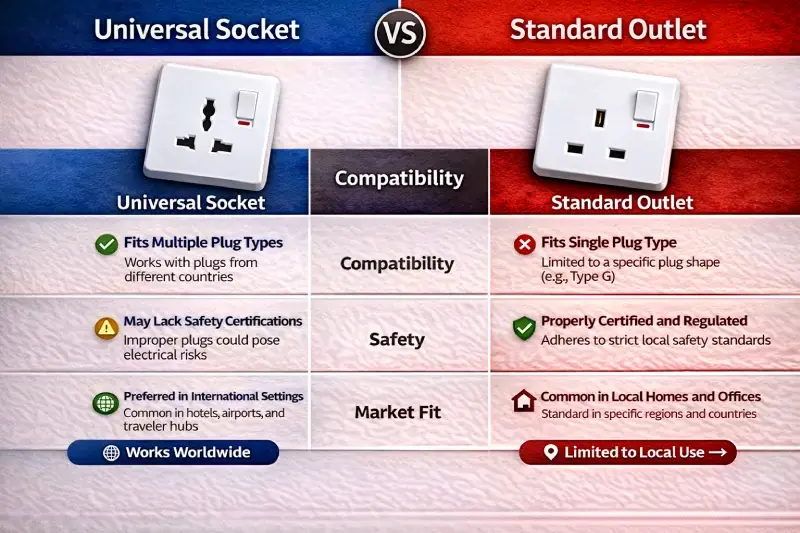
| Aspect | Universal socket | Standard outlet | Buyer impact |
|---|---|---|---|
| Compatibility logic | Broad physical acceptance of multiple plug types | Controlled fit with one defined socket system | Buyers compare flexibility against clearer system alignment |
| Safety review | Needs closer checking of contact behavior, earthing, and protection claims | Usually easier to review because product behavior is tied to one known format | Weak documentation creates more approval risk on the universal side |
| Market positioning | Often sold as export-friendly, hotel-friendly, or multi-use | Usually tied to one destination-market expectation | Standard outlets are often easier to defend in fixed-market distribution |
| Certification path | Often less clear because the product is not built around one defined national system | Usually clearer because the product is tied to a known system and approval logic | Buyers usually face more document and interpretation pressure on universal products |
| Procurement logic | Verification burden is higher, especially on copper quality and factory trust | Interpretation burden is lower | Buyers usually need stronger files and stronger supplier confidence before approving universal products |
Compatibility logic: multi-plug acceptance vs controlled system fit
Universal sockets are designed for broader physical acceptance, while standard outlets are built around one defined plug relationship. For buyers, that means comparing commercial flexibility with clearer system fit.
Safety logic: convenience design vs predictable socket behavior
Universal sockets are often sold through convenience, but buyers should look past convenience claims and focus on contact stability, earthing logic, live-part protection, and whether the internal contact path still makes sense when multiple plug shapes are accepted. Standard outlets usually offer more predictable behavior because they are designed for one known system.
Market logic: hotel convenience vs fixed-market distribution
Universal sockets can make sense in controlled hospitality scenarios where guests may carry different plug types. Standard outlets are usually stronger in fixed-country retail or project distribution, where the market expects one defined system and one clearer approval path.
Procurement logic: where buyer verification becomes stricter
Buyers should verify supported plug formats, technical files, safety claims, visible marking, destination-market fit, and whether the supplier's raw-material choices are strong enough for a non-standard socket design. If those points remain vague, approval risk rises quickly.
| Real buying scenario | Why a universal socket looks attractive | Why a standard outlet may still be stronger | Buyer note |
|---|---|---|---|
| Hotel guest room | Traveler convenience and fewer adapter complaints | Main room power points may still be safer as a fixed standard system | Use universal sockets as controlled convenience points, not by default as the whole room standard |
| Residential project in UAE or Saudi Arabia | Developer may think one socket face looks more flexible | BS-style expectations and project review are usually clearer with a defined outlet system | Fixed-market residential work usually favors standard outlets |
| Retail distribution in one country | One SKU appears easier to sell broadly | After-sales explanation and approval logic are usually easier with one standard outlet type | Broad shelf appeal does not always reduce return or complaint risk |
| Mixed export quotation | Supplier can show one "international" option quickly | Different destination markets may still need different socket systems and documents | Commercial simplicity at quotation stage can create approval problems later |
Universal Outlet Safety: What Buyers Should Review Carefully
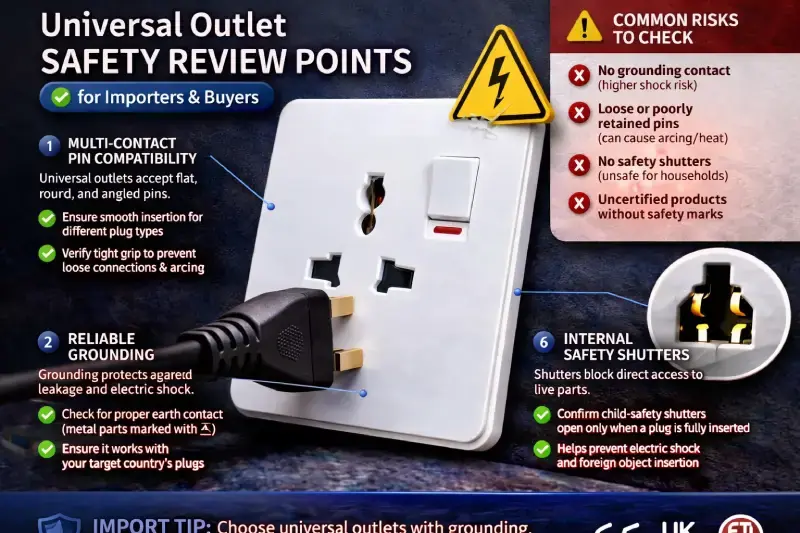
Contact stability and plug-fit concerns
Buyers should review whether broad plug acceptance still provides stable contact and reliable plug fit rather than only broad physical entry. This matters even more when the product is nominally 13A but physically accepts plugs that buyers associate with 16A systems. Physical acceptance without dependable contact behavior is not a strong safety basis.
Earthing, live-part protection, and internal contact design
They should also check earthing logic, protection against live-part access, and whether the internal contact structure supports safe and predictable use rather than only a multi-format appearance. Universal products create more room for bad internal design to hide behind a convenient front view.
Why copper quality and factory reputation matter more here
If a buyer still chooses a multi-function socket, raw-material quality becomes more sensitive. Copper usage, brass quality, contact spring stability, and the reputation of the factory matter more because the product is already asking more of its internal design. A weak factory with weak copper content is a much bigger risk on a non-standard socket than on a simpler standard-format outlet.
Why universal outlet safety claims require closer document review
Universal outlet safety claims need tighter document review because broad wording such as multi-use, international type, or safe design does not prove actual product behavior. Buyers should look for clear model description, intended use logic, and files that match the quoted product consistently.
| Safety point | What buyers should check | Why it matters | Typical sourcing risk |
|---|---|---|---|
| Plug fit | Confirm that accepted plug formats still maintain stable contact | Loose fit can create weak connection quality and heat risk | Product looks versatile but behaves inconsistently in use |
| Earthing logic | Check whether grounding behavior is defined clearly for intended plugs | Unclear grounding undermines technical confidence and approval review | Buyer cannot defend the product in project or import review |
| Live-part protection | Review how protection against access to live parts is described | This is central to buyer-side safety review | Broad safety claims with no specific product explanation |
| Internal contact design | Look for credible design description rather than general marketing wording | Internal structure affects long-term predictability | Approval granted on language, not on real technical clarity |
| Raw material quality | Ask about copper and conductor quality, not just outer appearance | Weak conductor materials make non-standard designs more fragile in real use | Low-cost factory uses flexible marketing but weak internal metal quality |
When a Standard Outlet Is the Safer Choice
For market-specific distribution and retail channels
A standard outlet is usually safer for clearly defined retail and distribution markets because it matches one known plug-and-socket system and creates less confusion after sale.
For projects with clearer installation and compliance expectations
Projects with fixed installation and compliance requirements usually favor standard outlets because system fit, supporting documents, and buyer review logic are easier to confirm.
For buyers who want lower approval risk and simpler documentation review
Standard outlets usually offer lower interpretation risk and a clearer documentation path, which makes them easier to approve and easier to defend commercially.
Typical strengths and tradeoffs of standard outlets
The main strengths are clearer standards logic, easier approval review, more predictable installation behavior, and fewer after-sales questions in fixed markets. The tradeoff is lower flexibility: one outlet does not try to serve every plug type, so buyers may need different SKUs for different markets.
- fixed-country retail programs usually benefit from standard outlet logic
- project bids with defined specifications are easier to manage with standard outlets
- buyers under tighter approval control usually prefer the clearer system match of standard outlets
When Buyers Still Consider Universal Sockets
For hotel and hospitality scenarios
Universal sockets are most often considered in hotels, serviced apartments, and guest-facing hospitality environments where short-term convenience for travelers is part of the commercial offer. Even there, the buyer still needs to define whether the product is meant as a convenience feature or as a fully market-specific installation choice.
For multi-use or export-oriented product programs
They may also be considered in export-oriented or mixed-market offers where one product face is expected to serve several customer groups and the use environment is tightly controlled.
Typical strengths and tradeoffs of universal sockets
The main strengths are flexibility, easier traveler-facing convenience, and commercial simplicity when a supplier wants one broad-use presentation. The tradeoffs are higher interpretation risk, a less clear standard path, more pressure on internal design quality, and a greater need to trust the factory behind the product.
What buyers must verify before approving this option
Before approval, buyers should verify plug claims, contact design, earthing behavior, visible marking, datasheet consistency, copper quality, and whether the product claim matches the intended sales market rather than just the supplier's convenience wording.
How to Evaluate Supplier Claims About Universal and Standard Outlets
Which product details should appear clearly in datasheets
A credible datasheet should clearly show socket type, supported plug logic, rating, earthing arrangement, visible marking, and intended product positioning.
What vague wording usually fails to prove
Terms such as multi-use socket, international type, safe design, or widely compatible do not prove plug-fit stability, internal contact design, or destination-market suitability.
How to review product claims against the intended sales market
Buyers should compare the socket format, supporting files, marking, commercial claim, and factory credibility against the actual target market. On a universal socket quote, factory trust matters more because the product itself already sits in a greyer interpretation zone than a defined standard outlet. If the standards discussion becomes a question of broad framework versus destination-specific system logic, the next comparison page is IEC 60884 vs BS1363. If broader market-by-market outlet context is still missing, go back to the standard electrical outlet guide before approval decisions are made.
FAQ: Universal Socket vs Standard Outlet for Buyers
Why is a multi-function socket often called a non-standard socket?
Because it is usually designed around broad plug acceptance rather than one clearly defined national socket system. In sourcing terms, that means the product often does not have the same clean standards path that a BS1363 or other market-specific outlet can use.
Why do buyers worry when a universal socket is marked 13A but accepts some 16A-style plugs?
Because the visual plug acceptance can create the impression that the socket is equally suitable for different systems and load expectations. Buyers then need to check much more carefully whether the contact design, rating logic, and actual use positioning are still defensible.
When does a universal socket make the most sense?
Usually in controlled hospitality scenarios such as hotels, serviced apartments, or guest-facing rooms where traveler convenience is part of the product concept. It makes much less sense when the project is a fixed-market installation that should follow one clearer outlet system.
Why should buyers pay more attention to copper quality and factory reputation on multi-function sockets?
Because a non-standard socket depends even more on strong internal contact design and stable raw materials. If the factory cuts copper quality or has weak process control, the commercial convenience of the product is outweighed by a much higher safety and complaint risk.
What are the practical advantages and disadvantages of standard outlets compared with universal sockets?
Standard outlets are usually easier to approve, easier to explain to customers, and easier to match to one destination market. Their disadvantage is lower flexibility across countries. Universal sockets offer broader convenience and can fit hotel-style scenarios better, but they bring a weaker standards path, higher interpretation risk, and more dependence on supplier credibility.
Conclusion
In a universal socket vs standard outlet decision, buyers should focus on market fit, safety review, and document clarity rather than convenience claims alone. Universal sockets may look commercially flexible, but standard outlets often offer clearer system matching and lower approval risk. If the next step is full standards context rather than comparison logic alone, continue to the standard electrical outlet guide. If the buyer now needs the broader decision framework for choosing the final product by market, size, color, sales channel, and repeat-order logic, see how to choose the right electrical outlet for your market.