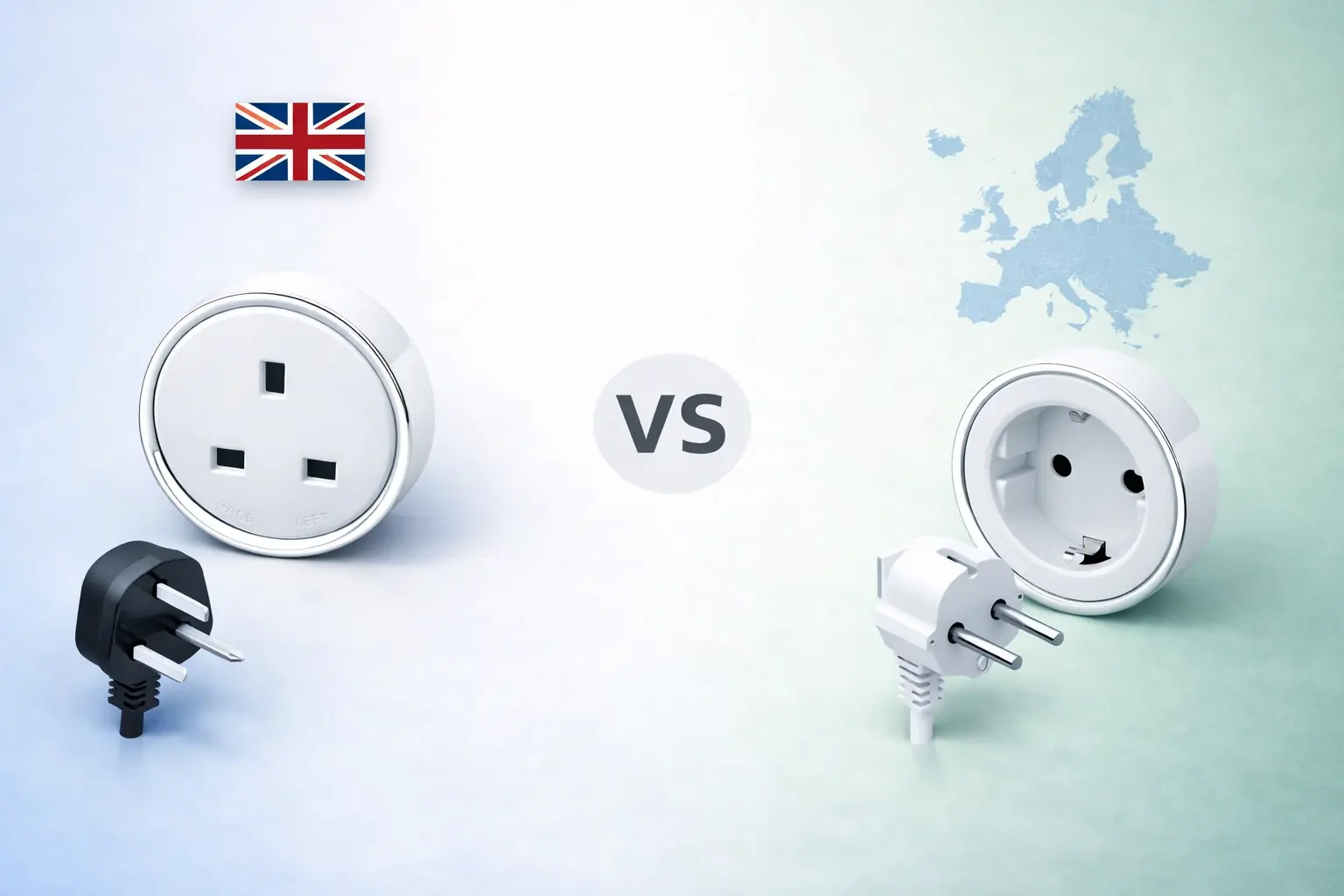
IEC 60884 and BS1363 are not interchangeable standards, and buyers should not treat them as if they answer the same market question. IEC 60884 is commonly used as a broad international framework for plugs and socket-outlets, while BS1363 is tied to the British plug and socket system and to markets that expect that specific format. This article compares them from a buyer’s perspective so procurement teams, importers, distributors, wholesalers, and retailers can judge market suitability, compliance alignment, and document reliability before placing orders.
Contents
- Why Buyers Need to Understand the Difference Between IEC 60884 and BS1363
- What IEC 60884 Covers
- What BS1363 Covers
- IEC 60884 vs BS1363: The Key Differences Buyers Should Know
- Which Standard Matters More for Your Target Market
- How to Evaluate a Supplier When Comparing IEC 60884 and BS1363 Products
- When to Use a Comparison Page Like This and When to Go Deeper
- FAQ: IEC 60884 vs BS1363 for Sourcing and Compliance
- Conclusion
Why Buyers Need to Understand the Difference Between IEC 60884 and BS1363
Why this comparison matters for importers, distributors, and project buyers
For importers, distributors, and project buyers, comparing IEC 60884 and BS1363 is not a technical exercise for its own sake. It is part of a purchasing decision. Buyers need to know whether a product is suitable for the destination market, whether the supplier’s standard claim matches the intended sales channel, and whether the supporting documents are strong enough for procurement review. That is why this page is designed as a comparison resource rather than a broad standards guide.
How choosing the wrong standard can create compliance and market-entry problems
The risk is not only misunderstanding the standard name. The real risk is making the wrong market judgment. A socket may look similar to a British-style product and still be unsuitable for the destination market. A supplier may describe a product in broad export terms while the actual sales region expects a more specific system match. In practice, that can lead to document inconsistencies, weak buyer confidence, customer rejection, channel problems, or delays in market entry. If you need broader country-by-country context before making that decision, review global outlet types and regional market differences before narrowing the product range.
What IEC 60884 Covers
IEC 60884 as an international framework for plugs and socket-outlets
IEC 60884 is generally referenced as an international framework for plugs and socket-outlets used in household and similar applications. For buyers, it often appears in export-oriented quotations, datasheets, and technical documents for products intended for more than one market.
What kinds of product requirements it generally addresses
It is commonly associated with construction, electrical safety, mechanical performance, and basic reliability. For procurement teams, this makes IEC 60884 useful in early product screening as a recognized technical reference.
Why IEC 60884 often appears in multi-market sourcing discussions
IEC 60884 appears frequently in multi-market sourcing because it helps describe products in broadly accepted technical terms. However, its presence in product documents does not by itself confirm suitability for a UK channel or a British-style socket program.
What BS1363 Covers
BS1363 as a UK-specific standard for plugs, sockets, and related accessories
BS1363 is a UK-specific standard for plugs, socket-outlets, and related accessories used in British-style electrical systems. Unlike IEC 60884, it is tied to a defined national system and market. That difference matters commercially because a broad international reference and a UK market-specific standard do not answer the same buyer question.
Why BS1363 is especially relevant for the UK and markets aligned with British-style systems
For buyers serving the UK and similar markets, BS1363 is commercially important because it helps confirm whether a product matches local plug and socket expectations, installation practice, and supporting documentation requirements.
How BS1363 requirements affect sourcing and product positioning
In sourcing, BS1363 influences product evaluation, supplier claim review, and sales positioning. A product described for general international use may still be unsuitable if the target market expects clear BS1363-based compatibility supported by the right socket format, ratings, markings, and technical files.
IEC 60884 vs BS1363: The Key Differences Buyers Should Know
Scope: international framework vs market-specific national standard
The main difference in IEC 60884 vs BS1363 is scope. IEC 60884 is generally used as an international framework for plugs and socket-outlets in household and similar applications. Buyers often see it in export-oriented or multi-market product discussions. BS1363, by contrast, is tied to the British plug and socket system and to markets that expect that specific format.
Design implications: plug/socket format, fused plug systems, and compatibility expectations
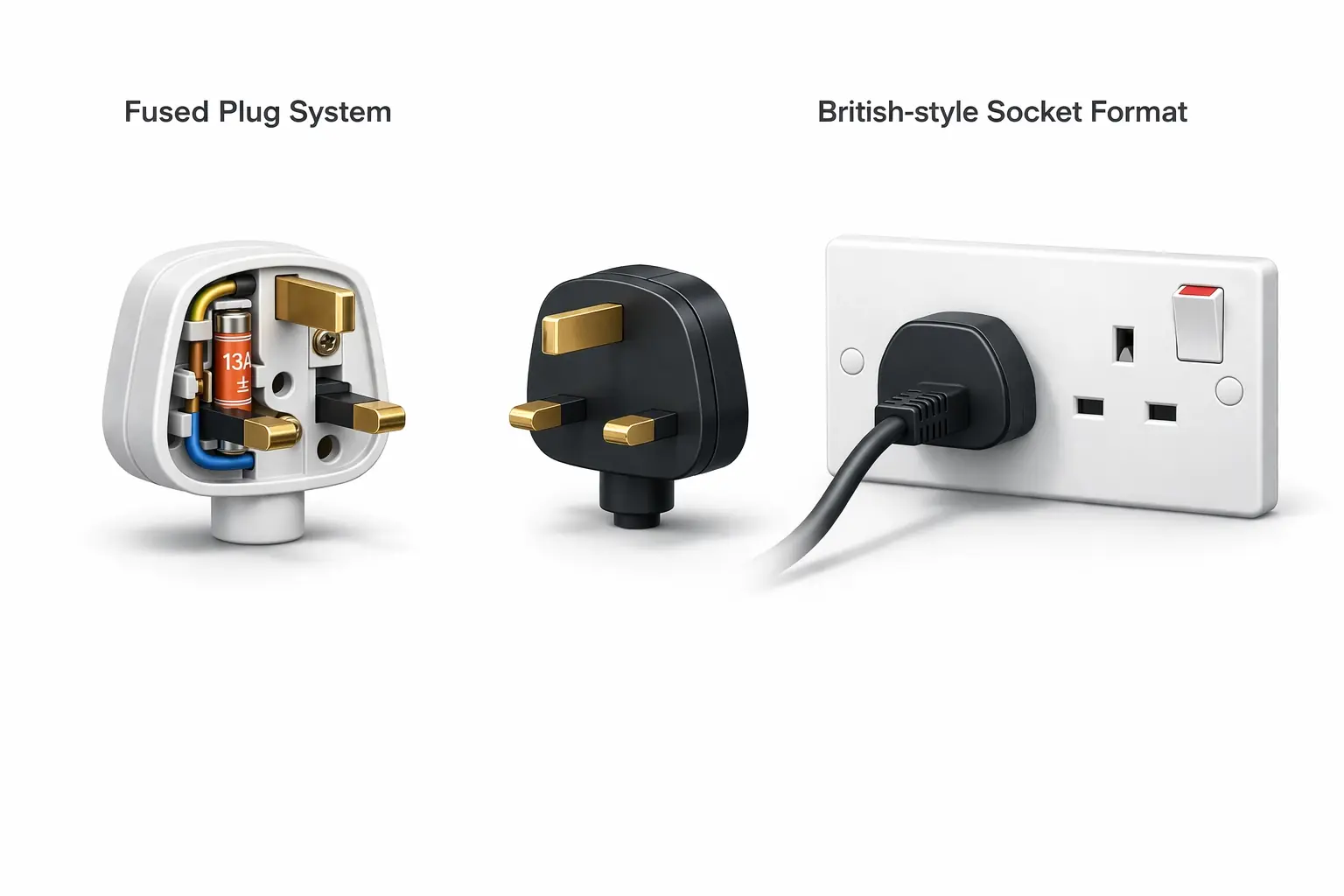
This scope difference affects system compatibility. BS1363 is associated with a defined plug and socket format and with market expectations around British-style system use. That includes the broader ecosystem commonly associated with fused plugs. Buyers therefore need to judge more than general product appearance. They need to confirm whether the product is actually aligned with the intended market system.
Compliance implications: what buyers must verify before importing or distributing
In an outlet standards comparison, document review is not enough unless the claimed standard also matches the destination market. Buyers should verify the standard reference, technical files, product description, and target sales region together. A product that looks like a British-style item does not automatically mean it is suitable for a BS1363 market.
Market fit: where each standard is more relevant commercially
Commercially, IEC 60884 is more common in broad export and multi-market sourcing. BS1363 is more relevant when the product will be sold into the UK or another British-style socket market. The key buyer question is not which standard is broader, but which one fits the actual market, channel, and compliance expectation.
| Aspect | IEC 60884 | BS1363 | Buyer impact |
|---|---|---|---|
| Scope | Broad international framework used in household plug and socket discussions. | UK-specific standard tied to a defined national system. | Helps buyers separate early technical screening from true destination-market fit. |
| Commercial use | Appears often in export-oriented quotations and multi-market sourcing files. | Matters more in UK and British-style socket channels. | Prevents buyers from using one document label for markets that need different positioning. |
| System expectations | Does not by itself define a British socket format. | Linked to the British plug and socket ecosystem, including fused-plug expectations. | Reduces the risk of product rejection caused by visual similarity without actual system alignment. |
| Document review | Useful in broad technical reference review. | Requires tighter product-description and market-document consistency. | Buyers need to review standard claim, socket format, labeling, and destination market together. |
Which Standard Matters More for Your Target Market
For UK-focused buyers and BS1363 product lines
If the target market is the UK or uses British-style socket systems, BS1363 usually matters more. Buyers need to confirm plug and socket compatibility, market expectations, and product suitability for that system.
For buyers serving multiple international markets
For products intended for several export markets, IEC 60884 often appears earlier in supplier discussions because it supports broad screening and cross-market evaluation. However, it does not by itself confirm suitability for a specific destination market.
For distributors balancing compliance, inventory, and product range decisions
Distributors must balance compliance confidence, stock efficiency, and product positioning. A British-style appearance or broad export wording does not prove BS1363 suitability. The standard that matters most is the one that matches the actual sales region, documentation requirements, and channel needs.
- UK-focused buyers should prioritize socket-system compatibility and BS1363 document consistency.
- Multi-market buyers can use IEC 60884 for screening, but should not treat it as a substitute for local market fit.
- Distributors should compare compliance risk, stock complexity, and channel expectations before consolidating product ranges.
How to Evaluate a Supplier When Comparing IEC 60884 and BS1363 Products
Questions to ask about certification, testing, and technical documents
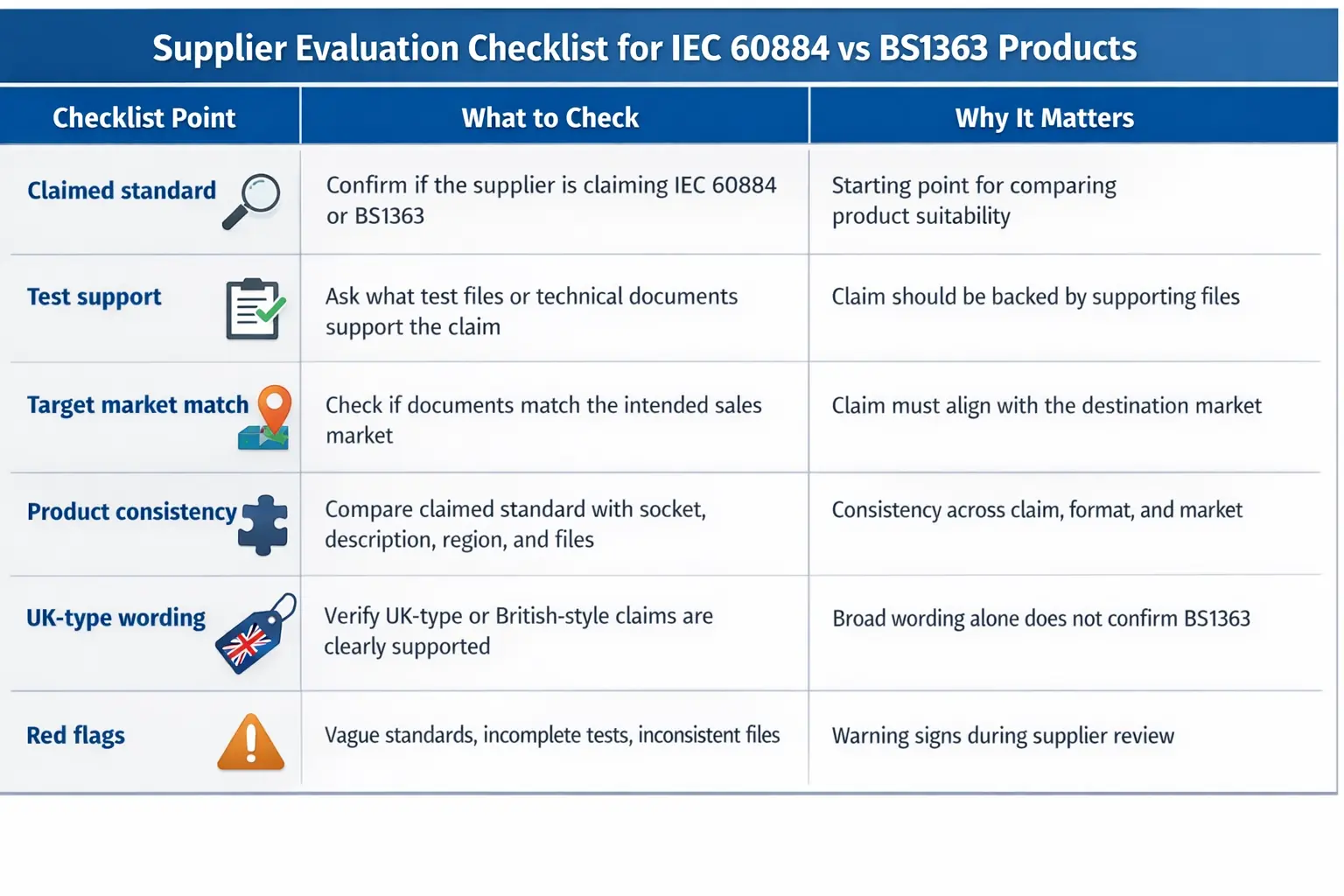
Buyers should start with documents, not appearance. Ask which standard is claimed, what test or technical files support it, and whether those files match the target market. If a supplier uses both IEC 60884 and BS1363 in the same product discussion, the buyer should understand whether that reflects true product scope or only loose sales wording. If the immediate question is how to read UK outlet standard wording versus a real BS1363-based claim before going deeper into specification review, see our UK wall outlet standard explained for buyers guide. If the buying context is already GCC distribution, project supply, or Middle East supplier screening, the cleaner next step is our BS1363 socket supplier guide for GCC buyers.
How to verify whether a product is truly designed for the target standard
Verification should focus on consistency between the claimed standard, socket format, product description, sales region, and supporting files. A product can be technically presented for international trade and still fail the buyer’s market-specific evaluation if those elements do not line up.
Red flags when standard claims are vague or incomplete
Red flags include vague use of IEC 60884 and BS1363, unclear UK-type claims, incomplete test references, inconsistent technical documents, or a mismatch between socket appearance and the destination-market claim. These are not small wording issues. They usually indicate weak product positioning or weak supplier control.
Supplier review checklist
- confirm which standard is being claimed for the exact model under discussion
- check whether test references and technical documents match the destination market
- review socket format, rating, labeling, and product description for consistency
- ask whether UK-focused products are presented as true BS1363 items or only as British-style lookalikes
- treat vague “international standard” wording as a risk signal until supporting files are verified
When to Use a Comparison Page Like This and When to Go Deeper
When buyers need a quick standard-selection overview
This page helps buyers compare IEC 60884 and BS1363 in terms of scope, market relevance, and sourcing impact. It is useful when the immediate question is which standard matters more for the intended sales channel.
When to continue to the full BS1363 specification page
If the product is clearly for British-style socket markets, buyers should continue to the full BS1363 specification page for detailed requirements, construction checks, ratings, and marking expectations.
When to review broader outlet standard and safety guidance
For wider multi-market research, buyers should also review broader outlet standard and electrical safety guidance. A comparison page clarifies the decision point, but it does not replace a full destination-market review, especially when the sourcing program covers more than one region.
FAQ: IEC 60884 vs BS1363 for Sourcing and Compliance
Is IEC 60884 the same as BS1363?
No. IEC 60884 is a broader international framework, while BS1363 is a UK-specific standard tied to a defined national socket system.
Can a socket comply with IEC 60884 but not BS1363?
Yes. IEC 60884 does not automatically mean BS1363 suitability. Buyers still need to confirm destination-market fit and British-style system compatibility.
Which standard should importers focus on for the UK market?
For the UK market, BS1363 is usually more relevant because it matches British-style socket requirements and associated documentation expectations.
Can importers source one socket type for all markets?
Not safely as a default assumption. Multi-market sourcing needs destination-specific review because one broad export claim does not guarantee market-level suitability everywhere.
How should wholesalers compare these standards before placing orders?
They should compare market fit, technical documents, socket-system expectations, and sales-channel relevance together instead of reviewing only one document label or one product image.
Conclusion
What buyers should take from this comparison
In IEC 60884 vs BS1363, buyers should focus on market fit, socket system, and compliance support rather than standard familiarity alone. IEC 60884 is useful in broad technical screening, but BS1363 matters more when the destination market expects British-style compatibility. The right choice depends on the actual region, channel, and documentation requirement behind the order.
How to use this page next
Use this page as a decision tool when comparing sourcing routes. If the project is UK-focused, continue deeper into BS1363 requirements. If the project spans several regions, continue with broader outlet-standard review before final supplier approval.