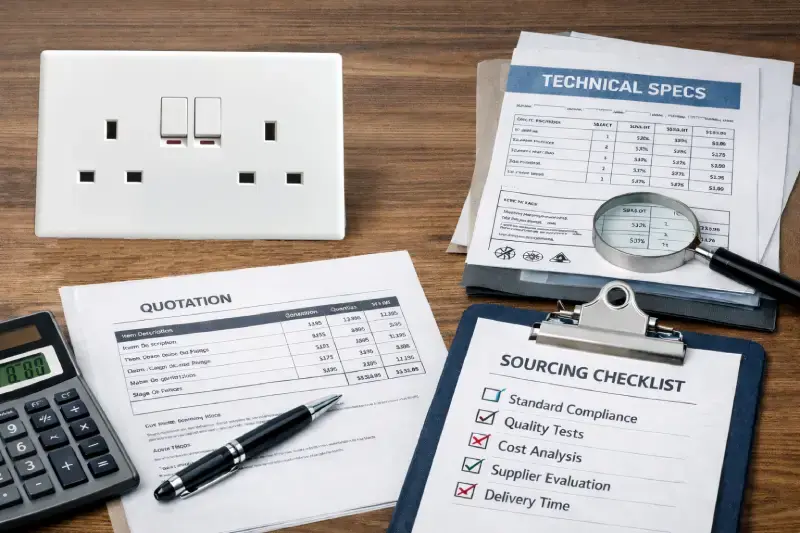
When buyers search for a UK wall outlet standard, they usually are not asking a theory question. They are trying to decide whether a product can be quoted, sampled, stocked, or explained to customers as a real UK-market socket without creating trouble later.
This page explains the gap between two very different ideas: UK-style outlet appearance and a real BS1363-based product claim. It is not the detailed datasheet page. It is the buyer-facing interpretation page that helps you decide whether the product should be treated as style only, standard-based, or too unclear to move forward.
The main risk is simple. A socket can look British from the front and still be too loosely defined to support a real BS1363 claim. If buyers miss that difference early, the problem usually appears in quotation comparison, sample approval, stock decisions, or customer communication.
Contents
- Start With One Question: Style or Standard?
- What UK Outlet Standard Usually Means
- Where Buyers Commonly Mix the Two Terms
- When Style Is Enough and When BS1363 Must Hold
- What Buyers Should Ask and Check Before Accepting BS1363 Claims
- From Quotation to Stock: How Buyers Should Decide
- When to Move Into a Detailed BS1363 Specification Review
- FAQ About UK Wall Outlet Standard and BS1363
Start With One Question: Style or Standard?
Start with one simple question: is the customer asking for a UK-style outlet, or for a product that can support a BS1363 claim?
Those are not the same thing. UK-style language usually describes front appearance, market familiarity, and the socket family the buyer wants. A BS1363 claim is stronger. It should point to one defined socket-outlet type, one stable rating, and one clear product version that is supported by matching sample, marking, quotation, packaging, and file wording.
If this is not clarified early, the buyer can go wrong from the start. The sample may be approved on appearance, the quotation may hide a weaker product definition, and the sales team may end up promising a standard claim the supplier cannot support later.
What UK Outlet Standard Usually Means
In real procurement, UK outlet standard usually works as market language. It helps identify a British-style socket family and distinguish it from other outlet types around the world.
That wording is useful in early screening because it tells the supplier which outlet family the buyer wants to discuss. But it is still broad. It does not prove product type, rating logic, marking support, or whether the quoted model really stands on a stable BS1363 basis.
So buyers can use UK outlet standard as a first filter, but not as final proof. It is market direction language, not yet a full product-definition answer.
What a BS1363 Claim Should Mean to a Buyer
A BS1363 claim should mean more than front appearance. For buyers, it should point to a defined UK 13A / 250V plug-and-socket system and one exact socket-outlet version, not a loose UK-style family that keeps changing depending on who is speaking.
At buyer level, this usually means the product can be identified clearly as something like a 13A switched socket outlet or 13A unswitched socket outlet, with the same wording holding across the sample, quotation, marking, packaging, and technical file.
| Screening layer | What buyers should see | Why it matters |
|---|---|---|
| Style screen | UK-style rectangular socket layout | Confirms the product family direction |
| Basic rating screen | Clear 13A / 250V logic | Shows the product is not being sold only by appearance |
| Definition screen | One stable socket-outlet type and model | Prevents quotation and sample drift later |
| Support screen | Matching sample, marking, packaging, and file wording | Shows the BS1363 claim can hold across the real product definition |
If those points do not stay aligned, buyers should stop treating the product as a stable BS1363-based item.
Where Buyers Commonly Mix the Two Terms
The confusion usually starts in supplier wording. A quotation may say UK standard socket, British standard outlet, and BS1363 socket in the same conversation, even though the model code, sample label, carton wording, and file set do not all point to one confirmed version.
That is how buyers get trapped. The front appearance looks right, so the language feels believable. But if the supplier is only describing style, the buyer may end up comparing unequal quotations, approving the wrong sample, or promising a standard-based product story that cannot be defended later.
A simple warning sign is this: the supplier says “yes, British standard,” but cannot answer one basic question clearly. What exact model is this? If that answer shifts from one document to another, the standard claim is not under control.
When Style Is Enough and When BS1363 Must Hold
Not every order needs the same level of proof. In some retail and wholesale channels, UK-style appearance is the first practical filter. The buyer may care mainly about shelf fit, price, packaging, finish, and replenishment speed. In that case, style can be the starting point.
But even then, the product still needs one clear commercial version. The sample, model code, quotation scope, and packaging wording should already match. Style-led buying is not an excuse for loose product definition.
The rule changes when the order involves engineering review, project supply, brand use, or stronger approval-side checks. In those cases, appearance is not enough. The buyer should verify whether the BS1363 wording is supported by matching product definition, marking, and file logic.
| Buying scenario | Main concern | Buyer action |
|---|---|---|
| Retail or wholesale shelf stock | Appearance, packaging, replenishment, price | Confirm one stable model, sample, packaging, and quotation scope |
| Distributor repeat stock | Stable product identity over later orders | Lock model code, sample, rating, and carton wording early |
| Project or engineering order | Defensible BS1363 wording and document support | Verify files, marking, rating, and exact product type |
| Brand supply | Risk of overclaiming to customers | Use BS1363 language only when the product definition can hold consistently |
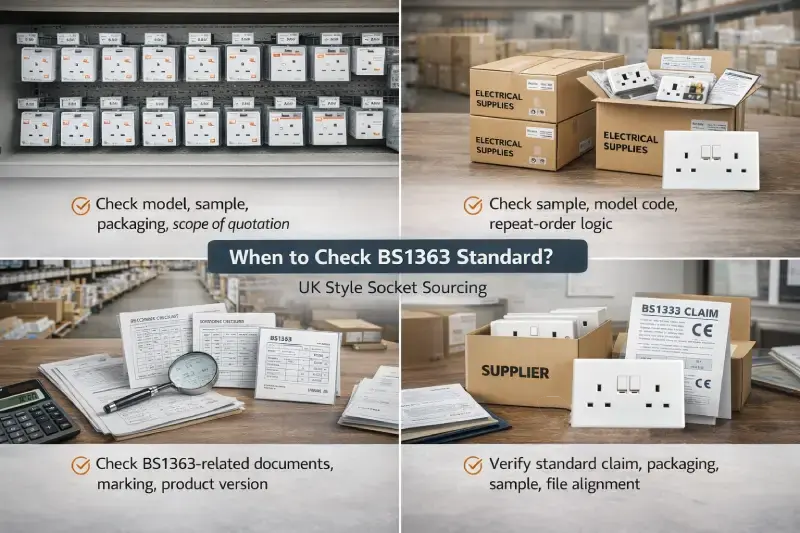
Why This Matters in Middle East Import and Distribution
In many Middle East channels, UK-style socket demand is commercially important. But that does not mean every customer reads UK wording the same way. One buyer may mean shelf-ready British-style appearance. Another may mean a product that can be discussed as a real BS1363-based item in project, engineering, or branded supply.
That difference changes the whole sourcing approach. A price-led wholesale customer may mainly care about appearance, finish, and packaging. A project customer may care about standard wording, technical support, and whether the claim can be defended without backtracking later.
If importers treat those two demand types as if they were the same, the product definition becomes unstable very quickly. That is why this page is useful before jumping into either a broad standard electrical outlet guide discussion or a deeper specification review.
What Buyers Should Ask and Check Before Accepting BS1363 Claims
Do not accept UK standard as a finished answer. Make the supplier define what the claim actually means.
Start with one direct question
When you say UK standard, do you mean UK-style appearance, or do you mean this exact model supports a BS1363-based claim?
Then move to the exact product definition
- What is the exact model code?
- Is this a 13A switched socket outlet or a 13A unswitched socket outlet?
- Does the sample show the same rating and wording as the quotation?
- Does the carton use the same product description?
- Does the datasheet describe the same version?
- Are the documents meant for internal review only, or for customer confirmation and project use?
If the supplier cannot answer those points clearly, the wording is not stable enough for serious buying decisions.
Then verify whether the claim can really hold
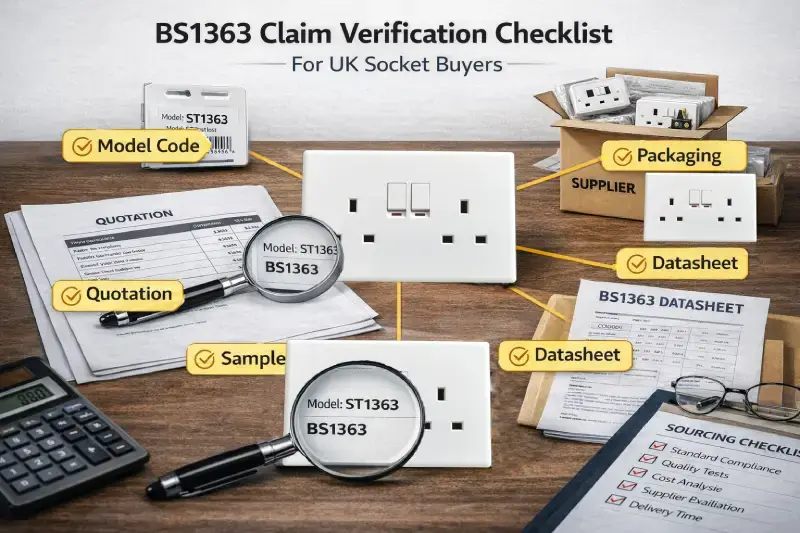
Before accepting a BS1363 claim, buyers should check four things: product type, rating, model identity, and support consistency. If the buyer is working on GCC or Middle East orders where marking, FUSE covers, BOM materials, USB modules, and carton labels must all stay aligned, our BS1363 approval and marking checklist for GCC buyers gives the next-level review path.
First, the quotation and file should identify the socket clearly as a defined product type. If the supplier only says UK socket or British standard outlet, the definition is still too broad.
Second, the rating and visible marking should make sense at buyer level. The sample should normally show a clear rating such as 13A / 250V, together with readable product identity information.
Third, the model code and wording should match across quotation, sample label, carton wording, and datasheet. Fourth, the supplier should be able to explain the claim in one stable sentence instead of switching between several labels depending on the conversation.
| Check point | What should match | Red flag |
|---|---|---|
| Product type | Defined as 13A switched or 13A unswitched socket outlet | Supplier only says UK socket or British standard outlet |
| Rating | Sample, quotation, and file all support 13A / 250V | Rating is vague, missing, or inconsistent |
| Model code | One code appears across quote, sample label, carton, and datasheet | Different codes or only a broad series name appears |
| Marking and support files | Marking and documents support the same product version | Sample looks right, but file and marking logic do not hold |
From Quotation to Stock: How Buyers Should Decide
When buyers mix UK outlet standard and BS1363 as if they were equal, the first damage usually appears in quotation comparison. One supplier may quote a broad UK-style socket, while another quotes a more clearly defined BS1363-based version with stronger marking, packaging, and file support. The lower price may simply reflect a weaker definition, not a better commercial offer.
The same risk appears at sample stage. A socket may look right from the front, but that is not enough. If the rating, model code, marking, or datasheet do not match the quotation, the buyer is not approving one stable BS1363-based product.
Stock decisions carry the biggest risk. A loosely defined UK-style socket may still move in some price-led channels, but become difficult once customers ask for stronger proof. That is how inventory turns from a product opportunity into a communication and approval problem.
| Stage | What can go wrong | Buyer action |
|---|---|---|
| Quotation | UK-style and BS1363-based products are compared as if they are equal | Lock the exact version before comparing price |
| Sample | Front appearance looks right, but rating, marking, or file logic does not match | Check sample, model code, marking, packaging, and file together |
| Customer communication | Sales teams use BS1363 wording without support | Use standard wording only when the product definition can hold |
| Stock | Product looks sellable but becomes weak once project questions begin | Keep it for style-led channels only, or verify before stocking |
Buyer Decision Framework: Style, Standard, or Stop
Use three simple outcomes before moving forward.
Style means the customer mainly wants UK-style appearance, one clear commercial version, and reasonable channel fit. In this case, confirm sample, packaging, and quotation scope, but do not overstate the standard claim.
Standard means the order depends on a real BS1363-based claim supported by matching sample, rating, marking, packaging, and documents. In this case, appearance is only the starting point.
Stop means the supplier cannot explain which one applies, or the sample, quotation, marking, and files do not support the same version. If the claim cannot be locked clearly, do not approve the quote or build stock around it.
When to Move Into a Detailed BS1363 Specification Review
Move into a detailed BS1363 wall socket specification review when the order depends on proof, not just market wording. Once the customer asks about shutter details, terminal structure, construction requirements, markings, test basis, or conformity support, appearance-based language is no longer enough.
If the next question is how UK-specific socket logic differs from broader household socket frameworks, our IEC 60884 vs BS1363 comparison is the cleaner next step.
FAQ About UK Wall Outlet Standard and BS1363
Is UK wall outlet standard the same as BS1363?
No. UK wall outlet standard usually describes socket style or market wording. BS1363 is a stronger product claim that should be supported by a stable product type, rating, marking, and matching files.
Does a UK-style socket automatically mean BS1363 compliance?
No. Front appearance does not prove BS1363 compliance or project-ready support. Buyers should verify the exact model, rating, marking, packaging, and technical wording before using BS1363 language with customers.
What should buyers check first before accepting a BS1363 claim?
Check whether the socket is clearly defined as one product type, usually a 13A switched or unswitched socket outlet, and whether the sample, rating, model code, quotation, packaging, and file wording all point to the same version.
How does this affect quotation comparison?
It stops buyers from comparing a broad UK-style offer with a tightly defined BS1363-based offer as if they were equal. The cheaper quote may simply be based on a weaker product definition.
Should Middle East distributors stock UK-style sockets without checking BS1363 claims?
Only for clearly style-led wholesale or retail use. If the product may enter project, engineering, or branded supply channels, the BS1363-related claim should be checked before stocking. If the next question is how GCC importers, distributors, and project buyers should screen suppliers, shipment risk, OEM support, and repeat-order control around that same socket family, continue to our BS1363 socket sourcing guide for Middle East projects.
Conclusion
Do not read UK wall outlet standard by appearance alone. First decide whether the request is for UK-style appearance, a real BS1363-based product claim, or a level of proof the supplier cannot support clearly. Then confirm the exact version, quotation scope, sample, rating, marking, packaging, and documents before quoting, approving, or stocking the product.