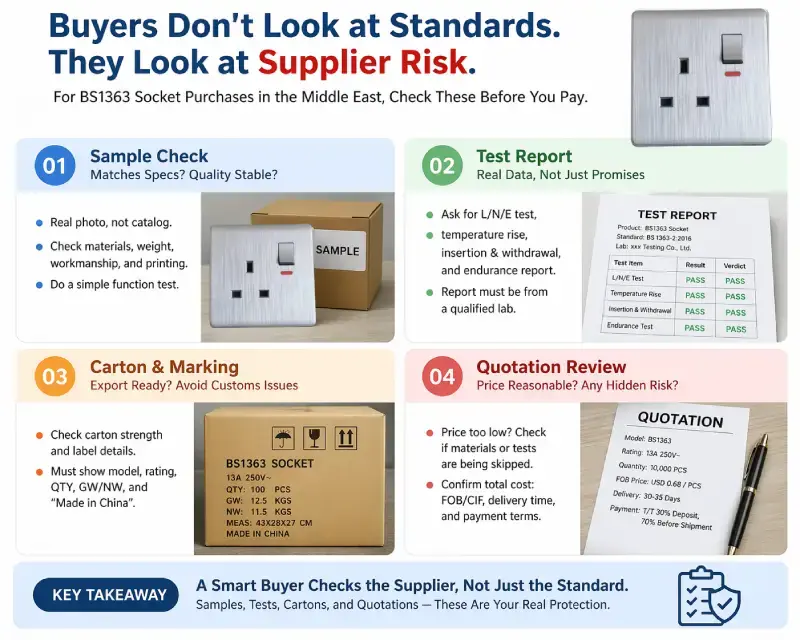
Buyers searching for a BS1363 socket Middle East offer are usually not looking for a standard explanation. They are trying to avoid a weak supplier, an unstable product version, or a shipment that creates loss after approval.
For GCC importers, distributors, and project buyers, the question is practical: can this supplier keep the product, file set, delivery, and margin stable across repeat orders?
Based on export quotation review, repeat-order follow-up, packing-claim handling, and OEM project support in GCC-facing wiring-device business, the most expensive problems usually do not start with one dramatic defect. They start when a supplier looks acceptable at sample stage but cannot keep the same control logic through production, shipment, and replenishment.
Contents
- Why Middle East Buyers Search for BS1363 Sockets Instead of Generic Wall Sockets
- How Buyers Verify What They Are Really Buying Before the First Container Ships
- How Buyers Protect Margin When BS1363 Sockets Become a Commodity
- What Buyers Should Ask About Lead Time, Packing, Documents, and Copper-Price Warning
- What Middle East Buyers Expect from OEM Support, Territory Protection, and USB Fast-Charging Growth
- FAQ About BS1363 Socket Suppliers in the Middle East
- Conclusion
Why Middle East Buyers Search for BS1363 Sockets Instead of Generic Wall Sockets
In GCC business, the BS1363 outlet standard is already familiar across apartments, villas, hotels, and light commercial interiors. The real issue is supplier risk, not socket type.
That risk usually appears in four places. A good sample may be followed by weaker production if copper thickness, fire-retardant material grade, or internal structure changes. Standard white models quickly fall into price wars. Unstable lead time causes stock breaks and lost distributors. Heavy socket products also create freight, packing, and clearance problems if cartons, loading logic, or documents are weak.
| Risk Area | What Goes Wrong |
|---|---|
| Sample to production | A good sample may be followed by weaker production if copper thickness, fire-retardant material grade, or internal structure changes. |
| Commodity pressure | Standard white models quickly fall into price wars. |
| Delivery stability | Unstable lead time causes stock breaks and lost distributors. |
| Shipping and clearance | Heavy socket products also create freight, packing, and clearance problems if cartons, loading logic, or documents are weak. |
How Buyers Verify What They Are Really Buying Before the First Container Ships
Which compliance proof should already exist before quotation moves forward
A serious supplier should show valid files for the exact quoted model, not just a similar series. In GCC business, buyers often look for G-Mark, and many also treat ASTA or equivalent BS1363-related testing as a strong credibility signal. “We can apply” is not compliance readiness. It means the quoted product is still not ready for approval-safe business. For a more detailed review of marking, FUSE covers, BOM consistency, USB module matching, and carton traceability, use our BS1363 approval and marking checklist for GCC buyers.
Which product details and files must be fixed before mass production
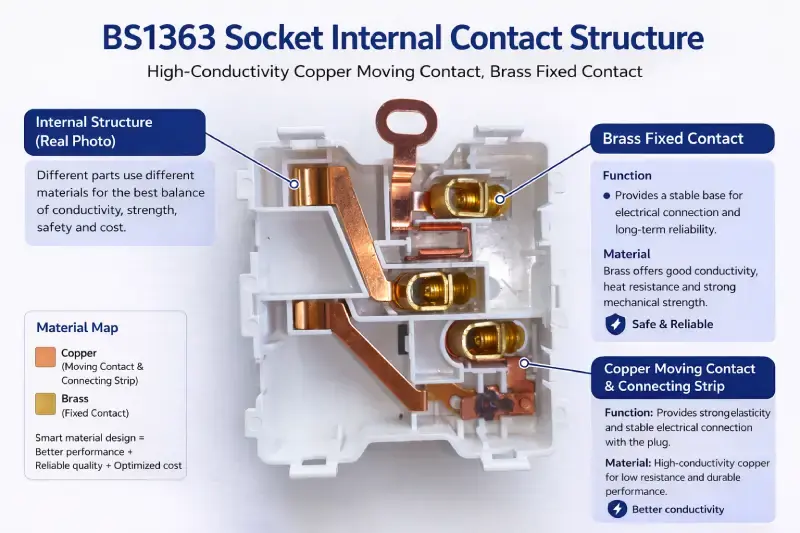
Before production starts, the product definition should already be fixed. For BS1363 sockets, that usually means copper thickness, fire-retardant material grade, and contact structure. In better-controlled designs, the conductive material map is not the same across every part. The moving contact and connecting strip may use higher-conductivity copper, a point explained further in our guide to how conductor material affects overheating risk, while the fixed contact remains brass. That arrangement supports conductivity and contact performance without pushing cost unnecessarily high.
The quotation, approved sample, datasheet, carton marking, and test report should all point to the same model and the same structure. If one file stays broad while the others stay specific, the buyer is no longer controlling one fixed socket. “Same series,” “small change is okay,” “we can adjust based on price,” and “same as before” are all red-flag answers.
Why similar BS1363 quotations are not comparable until the version is locked
A lower quote does not automatically mean a more efficient supplier. In many BS1363 socket Middle East offers, the lower price comes from thinner copper parts, lower material grades, simplified internal structure, or weaker repeat-order control. Two suppliers may use similar wording, but the actual product level may still be different. Compare fixed specifications before FOB price. Before that point, a lower number may only mean a weaker product.
How Buyers Protect Margin When BS1363 Sockets Become a Commodity
Why standard white sockets fall into price wars and which upgrades still support margin
Once a BS1363 socket becomes a standard white commodity, price pressure follows quickly. Buyers who want healthier margin need versions that are harder to compare line by line with entry-level stock. A standard white faceplate still works in cost-driven jobs, but once every supplier offers the same look, same function, and the same quotation language, margin disappears first. That is why serious buyers look for upgrades that change channel positioning instead of only adding decorative detail.
How slim design, premium finishes, and modular looks improve resale value
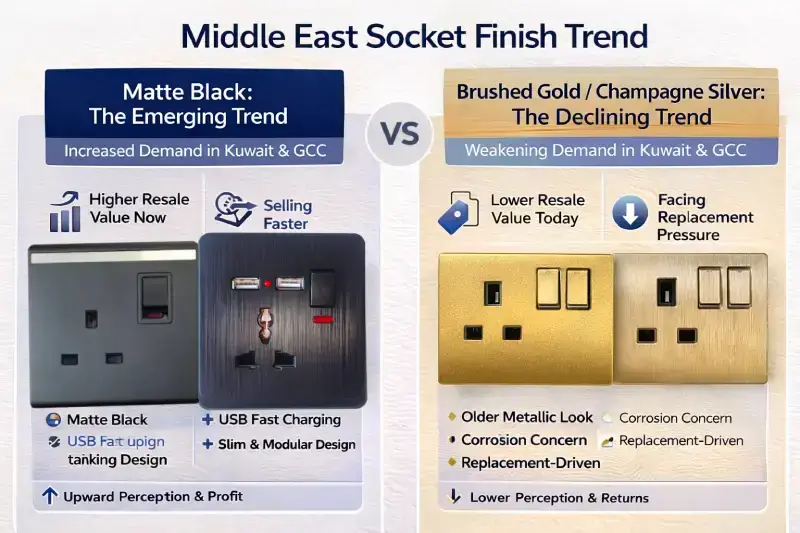
In Kuwait and similar GCC channels, older decorative demand favored brushed gold and champagne silver. As minimalist hotel and residential styles became more influential, demand moved toward matte black, brushed black, soft-touch black, and other low-gloss black finishes.
That shift is commercial, not just visual. Black-finish versions can carry a higher end-market price and still sell faster than older gold or silver styles. One reason is style. Another is environment. In high-salinity Middle East conditions, older metallic decorative finishes are more exposed to visible oxidation marks over time, which is one reason they are moving toward lower-end replacement demand instead of higher-margin project use.
Not every premium-looking feature creates the same willingness to pay. In practical shipment experience, USB-C fast charging and ultra-thin borderless design or flat-profile styling are the upgrades buyers accept as real value. Brushed metallic faceplates may still face price pressure because buyers in coastal markets such as Dammam worry about salt-air corrosion and surface aging.
| Finish or Upgrade | Commercial Direction |
|---|---|
| brushed gold and champagne silver | moving toward lower-end replacement demand instead of higher-margin project use |
| matte black, brushed black, soft-touch black, and other low-gloss black finishes | can carry a higher end-market price and still sell faster than older gold or silver styles |
| USB-C fast charging and ultra-thin or flat-profile design | the upgrades buyers accept as real value |
What Buyers Should Ask About Lead Time, Packing, Documents, and Copper-Price Warning
Why stock breaks matter more than late production
For distributors and project buyers, the real cost of delay is the stock break that follows. Once a fast-moving item disappears from the warehouse, buyers risk losing shelf space, delaying supply, and pushing contractors or sub-distributors toward another brand.
Which shipping and document mistakes create avoidable cost
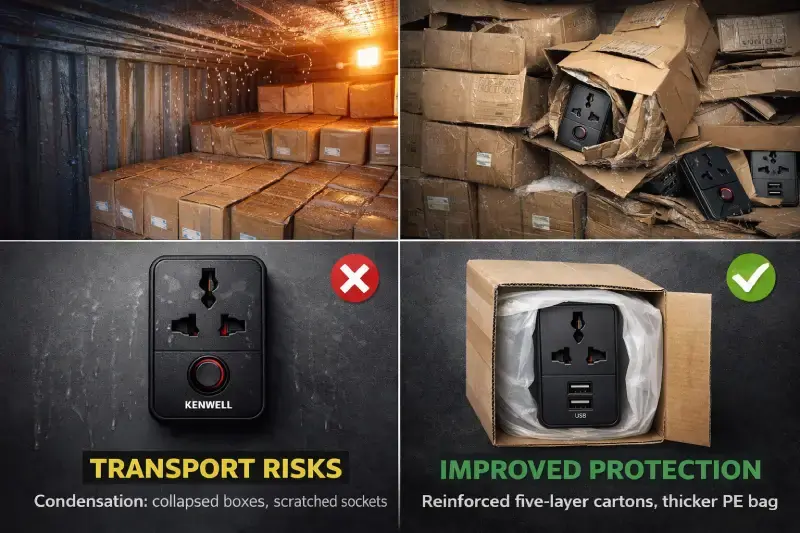
Shipment control matters as much as product approval. Socket products are heavy because of their metal parts, so poor loading logic raises freight cost quickly. Weak cartons, incorrect carton marks, or errors in the packing list, invoice, or origin documents can all create avoidable storage charges and clearance delays.
A common failure appears after long container exposure in places such as Dubai. Strong daytime heat followed by cooler nights creates condensation inside the container. Once cartons absorb moisture, stacking strength drops under the weight of the sockets. Lower cartons start leaning, inner color boxes get crushed, and faceplates rub against debris or adjacent products during transport.
This problem is more visible on dark finishes. Black and matte panels show surface scratches much more easily under light, so export packing cannot be treated as a minor logistics detail. In practice, reinforced five-layer cartons built with heavier paper combinations such as 250g+180g, together with thicker PE bags, are often necessary to reduce transport damage on darker finishes.
Why buyers want copper-price warning before the order
A low quote helps only if it stays usable. Buyers often want early warning when copper cost pressure may affect validity, especially on larger-volume orders. A disciplined supplier should explain the quotation window, signal whether material pressure is rising, and advise whether the buyer should lock pricing early rather than wait for a later adjustment.
What Middle East Buyers Expect from OEM Support, Territory Protection, and USB Fast-Charging Growth
Why deep OEM support and territory discipline matter in serious GCC cooperation
Large GCC buyers usually need more than a basic brand mark on a standard socket. Serious OEM support includes finish selection, packaging style, catalog presentation, and product positioning that fit local retail or project expectations. If you need the broader capability background behind that kind of cooperation, our OEM and ODM wall switch and socket capability guide explains how buyers usually judge scope, standards, and market fit. Logo printing is basic. Market-facing adaptation is where margin starts.
At higher annual volume, that kind of cooperation also changes the commercial expectation. If the same design, finish, and packaging can be sold immediately to another distributor in the same region, the buyer carries brand-building cost without real market protection. For that reason, territory discipline often becomes part of supplier evaluation once the relationship moves beyond simple private labeling.
What buyers should ask about USB A+C compliance and stability
USB A+C sockets can open a stronger margin segment, but they should not be treated as a standard BS1363 outlet with one extra feature. Once charging ports are integrated, buyers should no longer assume that the traditional socket file covers the whole product.
In GCC compliance practice, the charging function introduces an additional electronic safety pathway. GSO has adopted IEC 62368-1 as a Gulf standard, and IEC 62368-1-based safety evaluation may become relevant for the charging function depending on product classification, certification route, and market requirement. That is why buyers should confirm not only the socket-side file, but also which safety file set actually covers the charging module. In practice, approval logic should be treated as product-specific, not assumed from one broad USB claim.
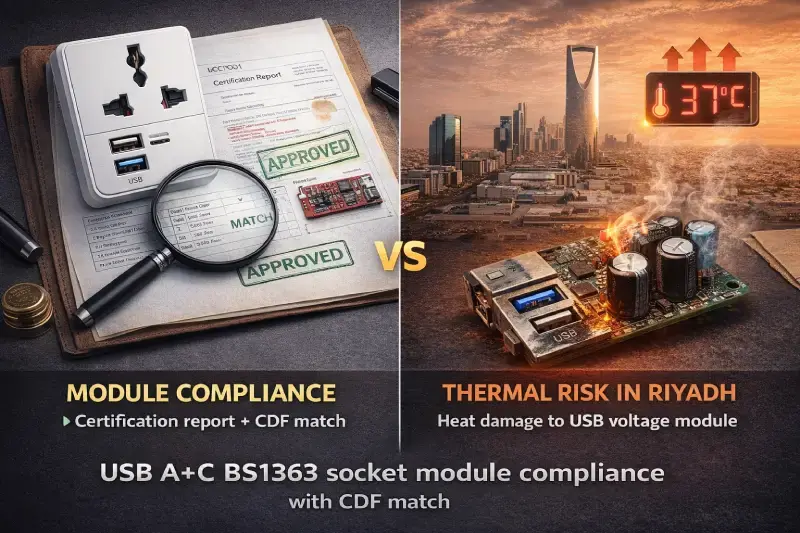
The larger risk is field stability, not only paperwork. A USB module that performs well in a laboratory at around 25°C may behave very differently in Riyadh when indoor ambient temperature stays above 35°C because air conditioning is intermittent. Under that heat load, electrolytic capacitor life drops sharply, and a common engineering rule of thumb is that every 10°C rise can roughly halve service life. The protocol control chip may then start triggering thermal protection, causing intermittent charging cut-off.
There is also a file-integrity risk. In one common failure pattern, a supplier submits a USB module from Factory A for certification, then switches to a cheaper module from Factory B in mass production. During customs inspection, once the housing is opened, the actual PCB components can be checked against the CDF and the certified component record. If the capacitor brand, transformer model, or other critical parts do not match, the issue becomes a product-integrity problem, not a simple paperwork gap.
Review basis used in this page: GCC quotation comparison, sample-to-bulk consistency checks, repeat-order follow-up, packing and shipment-risk review, USB module file-integrity review, and buyer-side evaluation of approval readiness for BS1363 socket programs. This page supports buyer review and supplier evaluation. It does not replace market-specific legal, customs, or certification advice.
FAQ About BS1363 Socket Suppliers in the Middle East
What certifications should a BS1363 socket supplier already have for Middle East business?
Buyers should expect product-specific compliance files, not broad factory claims. Depending on the market and project type, that may include G-Mark, current BS1363-related test reports, and other required documents that match the quoted model.
How can buyers verify batch consistency before placing large orders?
Lock the product definition before production starts. The quotation, approved sample, datasheet, carton marking, and test file should match one model, with copper thickness, material grade, and internal structure clearly fixed.
Why do similar BS1363 quotations carry very different risk?
Because similar wording does not guarantee the same product level. A lower quotation may reflect weaker materials, looser internal control, or a broader specification that still leaves room for change after approval.
What kind of OEM support matters in the GCC market?
Useful OEM support goes beyond branding. Buyers often need help with finish selection, packaging style, catalog presentation, and market-facing details that make the product easier to position and harder to compare as a pure commodity.
Are USB A+C BS1363 sockets harder to approve than standard versions?
In many cases, yes. A USB version adds another technical layer, so buyers should confirm safety-file coverage for the charging function, thermal stability in regional operating conditions, and repeat-order consistency in the USB module as well as the socket body.
Conclusion
The real question is not which BS1363 socket Middle East offer looks cheapest at quotation stage. It is which supplier can keep the product stable, the file set aligned, the shipment protected, and the margin defensible after the first order. A reliable wall socket supplier Middle East buyers can scale with is defined by repeat-order discipline, commercial transparency, and product choices that still hold up in actual GCC market conditions.