Choosing the right electrical outlet is not just a quotation exercise. For buyers, importers, and distributors, the real task is to remove the models that are likely to create market mismatch, approval delays, weak sell-through, or unstable repeat orders before they move from sample stage into stock risk.
This page is a buyer decision guide, not a basic standards glossary. It focuses on outlet selection logic: how destination market, socket system, sales channel, sample approval, and repeat-order reliability work together. If the buyer needs standards background first, start with the standard electrical outlet guide.
The right outlet is usually not the one with the broadest claim. It is the one that fits the target market, is easy to position in the intended channel, matches approval logic, and can stay commercially stable across later orders.

Contents
- Why the Wrong Outlet Creates Real Business Risk
- What Buyers Must Define Before Comparing Outlet Models
- How to Choose Outlet Types Based on Market and System Fit
- How Sales Scenario Changes the Right Outlet Choice
- How Environmental Conditions Change Outlet Selection
- What Buyers Should Confirm Before Sample Approval
- Why Bulk Orders Fail Even After Sample Approval
- What Buyers Should Confirm Before Placing a Bulk Order
- Common Outlet Selection Mistakes That Create Unsellable Stock
- How to Review Supplier Claims in an Outlet Selection Process
- Buyer Checklist: How to Choose an Electrical Outlet That Can Sell and Reorder
- FAQ: How to Choose the Right Electrical Outlet
Why the Wrong Outlet Creates Real Business Risk
A workable price and acceptable quality are not enough if the outlet does not match the destination market. Wrong-fit models slow approval, weaken channel confidence, create extra explanation burden, and turn into dead stock, discount pressure, and weak repeat orders. The real job is to remove commercially wrong models before quotation comparison becomes the main discussion.
What Buyers Must Define Before Comparing Outlet Models
Buyers should define the destination market, channel, installation method, and panel format before comparing models. Without that, comparison starts from the wrong basis. The same socket standard can still fail commercially because size, layout, module form, color preference, or local use habits are wrong. If the buyer still needs to confirm what systems are common by country, the best starting reference is electrical outlet types around the world.
| Market example | What buyers often assume | What really matters | Commercial lesson |
|---|---|---|---|
| Iraq | British-style or multi-function means the model should be broadly sellable | Mainstream market demand is usually 86 x 86, while only a smaller northern share prefers 146 x 86; hotel projects may also need combined gang units rather than single 86-type switches | The standard alone is not enough. Panel size and module format still decide whether the product can move smoothly. |
| Jordan | If British, European, or Italian formats are all present, any matching standard should work | The market still leans heavily toward 118-type dimensions, so even a technically correct standard can become commercially weak if the size is wrong | Correct standard plus wrong dimensions is still a slow-moving product. |
| Saudi Arabia | Once the model and standard are right, color is a secondary issue | Color preference can shift sharply. Gold and silver once sold strongly, but in recent years black has become the dominant hot-selling finish | Correct model with the wrong color can still weaken sell-through. |
| Nigeria | Oversized modern panels will replace older styles everywhere | Many buyers still prefer the more familiar thumb switch format | Design trend alone does not override installed habit and market familiarity. |
Before selection starts, buyers should also know what ratings, markings, drawings, and descriptions must align for approval. In practice, outlet choice depends on a full combination of market demand, socket system, size, style, color, installation method, use scenario, sales method, and local environment. If those points are still floating, the buyer is not comparing products yet, only unfinished assumptions.
| Decision factor | What buyers should confirm | Typical mistake | Result if ignored |
|---|---|---|---|
| Market demand | What format, finish, and visible style the channel already accepts | Choosing by supplier recommendation instead of actual local demand | Slow stock movement and weaker repeat orders |
| Product specification | Socket system, rating, module logic, and model definition | Assuming a broadly described product can fit several systems equally well | Approval friction and more buyer-side explanation burden |
| Size and panel format | 86-type, 118-type, 120-type, 146-type, or linked combinations | Getting the standard right but the dimensions wrong | Weak sell-through even when the outlet is technically usable |
| Color and finish | Which finishes actually sell in the target market now | Treating color as a minor detail | Correct model with weak market acceptance |
| Sales method | Retail, wholesale, project supply, or local assembly route | Using the same model logic for all channels | Wrong positioning and poor reorder logic |
| Use environment | High heat, salt mist, humidity, or waterproofing exposure | Choosing by appearance without checking environmental fit | Faster complaints, return risk, and weaker channel trust |
| Brand strategy | Whether the line is for factory branding, private label, a new brand launch, or an established brand range | Using the same outlet logic for every brand stage and channel position | Weak product identity, weaker pricing power, and unstable repeat business |
How to Choose Outlet Types Based on Market and System Fit
A market-specific outlet is usually the safer choice when the destination market, installation method, and sales logic are already clear. The standard electrical outlet guide helps define that baseline. Universal or multi-standard claims usually increase review pressure, not reduce it. If the buyer needs to compare that tradeoff directly, the next step is universal socket vs standard outlet.
How Sales Scenario Changes the Right Outlet Choice
Wholesale buyers should prioritize sell-through stability over feature flexibility. Retail usually needs familiar format and easy explanation. Project supply depends more on configuration fit, approval support, and document alignment. Importers also need to think beyond the first order: a strong model must support repeat orders, matching accessories, and stable positioning over time.
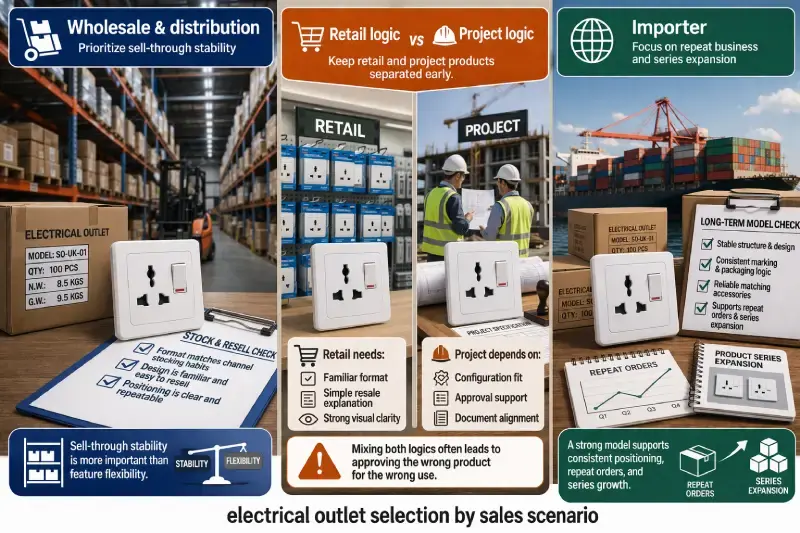
Regional buying habits usually matter more than catalogue trend. Some Southeast Asian markets prefer simpler styling. India changes appearance faster, so a flexible platform matters more than one fixed look. Nigeria still favors thumb switches in many channels even when oversized plates appear more modern in samples.
Hospitality projects add another layer. In Iraq, hotel switch demand may not be centered on a single 86-type outlet face at all; buyers may instead need linked multi-gang combinations that fit bedside and room-control logic better. In Bangladesh, high duty and tariff pressure can make SKD import the stronger commercial route, which means buyers must care much more about whether the product is easy to assemble locally rather than only how it looks in a finished sample.
| Use scenario | What usually matters more | What buyers often underestimate |
|---|---|---|
| Hotel or hospitality project | Linked combinations, bedside control logic, convenience modules, visual consistency | A hotel project may need combined units rather than simple single-gang retail faces |
| School or public building | Durability, stable structure, easier maintenance, lower complaint risk | Heavy daily use can punish decorative or less robust models quickly |
| Villa or high-end residential compound | Style, finish, coordinated appearance, and more visible design choice | Color and finish can affect acceptance more than buyers first expect |
| Mass residential building | Familiar standard, stable dimensions, easier resale and replacement logic | Overly flexible or unusual products can weaken later stocking and maintenance |
| Retail self-operated store | Visual clarity, easy explanation, familiar fast-selling models | Broad-claim products can be harder to explain to walk-in buyers |
| Wholesale distribution | Repeat stocking stability, clearer channel positioning, easier classification | One-time sample appeal does not guarantee reorder strength |
In wholesale business, catalogue specs are not enough. Electricians, installers, and shop owners still influence what gets recommended. If the outlet is hard to wire, hard to dismantle, lacks expected child protection, or has weak paint durability, channel push drops even when the price is acceptable.
| Wholesale check point | Why it matters | What goes wrong if ignored |
|---|---|---|
| Electrician-friendly opening and dismantling | Installers are more willing to recommend products that are easier to wire, open, and service | Electricians stop pushing the model even if the end customer price is acceptable |
| Terminal layout and installation convenience | Cleaner installation reduces complaint risk and speeds up repeat work | The product gains a reputation for being troublesome on site |
| Child protection | In many family and public-use channels, this is part of expected product safety | Retailers and buyers may treat the model as commercially weaker or less trustworthy |
| Paint and surface wear resistance | Retail handling, repeated cleaning, and daily use quickly expose weak finishing | Good-looking samples turn into poor-looking stock and weaker shelf confidence |
How Environmental Conditions Change Outlet Selection
Environmental fit should be screened early. High-temperature markets need better housing and conductor stability. Salt-mist or humid regions put more pressure on metal quality and corrosion resistance. Outdoor, semi-outdoor, or wet-use points should be separated from normal indoor outlets instead of being forced into one selection logic.
- high-temperature markets need stronger confidence in housing material, conductor quality, and internal contact stability
- salt-mist or humid regions raise the importance of corrosion resistance and metal quality
- wet or exposed installation points should be screened separately rather than forced into the same outlet decision as dry indoor areas
What Buyers Should Confirm Before Sample Approval
Before sample approval, buyers should confirm that model identity, outlet structure, claimed compatibility, rating, dimensions, panel size, and installation method all match one product logic. The sample should also align with the files and checks described in the electrical outlet safety standards guide. If the sample, datasheet, and drawings do not align, the buyer is not confirming one fixed product.
Why Bulk Orders Fail Even After Sample Approval
Sample approval often protects only the sample version. Bulk orders fail when marking, structure, packaging, or configuration drift later, or when the supplier defines a broad family but the buyer assumes one fixed commercial model. Weak model definition turns one approved sample into multiple bulk variations and creates complaint risk.
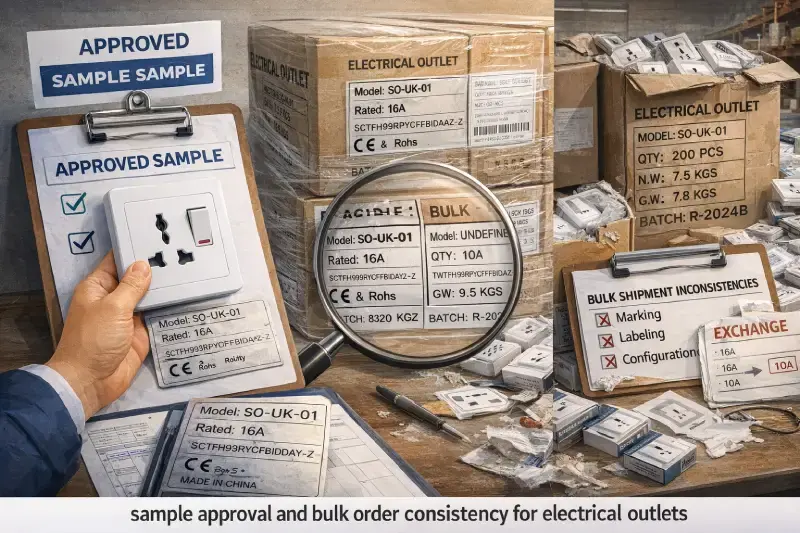
What Buyers Should Confirm Before Placing a Bulk Order
Before placing a bulk order, buyers should confirm that files, packaging, labeling, accessories, and the approved sample all match one model definition. Repeat-order reliability depends on whether the factory can keep structure, marking, packaging, and configuration stable over time. This is especially important in markets where demand changes through appearance rather than the internal platform. If India changes outer style quickly, or Saudi demand shifts toward black finishes, the stronger supplier is the one that can keep the internal platform stable while changing the visible design cleanly.
Brand strategy should also be defined before ordering. A private-label program needs stronger control over packaging, finish consistency, and later style updates than a simple factory-brand resale business. New brands usually need safer fast-moving models first, while older brands can support clearer product tiers.
- factory-brand resale usually benefits from familiar fast-moving models and lower explanation burden
- private-label business needs stronger packaging control, visual consistency, and product-platform stability
- new brands usually need safer commercial choices that build trust before expanding style variety
- older brands can separate outlet lines more clearly by price band, finish, and project level
Common Outlet Selection Mistakes That Create Unsellable Stock
- Choosing by quotation first and market logic second. A competitively priced outlet can still become slow-moving stock if it does not fit the target market.
- Mixing retail, distribution, and project products in one selection process. The wrong outlet then gets approved for the wrong commercial use.
- Trusting appearance as proof of compatibility. Familiar-looking products do not automatically match the correct socket system or channel logic.
- Approving a product before documents, marking, and use case fully align. That creates avoidable approval trouble, stock risk, and later rework.
- Treating one good sample as proof of stable mass production. Sample success and repeat-order reliability are not the same thing.
How to Review Supplier Claims in an Outlet Selection Process
Buyers should expect the datasheet to define model, structure, rating, visible marking, installation method, and intended market use clearly. Terms such as international type, widely used, multi-market, or safe design do not prove real market fit. The key test is whether the supplier can hold one approved model consistently across sample, files, packaging, and bulk production. For teams still screening factory stability more broadly, the next reference should be how to choose a reliable electrical wall switch and socket manufacturer.
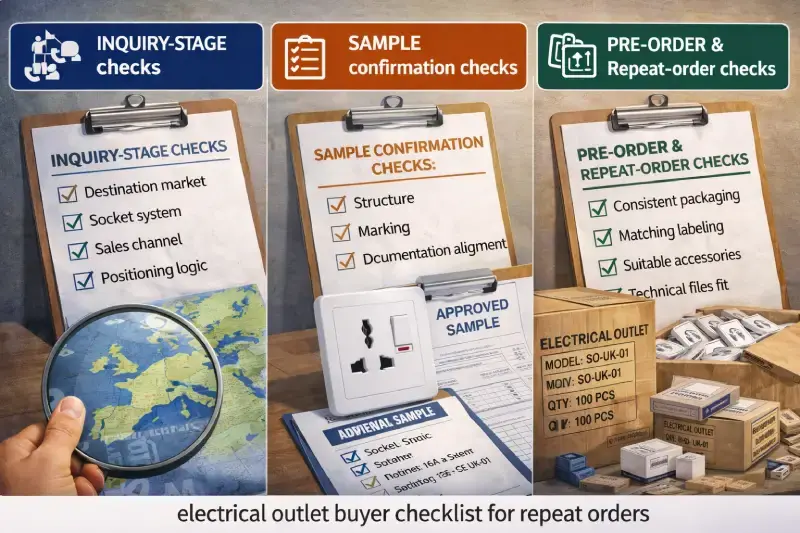
Buyer Checklist: How to Choose an Electrical Outlet That Can Sell and Reorder
| Stage | Main check | Why it matters |
|---|---|---|
| Inquiry stage | Market, socket system, product positioning | If these are unclear, model comparison starts from the wrong basis |
| Sample stage | Structure, marking, documentation alignment | Buyers need to confirm one fixed product logic, not several possible versions |
| Pre-order stage | Packaging, accessories, technical files, batch consistency | This determines whether the model supports real repeat-order confidence |
FAQ: How to Choose the Right Electrical Outlet
Should buyers choose by market habit first or by rated parameters first?
Choose by market habit and socket-system logic first, then confirm rated parameters within the correct commercial and installation context. Otherwise buyers may compare the wrong models very efficiently.
What kind of outlet looks acceptable but is still risky to import?
An outlet is risky when it looks familiar but still has weak system fit, unclear visible marking, loose product definition, or broad claims that do not commit to one clear commercial model.
How can a buyer tell whether a model fits wholesale sales or project sales?
Wholesale models need stronger sell-through stability and repeat-order consistency. Project models need clearer configuration fit and stronger document alignment. A hotel project in Iraq, for example, may need linked bedside combinations rather than a single 86-type face, while a retail market such as Jordan may reject the model mainly because the panel size is wrong even when the standard looks acceptable.
What should buyers ask the supplier for before ordering?
Ask for the exact model definition, datasheet, photos, drawings, marking details, packaging information, and the linked file set that proves the quoted model and the approved sample are the same product.
Why do wholesale buyers care whether electricians find the outlet easy to open and install?
Because electricians influence what wholesalers can move repeatedly. If the outlet is difficult to wire, awkward to dismantle, or inconvenient to service, installers are less willing to recommend it. That weakens sell-through even if the purchase price looks competitive.
Why do child protection and paint durability matter in outlet selection?
They affect both safety perception and channel confidence. In family and public-use markets, weak child protection can make the product less acceptable. Poor paint or spray durability creates fast visible wear, which hurts retail display, end-user impression, and repeat-order confidence.
How should outlet choice change for a private-label brand versus a factory-brand resale business?
A private-label program needs stronger control over packaging, finish consistency, and future style updates. Factory-brand resale usually benefits from familiar fast-moving models with lower explanation burden. New brands normally need safer, clearer commercial choices first, while older brands can support more segmented product tiers.
Can the right outlet standard still fail in the market because the size or color is wrong?
Yes. That is one of the most common commercial mistakes. Jordan may accept several outlet standards, but 118-type size still matters. Saudi buyers may accept the same product family but reject weaker finishes if black is the real hot-selling color. The correct standard does not protect a product from weak market fit if panel size, visible format, or finish preference are wrong.
Conclusion
Choosing the right electrical outlet is not about finding the broadest claim or the cheapest quotation. The safer decision is the model with the clearest market fit, the strongest product definition, and the most stable repeat-order logic. When destination market, outlet structure, documentation, and supply consistency all point to the same product logic, buyers are no longer just choosing an outlet. They are choosing a product that can be approved, sold, and reordered with confidence.