For importers, wholesalers, distributors, and project buyers, switch and socket sourcing in China is not mainly about collecting more supplier names. The harder task is verifying which factory can control real production, protect certification scope, keep approved materials unchanged, and support repeat orders without hidden substitution risk.
This factory verification checklist is written for Middle East, Gulf, Africa, and export-market buyers who already have a supplier shortlist and need a practical way to screen China switch and socket manufacturers before placing volume orders. It is especially useful when buyers are comparing a wall switch manufacturer China search result, a wall socket supplier China quotation, or several electrical switch socket manufacturers in China with similar catalogs.
The goal is not to make sourcing complicated. The goal is to make supplier claims testable before sample approval or balance payment: factory identity, production control, certificate scope, OEM/ODM capability, component traceability, sample consistency, and shipment evidence.
This article does not rank manufacturers or repeat a general supplier list. A top switch and socket manufacturers in China page can help build an initial shortlist. This checklist goes deeper for importers and OEM buyers: real factory evidence, OEM/ODM capability, certification scope, component traceability, sample-to-bulk consistency, and pre-shipment evidence.
Contents
- Why High-Volume Buyers Need More Than a Supplier List
- Step 1: Verify Whether the Supplier Controls Real Production
- Step 2: Check Certification Scope Before Sample Approval
- Step 3: Audit OEM Capability Beyond Logo Printing
- Step 4: Verify Product Design for Hot and Demanding Markets
- Step 5: Confirm Component Traceability and Substitution Control
- Step 6: Request Pre-Shipment Evidence Before Paying the Balance
- Step 7: Add Commercial Protection to the Factory Verification Process
- Factory Verification Checklist for Switch and Socket Buyers
- FAQ: Switch and Socket Sourcing China for Buyers
- Review Basis
- Conclusion
Why High-Volume Buyers Need More Than a Supplier List
The real problem: supplier fatigue, not product shortage
Experienced buyers are not short of factories, trading companies, catalog PDFs, or attractive quotations. They are short of reliable proof. Many suppliers use similar product photos, similar product names, and similar OEM claims. A shortlist can support early discovery, but it cannot show who controls molding, stamping, assembly, testing, packing, certification documents, and repeat-order stability.
Why a low quotation should trigger technical review
A low price is not automatically wrong. But in wall switch and socket sourcing, a low price should trigger a technical review before it triggers a purchase order. Before comparing suppliers, use this guide to compare supplier quotations on the same basis so the SKU, OEM scope, documents, packing, inspection and trade terms are aligned. Cost reduction may come from thinner current-carrying parts, lower-grade plastic, simplified terminals, weaker packaging, or a lower-output USB module.
Two BS1363-type sockets may look identical from the front, while the internal terminal structure, contact pressure, conductor thickness, and material control are different. In hot markets where wall boxes have limited heat dissipation and loads can run for long periods, weakened internal design may show up as higher temperature rise, loose plug engagement, softened plastic near terminals, or project consultant rejection.
What this checklist is designed to prove
This checklist is not a general article about how to choose a supplier. It is a factory verification tool for buyers who need evidence before annual volume, private-label orders, tooling investment, or regional distribution agreements are discussed.
Step 1: Verify Whether the Supplier Controls Real Production
Check the relationship between factory, exporter, and certificate holder
Compare the business license, factory address, export company name, certificate holder, invoice entity, and quotation issuer. They do not always need to be identical, but the relationship must be explainable. If the supplier cannot clarify who manufactures, who exports, and who carries certification responsibility, the sourcing risk is already visible.
Separate a real manufacturer from a trading company
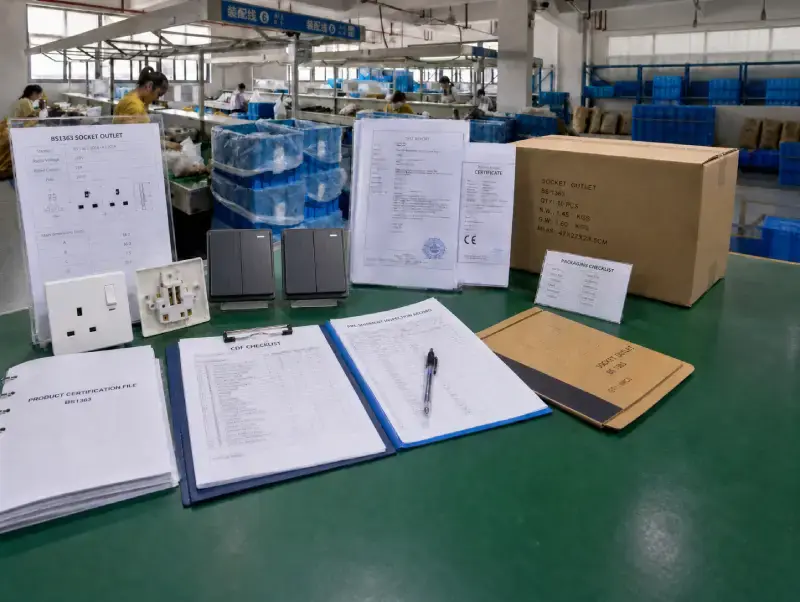
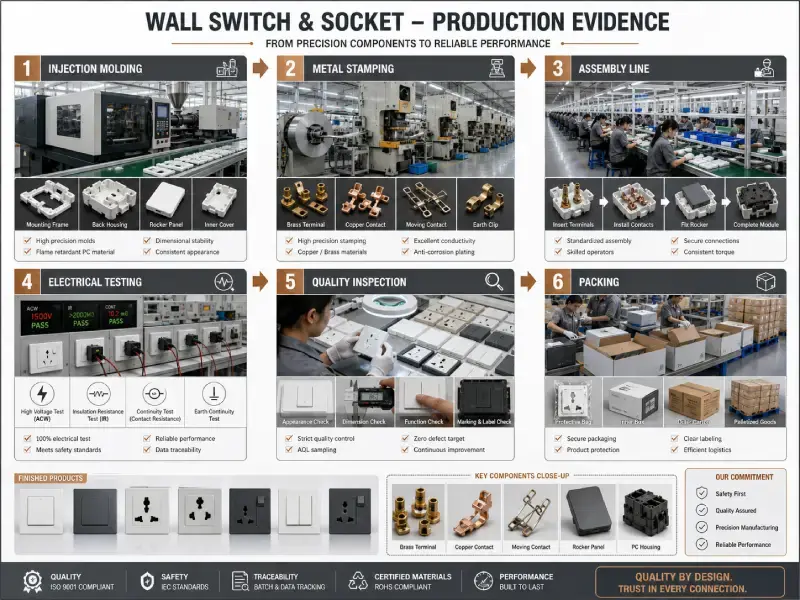
A real wall switch and socket manufacturer should provide current evidence of injection molding, metal stamping, assembly, electrical testing, packing, and quality inspection. The evidence should show the quoted product series, not a generic factory video from another line.
For large-volume orders, also check whether assembly and testing rely on controlled fixtures, semi-automatic equipment, documented line procedures, and batch inspection records. Manual bench work may be acceptable for small samples, but it is not enough evidence for stable container-level supply.
Request proof before discussing annual volume
Before discussing annual contracts or regional exclusivity, request a factory profile, key equipment list, production capacity by category, QC flow, export references, and previous OEM/ODM project examples. The question is not whether a supplier can ship one container. The question is whether it can repeat the same product without subcontracting key steps or changing critical components quietly.
A stronger verification package should connect three things: the quoted model, the actual production line, and the responsible factory entity. If those three points cannot be connected with documents and batch-level photos, the buyer is still working on trust rather than evidence.
Step 2: Check Certification Scope Before Sample Approval
Certification is product-specific, not a factory slogan
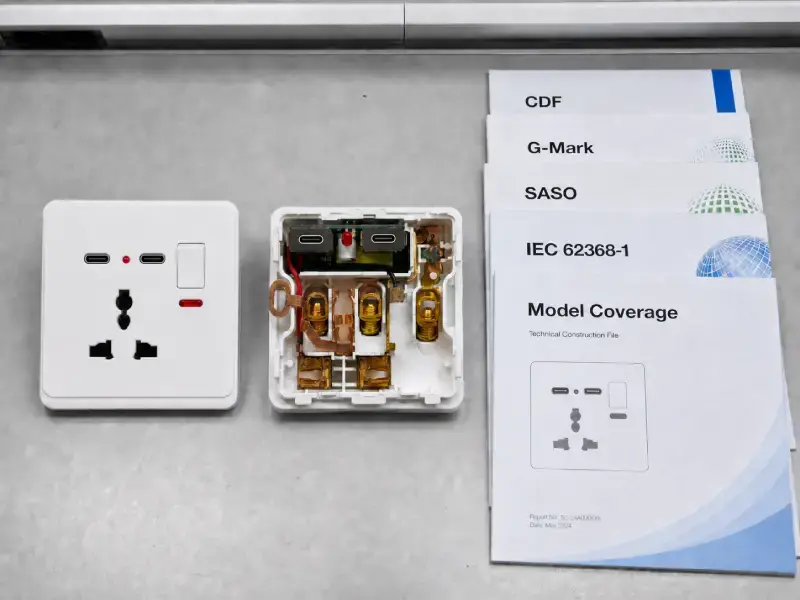
For Middle East and Gulf orders, certification should be checked at product-model level. Buyers may need to review G-Mark, GSO conformity requirements, SASO-related requirements for Saudi Arabia, CB documentation, or IEC-based test documents depending on product type and destination market.
The safest wording in procurement is simple: ask which exact model, rating, socket type, USB version, material structure, and marking layout are covered by the certificate or test file. A certificate copy is not enough if the quoted version, sample version, and production version are not the same.
USB socket versions need extra caution
A standard socket is mainly electromechanical. A USB-A, USB-C, or PD fast-charging socket also includes a PCBA, transformer, capacitor, charger IC, fuse or protection components, port structure, and thermal design. That means the USB module should be treated as a controlled component, not as a minor accessory.
One common risk is using a higher-specification USB module for sample approval and then switching bulk production to a lower-cost module. The front panel may look unchanged, but the PCBA, capacitor grade, IC, port, or output label may no longer match the approved file. This can affect charging stability, temperature rise, lifespan, and conformity review.
Match documents with product series and structure
Match certification documents against the exact product series, socket type, rated current, rated voltage, terminal design, flame-retardant material, faceplate structure, USB version, and marking method. Any change in plastic material, copper component, switch mechanism, USB module, or internal layout should trigger written review before production.
For buyers, the practical test is simple: the certificate photos, approved sample, quotation model, packaging label, and mass-production goods should describe the same product identity. If any one of these files points to a different version, the order needs clarification before bulk production.
Step 3: Audit OEM Capability Beyond Logo Printing
OEM capability should include drawings, molds, and version control
OEM capability should mean more than adding a logo to an existing plate. A capable OEM wall switch manufacturer in China should discuss mold development, panel dimensions, frame structure, rocker feel, color matching, surface finish, material limits, tooling ownership, mold maintenance, and drawing control.
Packaging and labels are part of OEM risk
Private-label work includes Arabic/English packaging, rating labels, carton marks, barcode placement, installation instructions, country-of-origin marking, batch codes, and importer information where required. These details affect customs review, warehouse handling, retail display, and after-sales traceability.
Product differentiation needs process control
Premium Gulf and Saudi project channels increasingly use matte black, anthracite grey, ultra-slim frames, borderless panels, brushed finishes, and coordinated design systems. These finishes can improve brand positioning, but they also reduce tolerance for batch variation.
Buyers should request finish samples, coating details, scratch-resistance checks, color consistency records, UV-aging references, and packing protection details where applicable. A supplier that cannot lock approved PC material, coating process, USB module, label files, and batch color consistency may not be ready for premium private-label work.
Step 4: Verify Product Design for Hot and Demanding Markets
Check plastic material, flame retardancy, and UV exposure risk
A product that works in a mild indoor market may not suit hotter regions. Buyers should confirm whether the faceplate and base use approved flame-retardant PC material, whether color and finish are suitable for strong sunlight or high indoor heat, and whether the material grade is locked in the approved sample record.
Review contact material, copper thickness, and terminal structure
Switches used for lighting, fans, and heavy-use commercial spaces must be checked beyond appearance. Verify contact material, copper part thickness, terminal screw strength, plug engagement, conductor layout, and rated current. If a low price depends on thinner metal parts or unspecified contacts, the commercial risk becomes a product risk.
Ask for temperature-rise evidence where risk is high
For BS1363-type sockets and high-load applications, review shutter design, terminal strength, plug engagement, internal conductor layout, and temperature-rise evidence where applicable. The issue is not whether a wall socket supplier can copy the outer shape. The issue is whether the internal structure supports safe, repeated use under realistic load conditions.
Step 5: Confirm Component Traceability and Substitution Control
Use a CDF or critical component list
A strong factory should provide a controlled CDF (Constructional Data Form), BOM, or critical component list for approved products. It should identify PC material grade, copper parts, contact material, switch mechanism, USB module where applicable, terminal screws, plating, and packaging specification.
Lock USB PCBA as a controlled component
For USB socket products, the PCBA must be locked as a critical component. A supplier may keep the same faceplate, socket body, packaging, and label, but change the USB module to reduce cost. Internally, the charger IC, capacitor, transformer, PCB layout, protection component, or USB-C port may be different.
A frequent USB socket complaint is intermittent charging. If the approved module is changed to one using lower-grade capacitors or weaker thermal design, internal temperature can rise faster in poorly ventilated wall boxes or hot storage conditions. Users may then see slow charging, repeated disconnection, or heat-related shutdown.
Agree substitution control before mass production
Substitution control should be agreed before mass production. Approved materials and components should not be changed without buyer approval, especially for certified or private-label products. This is where many sourcing risks appear: the sample is acceptable, but bulk production uses a different plastic grade, thinner copper part, cheaper contact, or alternate USB module.
Step 6: Request Pre-Shipment Evidence Before Paying the Balance
Ask for batch evidence, not catalog photos
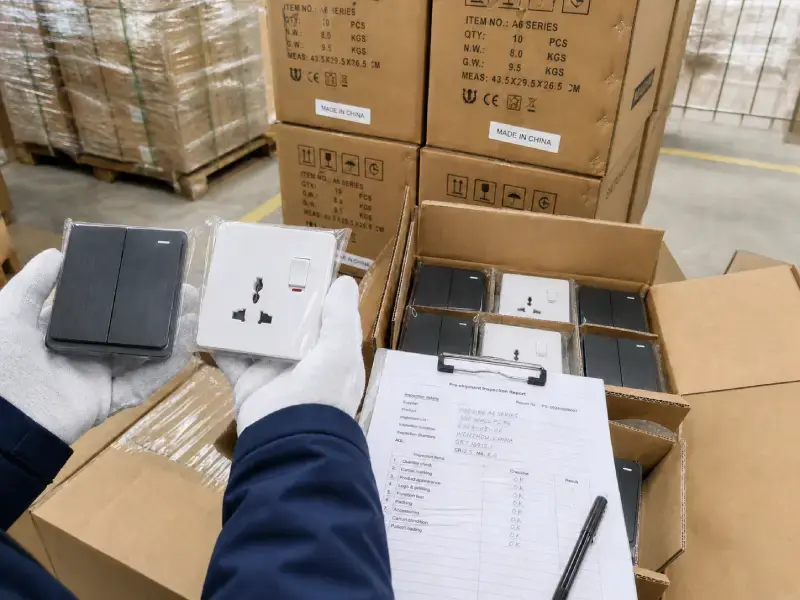
Before paying the balance, request evidence tied to the actual batch: batch photos, inner box and master carton marks, labels, packing list, pallet photos, quantity breakdown, and inspection records. The information should match the purchase order, model numbers, private-label artwork, destination market, and agreed packaging language.
Packaging evidence matters for heavy socket products
During sea freight to Jebel Ali, Dammam, Doha, Kuwait, or other hot and humid routes, temperature changes can create container condensation. If cartons absorb moisture and lose compression strength, inner boxes may deform and products may shift inside the packaging. This is especially risky for matte black, brushed, or glossy panels, where minor rubbing can leave visible scratches.
For LIBAIK shipment review, buyers can check whether each product is protected with plastic film, whether inner boxes and master cartons follow the approved paper specification, and whether palletizing, desiccants, or carton weight limits are required for the route.
Document whether bulk goods match approved samples
The factory should compare bulk goods against the approved sample, drawing, packaging proof, and confirmed component list. Photos or videos should show the front plate, back housing, terminals, internal conductor parts, switch mechanism, USB module label, outer carton, and finished pallet.
Practical evidence package: for volume orders, buyers should ask the supplier to provide a compact shipment file before balance payment. The file should include approved sample reference, CDF or critical component list, first-article photos, batch inspection records, electrical test records, packaging photos, carton label proof, and sample-to-bulk comparison photos.
This package does not replace third-party inspection. It creates a traceable baseline so the buyer can see whether the shipped batch still matches the approved product.
Step 7: Add Commercial Protection to the Factory Verification Process
Put critical specifications into the purchase file
Factory verification should be written into the purchase agreement, PI, technical confirmation sheet, or inspection instruction. Key points include copper part thickness, contact material, plastic material grade, terminal structure, USB module source, packaging specification, approved sample reference, and defect-handling method.
Define what happens if bulk goods differ
Define what counts as a material change, functional defect, labeling error, certification mismatch, packaging deviation, finish defect, or CDF mismatch. The agreement should also state the remedy: replacement, repair, credit note, discount, rework cost, rejected batch handling, shipment hold, or delayed balance payment.
Reliable suppliers should accept traceable responsibility
Reliable wall switch and socket manufacturers should accept traceable responsibility for critical components and approved specifications. This does not turn every issue into a dispute. It simply defines which materials, drawings, labels, and test records control the order.
Factory Verification Checklist for Switch and Socket Buyers
Before quotation: identity and production proof
| Procurement stage | Evidence to request | Risk controlled |
|---|---|---|
| Before quotation | Business license, factory address, export entity, factory profile | Unclear manufacturer identity |
| Before quotation | Production evidence for molding, stamping, assembly, testing, and packing | No real production control |
| Before quotation | Product catalog matched with quoted series and market standard | Misleading product range |
Before sample approval: certification and component control
| Procurement stage | Evidence to request | Risk controlled |
|---|---|---|
| Before sample approval | Certificate, test report, model list, certified photos, validity period | Certificate mismatch |
| Before sample approval | Material specification, CDF/BOM, contact and copper details | Hidden material substitution |
| Before sample approval | OEM drawings, packaging artwork, label proofs, color sample | Private-label errors |
Before shipment: batch evidence and shipment protection
| Procurement stage | Evidence to request | Risk controlled |
|---|---|---|
| Before shipment | Batch photos, labels, carton marks, packing list, pallet photos | Wrong product or packaging |
| Before shipment | Electrical test records and inspection files | Untested shipment |
| Before shipment | Internal component and sample-comparison photos | Bulk goods not matching approved sample |
| Before balance payment | Shipment evidence package tied to approved sample and CDF | No traceable proof before release |
FAQ: Switch and Socket Sourcing China for Buyers
What is a switch and socket factory verification checklist?
It is a buyer-side review tool used before sample approval, mass production, or balance payment. It helps importers check factory identity, production control, certification scope, OEM capability, component traceability, packaging evidence, and whether the shipment still matches the approved sample.
How can I tell if a Chinese switch and socket supplier is a real factory?
Check whether the supplier can connect its business license, factory address, export entity, certificate holder, and quotation company. Then request current production evidence for the quoted series, including molding, stamping, assembly, testing, and packing.
What certificates should Middle East switch and socket importers review?
Depending on the destination market and product type, buyers may need to review G-Mark, GSO conformity requirements, SASO-related requirements, CB documentation, and IEC-based test documents. The key is to verify model coverage, not only obtain a certificate copy.
Is G-Mark enough for selling wall switches and sockets in Gulf countries?
Not by itself. Buyers still need to check destination-country requirements, product category, certificate scope, labels, test reports, importer obligations, and whether the actual shipment matches the approved model.
What should I ask from an OEM wall switch manufacturer before opening a mold?
Ask for mold drawings, tooling ownership terms, material options, finish samples, certification impact, packaging artwork support, color control, and sample approval steps.
How do I prevent bulk goods from using different internal components?
Use an approved sample, technical specification sheet, and CDF or critical component list. Define which materials and components cannot be changed without written approval.
What pre-shipment evidence should I request before paying the balance?
Request batch photos, labels, carton marks, packing list, inspection records, electrical test evidence, packaging photos, and sample-comparison photos.
Review Basis
This article is a buyer-side factory verification guide, not a substitute for legal, customs, or certification-body advice. For market access and product approval, buyers should confirm the latest applicable requirements with the importer, conformity body, or destination-market authority. Useful review references include:
- BSI BS 1363-2:2023 for 13 A switched and unswitched socket-outlets: https://knowledge.bsigroup.com/products/13-a-plugs-socket-outlets-adaptors-and-connection-units-13-a-switched-and-unswitched-socket-outlets-specification
- SASO plug and socket-outlet awareness information: https://www.saso.gov.sa/en/consumer_awareness/awareness_campaigns/plugs_and_sockets_campaign/pages/campagine_about.aspx
- GSO conformity assessment scheme for Gulf technical regulation context: https://www.gso.org.sa/en/conformity/gcc-conformity-assessment-scheme/
Conclusion
For serious importers, wholesalers, OEM buyers, and project purchasers, switch and socket sourcing in China should not stop at catalogs, prices, or supplier claims. The stronger decision comes from verifying factory control, certification scope, OEM/ODM capability, product suitability, component traceability, and shipment-level accountability.
For buyers evaluating long-term cooperation with an electrical switch and socket manufacturer in China, this checklist helps screen whether a factory can support volume, compliance, and brand trust with verifiable evidence.