A supplier can pass a factory tour and still fail the order.
For an OEM buyer, the real question is not whether a Chinese wall switch and socket factory looks capable. It is whether the contracting entity controls the audited site, the quoted SKU matches its approval file, the bulk order follows the approved construction, and the inspected batch can be traced to the shipment.
This China wall switch socket supplier audit is written for importers, distributors, private-label buyers, and project purchasers serving the Middle East, Africa, and other export markets. It follows one evidence chain:
contracting entity -> factory -> exact SKU -> certificate and report -> BOM/CDF -> golden sample -> production batch -> packed shipment
If you are still shortlisting factories, start with LIBAIK's broader switch and socket sourcing guide. Before an audit, use this wall switch and socket RFQ checklist to align the exact SKU, quotation scope, documents, inspection and delivery basis across suppliers. If the next question is how to verify factory evidence before placing an order, use our switch and socket sourcing China factory verification checklist. This page starts one step later, when the buyer is already checking a named supplier, a named model, and a named purchase order.
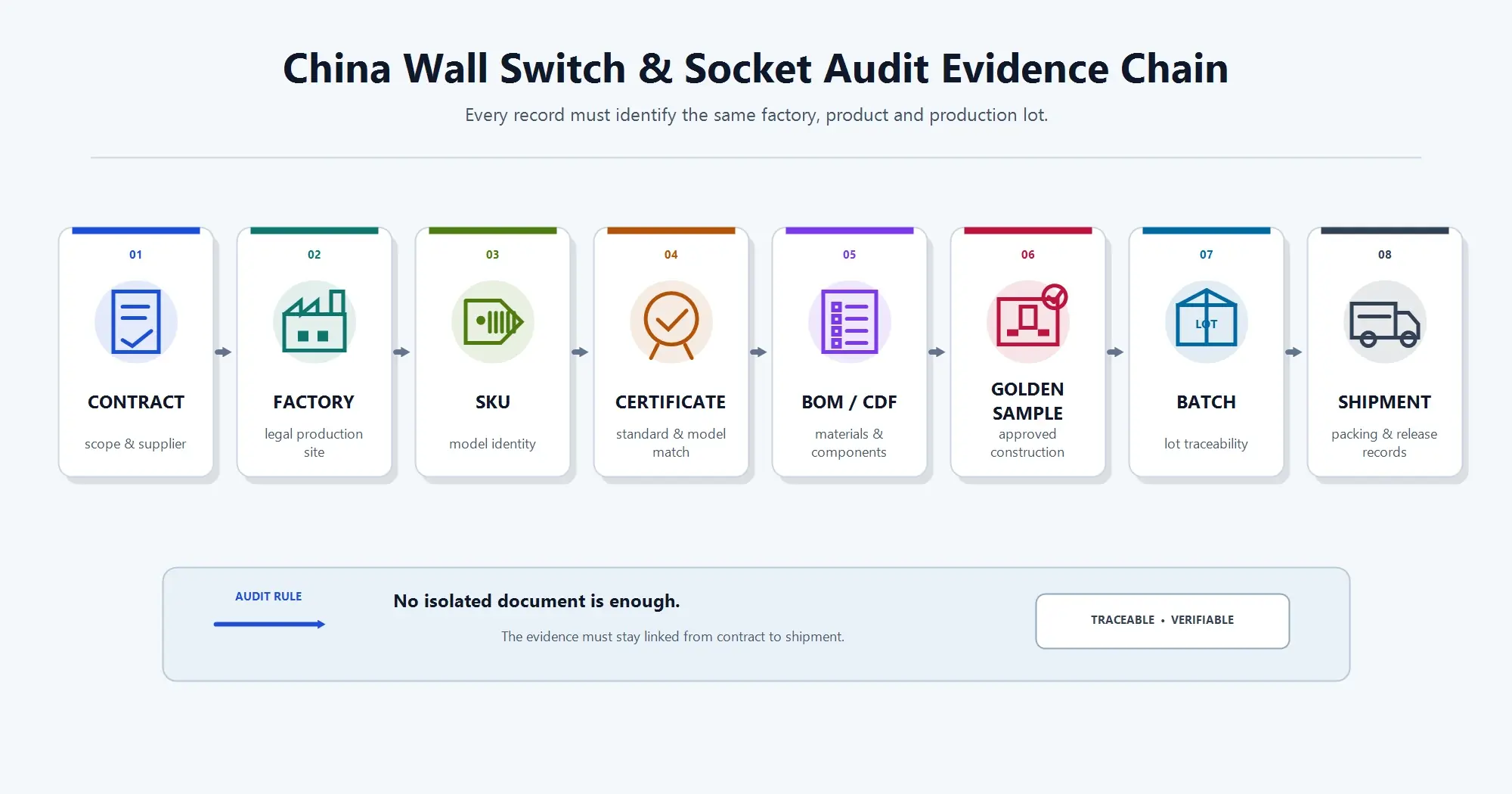
China wall switch socket audit evidence chain from contract to shipment
Contents
- What This Supplier Audit Should Prove
- 1. Define the Order Before Auditing the Factory
- 2. Verify the Legal Entity and Factory Control
- 3. Match the Exact SKU to Certificates and Test Reports
- 4. Open the Product and Check What Will Be Installed
- 5. Lock OEM Scope and Version Control
- 6. Audit QC Records, Packaging, and Shipment Traceability
- 7. Convert the Audit into a Purchase Decision
- One-Page China Wall Switch Socket Supplier Audit Checklist
- Frequently Asked Questions
- Conclusion
What This Supplier Audit Should Prove
A useful audit produces evidence, not a general impression that the factory "looks good". By the end of the review, the buyer should be able to answer six questions.
- Is the company receiving the order connected to the audited production site?
- Does the approval evidence cover the exact model, rating, functions, and factory?
- Does the opened product match the controlled drawings and component list?
- Can the product be installed in the specified back box with the intended conductors?
- Can the factory reproduce the approved sample during pilot, bulk, and repeat production?
- Can the inspected batch be traced through packing, loading, and shipment?
| Audit area | Evidence to request | High-risk warning |
|---|---|---|
| Company identity | Business licence, contract entity, bank account, factory address, certificate holder | Unexplained entity or address mismatch |
| Product approval | Exact model schedule, certificate, full report, amendments, validity | Similar model name used as proof |
| Product construction | Teardown photos, drawings, BOM/CDF, component references | Quoted sample differs from controlled file |
| Installation | Rear dimensions, terminal data, specified back box, wired mock-up | Fit assumed from faceplate size |
| OEM control | Tooling, artwork, finish reference, revision control | "OEM" means logo printing only |
| Production quality | Work instructions, test records, calibration, nonconformance control | Equipment displayed without batch records |
| Shipment traceability | Batch labels, inspection report, packing list, pallet and loading records | Generic warehouse or container photos |
1. Define the Order Before Auditing the Factory
Start with the product being purchased. A generic supplier checklist cannot identify the risks of a specific wall switch, socket outlet, USB model, finish, or project installation.
Create one audit file for every quoted SKU. It should contain:
- Destination country and sales channel
- Exact model code, rating, colour, finish, and functions
- Applicable approval and project requirements
- Back box, fixing centres, wiring method, and conductor details
- Consultant submittal requirements
- OEM logo, product marking, barcode, packaging, and manual
- Order quantity, pilot quantity, and delivery schedule
- Inspection stage and payment-release conditions
Do Not Treat the Middle East or Africa as One Approval Market
Gulf, Levant, East African, West African, and Southern African markets do not share one universal product or documentation route. Even where two destinations use a similar socket configuration, their national requirements, importer markings, consultant specifications, installation practices, or channel expectations may differ.
Record the requirement source for each destination. If a distributor, consultant, testing body, or local authority has issued a written requirement, keep it in the SKU file. Avoid vague purchasing descriptions such as "Middle East standard", "Africa model", or "BS/IEC type" without identifying the actual product and evidence expected.
Separate Mechanical and Electronic Functions
Products with USB charging, indicators, dimmers, smart controls, or other electronic modules need an additional review. Evidence covering the mechanical switch or socket body may not cover the incorporated electronics, EMC-related functions, power supply module, or final combined construction.
The buyer should see how each function is identified in the model code, technical file, markings, and report scope.
2. Verify the Legal Entity and Factory Control
Chinese suppliers may use separate companies for manufacturing, export, certification, or payment. That structure is not automatically a problem, but it must be transparent and documented.
Match the following:
- Business licence
- Contract and quotation entity
- Beneficiary bank account
- Commercial invoice
- Factory address
- Certificate and report holder
- Export documents
Record every mismatch and request an explanation supported by documents. Do not rely on a verbal statement that the companies are "the same group".
Map In-House and Subcontracted Processes
Identify who controls:
- Plastic injection moulding
- Metal stamping and conductive parts
- Plating or surface treatment
- Switch mechanism production
- Socket contact production
- Electronic modules
- Assembly and testing
- Printing and packaging
- Finished-goods storage
Outsourcing is common in electrical accessory manufacturing. The audit issue is whether subcontractors, specifications, incoming inspection, supplier changes, and nonconforming materials are controlled.
Approval should be limited to the sites and processes actually reviewed. Undisclosed subcontracting or production transfer is a stop signal.
Confirm Who Can Make Engineering Decisions
Ask who owns the tooling, drawings, certificates, BOM, test fixtures, and OEM artwork. Then establish who can:
- Quarantine defective components
- Revise a drawing or BOM
- Approve a replacement material
- Authorize mould correction
- Close a corrective action
- Release a revised product version
If the contracting company cannot control these decisions, it does not fully control the order.
3. Match the Exact SKU to Certificates and Test Reports
A wall of certificates is not product traceability. The auditor must connect the ordered SKU to the evidence submitted for it.
Compare:
- Model number and model schedule
- Product rating and functions
- Manufacturing address
- Certificate and report holder
- Product construction
- Critical components
- Electronic modules
- Standard or approval scope
- Report amendments
- Certificate status and validity
A similar faceplate, family name, or catalogue series does not prove coverage. A certificate cover page is also insufficient because important model and construction details may appear only in the report or annex.
Where model-family coverage remains unclear, obtain written confirmation from the relevant certification or testing body before approval.
Test the Supplier's Consultant Submittal Capability
Ask the engineering team to prepare a project-ready package for the exact quoted model. It should include:
- Product datasheet and complete model code
- Front, rear, and side drawings with measurement references
- Wiring diagram
- Terminal capacity, stripping length, and tightening torque
- Recommended back box and fixing details
- Material and construction declaration
- Applicable certificates and complete reports
- Product, carton, country-of-origin, and importer markings
- Colour and finish reference
- Packaging and installation instructions
This exercise quickly reveals whether the supplier has controlled technical files or is assembling documents from unrelated models.
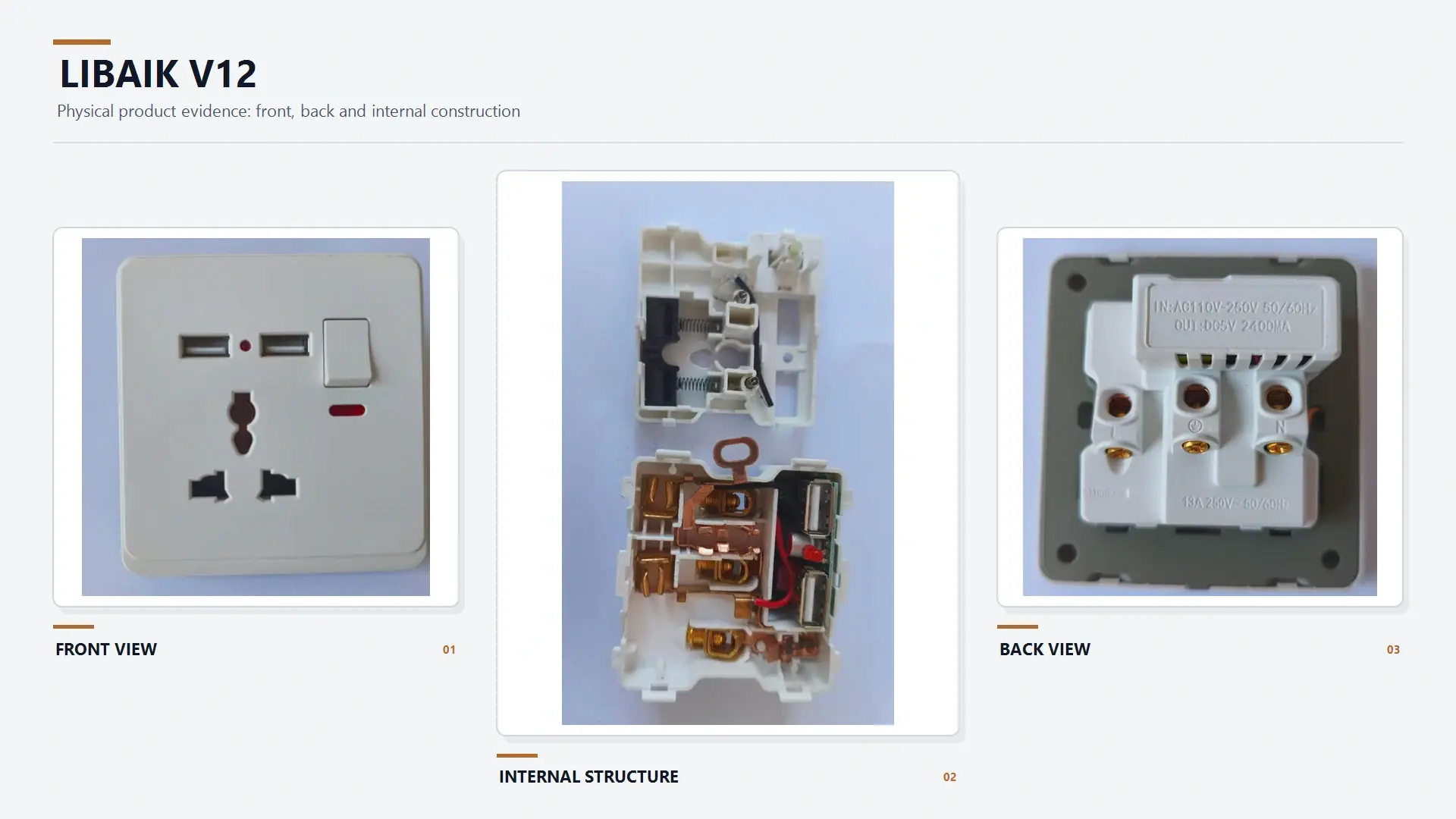
LIBAIK V12 front view, back view, and internal structure
4. Open the Product and Check What Will Be Installed
Open the exact quoted model, not a showroom sample from another range.
Record the:
- Mains terminals
- Switch mechanism
- Socket contacts
- Conductive links
- Earthing arrangement
- Insulating barriers
- Fastening and retention features
- Electronic module and internal wiring
Match critical parts to the BOM/CDF, drawings, golden sample, and approval file.
Integrated, riveted, welded, and other conductive structures should not be accepted or rejected by name alone. Teardown shows which construction is present; appropriate testing shows whether that construction performs as required.
Product-Evidence Example: LIBAIK V12
Front, rear, and teardown photographs of the LIBAIK V12 13A 1-Gang Switched Multi-Socket with Dual USB Ports and Neon Indicator show:
- Product and USB rating marks
- Mains terminals and earthing mark
- Switch mechanism
- Socket contacts
- USB circuit board and internal wiring
- 11 mm conductor stripping guide
These photographs identify the inspected construction. They do not independently prove material grade, certificate coverage, or test compliance. Those claims still require the corresponding controlled documents and test evidence.
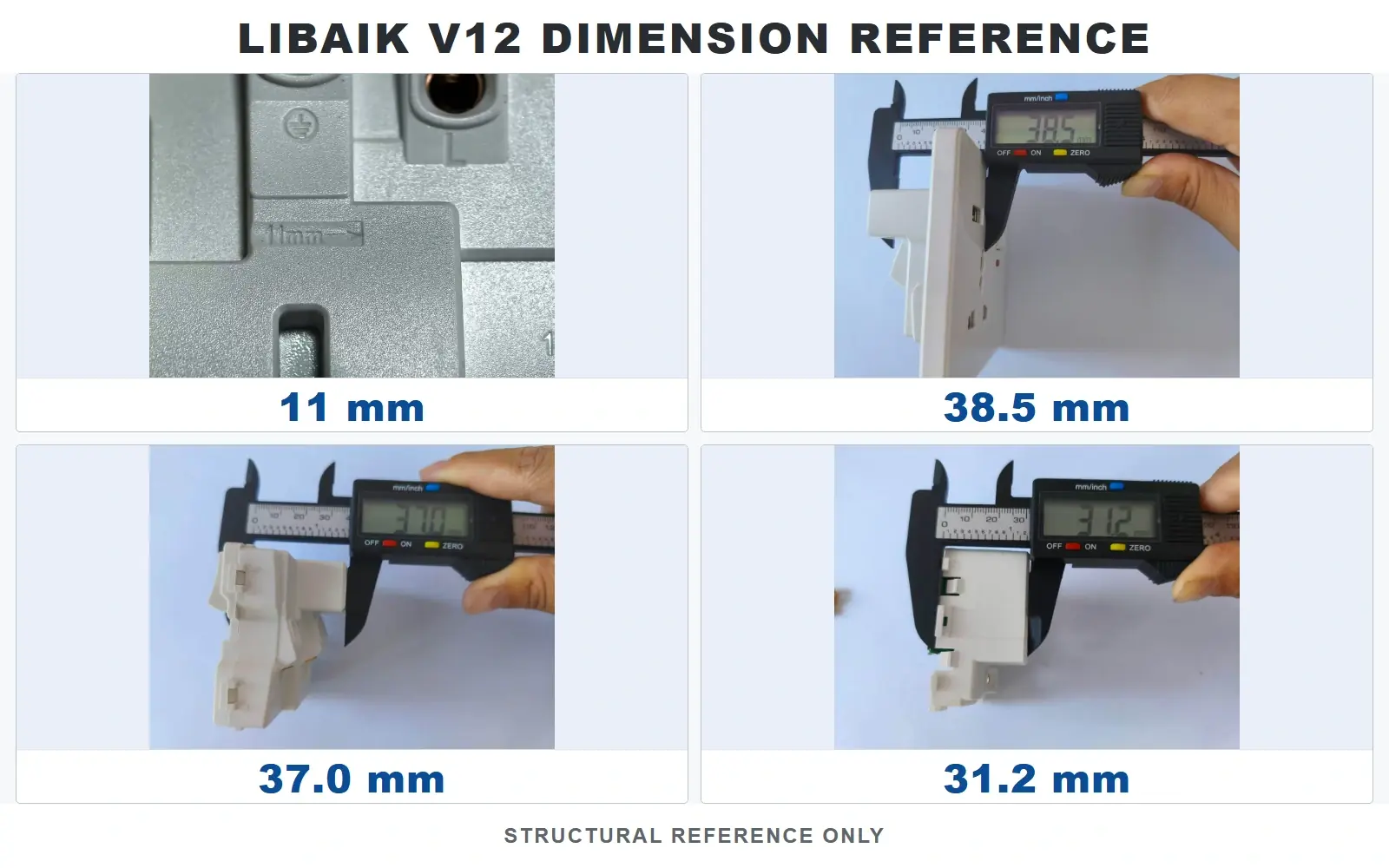
The inspected unit shows approximately 38.5 mm total depth from the front faceplate to the rear of the base, approximately 37.0 mm functional-unit depth after removing the faceplate and metal mounting frame, and approximately 31.2 mm rear-housing depth at the USB-module position.
These figures are useful reference points only. They help the buyer judge the product against the intended back box and conductor arrangement, but they do not replace a wired mock-up.
Check Terminals with Project Conductors
Use the conductor type, cross-section, and quantity specified for the project. Check:
- Terminal entry and capacity
- Stripping length
- Tightening torque
- Conductor retention
- Loop-in or loop-out arrangement
- Cable entry direction
- Access for installation tools
- Bending space behind the accessory
Terminal suitability cannot be confirmed from a large terminal opening alone. The factory's documented capacity and an actual wiring trial matter more.
V12 faceplate retention before and after mold update
5. Lock OEM Scope and Version Control
Private labelling is only one part of OEM wall switch and socket manufacturing. A capable supplier must be able to define, approve, reproduce, and trace the requested configuration.
Confirm the factory's control over:
- Product construction and dimensions
- Faceplate and rocker profile
- Colour and surface finish
- Tooling and mould maintenance
- Brand, rating, and terminal markings
- Barcode and batch coding
- Retail box, inner box, carton, and manual
- Arabic, English, French, or other language artwork where specified
Record the MOQ, lead time, sample charge, tooling requirement, and approval process for each variation. Standard white products, premium finishes, electronic models, custom packaging, and new tooling rarely follow the same commercial conditions.
A premium matte, metallic, or dark finish may be right for a confirmed hotel or residential project but unsuitable for a general replacement channel. The buyer should connect every finish decision to an actual BOQ, distributor plan, or target segment.
Lock the BOM, CDF, Golden Sample, and Revisions
Bulk production needs one controlled product definition.
The BOM should identify:
- Material specifications
- Critical dimensions
- Component and approved supplier references
- Terminal and conductor construction
- Electronic module
- Colour and finish
- Product markings
- Packaging
- Approved alternatives
Where a Constructional Data Form (CDF) or equivalent certification file applies, its components, ratings, construction, and manufacturing site must correspond to the ordered model.
The release package should contain:
- Signed or sealed golden sample
- Approved BOM and drawing revisions
- Colour and finish reference
- Product and packaging artwork
- Inspection plan and acceptance criteria
- Test requirements
- Approved alternatives
- Written deviation and engineering-change procedure
Every controlled document needs a revision number and approval date. Purchasing, engineering, production, and quality teams must work from the same version.
Control Pilot, Bulk, and Repeat Production
During the pilot run, compare first-article units with the golden sample. Check construction, dimensions, operation, finish, markings, assembly, and packaging.
Material, supplier, mould, subcontractor, production site, electronic module, finish, or packaging changes should trigger documented review. Buyer approval and certification review may also be required, depending on the change.
Repeat orders should trace the approved revision to production dates, component batches, test records, rework records, and shipment documents. "Same as last order" is not an adequate control method. For a deeper repeat-order control process, see our guide to OEM wall socket version control for repeat orders.
Corrective-Action Example: V12 Faceplate Retention
A customer reported that faceplates had separated from assembled V12 products after transportation. LIBAIK revised the faceplate injection mould and changed the retaining tabs.
The assembled products then underwent an internal manual retention check using firm pulling and flexing, followed by a packed transport trial. No recurrence was reported in later shipments, and the customer continued placing repeat orders.
The useful audit lesson is not simply that a mould was modified. The correction was checked on assembled and packed products, and later orders had to remain connected to the corrected mould and product revision.
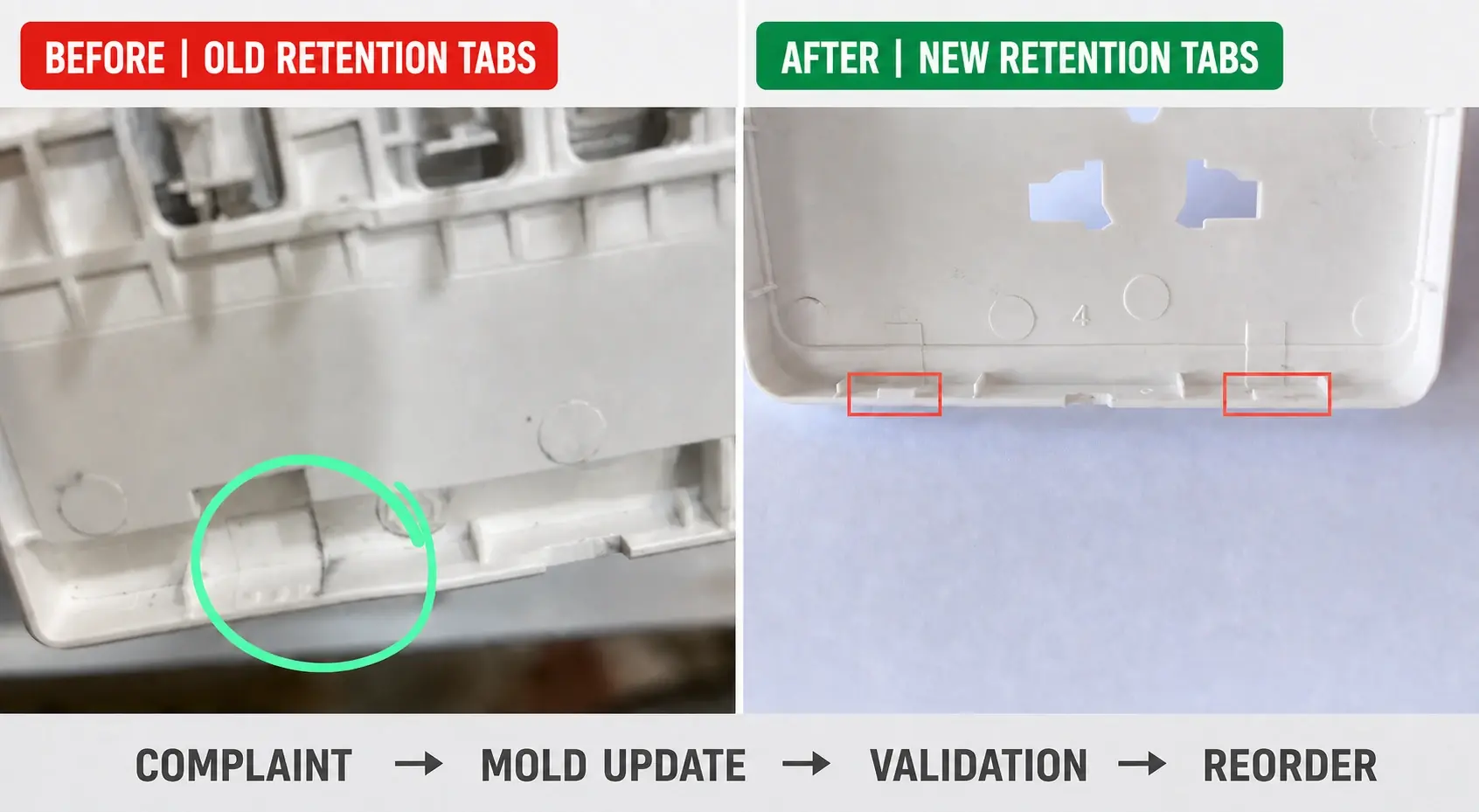
V12 faceplate retention before and after mold update
6. Audit QC Records, Packaging, and Shipment Traceability
Testing equipment on a clean workbench does not prove that routine production is controlled. Select equipment used for the quoted SKU and trace a completed test record to an actual batch.
Check:
- Test method and acceptance limit
- Sampling frequency
- Work instruction revision
- Equipment ID
- Range and resolution
- Calibration certificate and scope
- Calibration date and due date
- Interim verification records
- Operator and production batch
Do not rely on calibration sticker colour or assume that every instrument follows a 12-month interval. The equipment, method, range, and record must be suitable for the check being performed.
Follow One Failed Result
Ask the factory to show how nonconforming goods are:
- Identified
- Isolated
- Investigated
- Reworked or rejected
- Retested
- Released or disposed of
Containment should begin from the last verified acceptable inspection point and consider production time, material batch, tooling condition, and affected quantity.
Audit Finish Protection and Shipment Traceability
For UV, humidity, corrosion, adhesion, abrasion, or colour-stability claims, request the test method, exposure, duration, acceptance criteria, sample identity, and report. Do not assign an environmental category from a city name alone; use the actual project and installation conditions.
For easily marked finishes, inspect:
- Protective film
- Individual wrapping
- Product separators
- Inner-box contact points
- Carton strength and stacking
- Moisture protection
- Pallet arrangement
- Container loading method
Review packed production samples rather than pristine showroom units.
Shipment evidence should include:
- Batch and carton labels
- Final inspection record
- Packed quantity
- Packing list
- Pallet records
- Container and seal numbers
- Loading photographs
Each record must connect to the inspected lot. Generic loading photographs are not shipment traceability.
7. Convert the Audit into a Purchase Decision
Classify every finding as high, medium, or low risk. Assign the missing evidence, corrective action, responsible owner, and closure date.
| Outcome | Purchasing action |
|---|---|
| Approved for pilot order | Release a controlled trial quantity |
| Conditional approval | Release only after defined gaps are closed |
| Model-limited approval | Approve named SKUs, sites, or processes only |
| Rejected | Do not place or continue the order |
Immediate stop signals include:
- Contracting entity or factory mismatch without evidence
- Concealed subcontracting
- Certificate or report not linked to the ordered model
- Refusal to open or inspect the quoted product
- Missing BOM, golden sample, or revision control
- Unapproved component or material substitutions
- Failed installation mock-up without corrective action
- Untraceable inspection or shipment records
Close conditions with records and verified corrective action, not promises. For final supplier comparison, use our top switch and socket manufacturers in China guide.
One-Page China Wall Switch Socket Supplier Audit Checklist
Use this condensed list during the factory visit:
Company and Factory
- Contract, invoice, bank account, factory, and certificate entities are mapped
- Audited sites and subcontracted processes are recorded
- Tooling, drawings, BOM, and engineering authority are confirmed
Product and Compliance
- Destination and exact SKU are defined
- Model, rating, functions, site, and report scope match
- Electronic functions are reviewed separately where necessary
- Consultant submittal is complete and model-specific
Construction and Installation
- Exact quoted model is opened
- Critical parts match the controlled BOM/CDF and drawings
- Terminals are checked with intended conductors
- Back box fit is verified through a wired mock installation
OEM and Production Control
- Golden sample, finish, artwork, and packaging are revision-controlled
- Pilot units match the approved configuration
- Material, supplier, mould, and site changes require written approval
- Repeat orders remain linked to the approved revision
Quality and Shipment
- Test records trace to the production batch
- Calibration scope and status are verified
- Failed products are isolated and retested after rework
- Finish protection and packed-product condition are checked
- Inspection, packing, container, and loading records trace to one shipment
Frequently Asked Questions
How Do I Know Whether a Chinese Supplier Is the Actual Manufacturer?
Match the legal entity, audited factory address, certificate holder, production processes, tooling control, and authority to approve engineering changes. A factory signboard or production video is not enough.
Does One Certificate Cover Every Similar Switch or Socket?
No. Coverage depends on the listed model, rating, construction, functions, manufacturing site, report scope, amendments, and certificate status. Similar appearance or a shared series name does not establish coverage.
How Should Buyers Check Back Box Compatibility?
Install the product in the specified box using the intended conductors. Check fixing centres, rear clearance, terminal access, cable bending space, screw engagement, frame alignment, and final faceplate seating.
What Should Be Checked Before Final Payment?
Confirm the final inspection result, batch identity, packed quantity, carton labels, packing list, pallet records, container and seal numbers, and loading evidence. All records should trace to the inspected shipment.
Conclusion
A reliable China wall switch socket supplier audit approves a defined order, not an entire catalogue. The supplier must connect its legal entity to the factory, the exact SKU to its approval evidence, the opened construction to the controlled product file, and the inspected batch to the packed shipment.
The right outcome may be a pilot order, conditional approval, model-limited approval, or rejection. What matters is that the decision is supported by traceable evidence before tooling, mass production, or final payment.
This checklist helps buyers organize due diligence, but it does not replace the applicable national standard, certification-body determination, consultant specification, local installation rule, or independent inspection required for a particular market or project.
Buyers who also need to assess broader manufacturing capability can review LIBAIK's electrical switch and socket manufacturer in China guide or contact LIBAIK with the target market, model, back box, and OEM requirements.