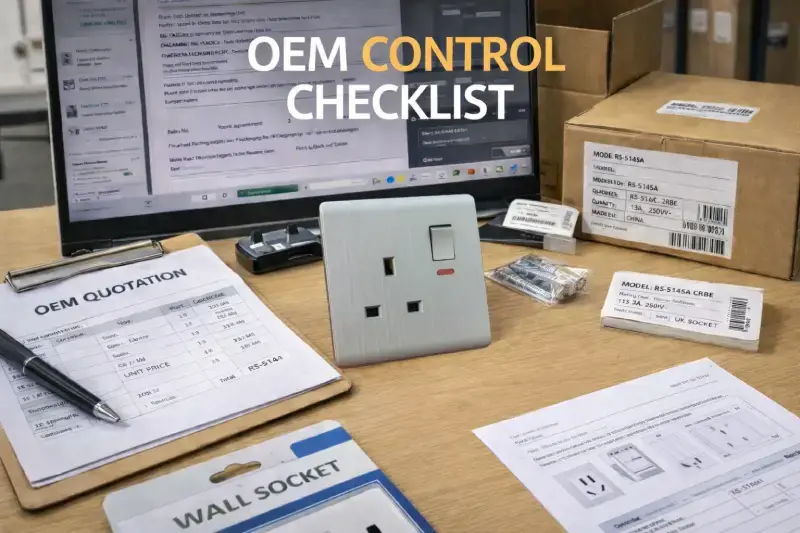
When buyers search for a wall socket OEM manufacturer or an OEM wall socket checklist, they are usually not looking for a basic private-label explanation. They are trying to answer a harder question: can this supplier keep one OEM version stable after branding starts?
That is the real issue. A standard wall socket may be easy to quote, stock, and reorder before OEM. Once logo changes, customer packaging, label logic, accessory differences, or internal material changes enter the project, the same product can become harder to compare, harder to replenish, and harder to explain. This page focuses on that control problem.
Contents
Why OEM Projects Drift
Most OEM projects do not fail because a factory cannot print a logo or revise a carton. Those are routine tasks. Projects drift when customization is handled as a sales promise instead of a version-control system.
The problem usually starts with one model carrying too many changes under one name. A buyer asks for logo replacement, then carton revision, then label changes, then a slightly different accessory set, then a lower-cost internal material. None of these changes looks serious on its own. Together, they create a product that is no longer clearly defined.
That is when commercial trouble begins. The quotation looks comparable but the scope is different. The sample looks right but the bulk version is not the same. The model name stays unchanged but the product behind it drifts. The first order may still ship. The real failure appears later, when the buyer tries to reorder or stock the same item and finds that “same model” no longer means “same product.”
For importers and distributors, this is the real OEM risk. It is not branding difficulty. It is version drift.
How to Test a Wall Socket OEM Manufacturer
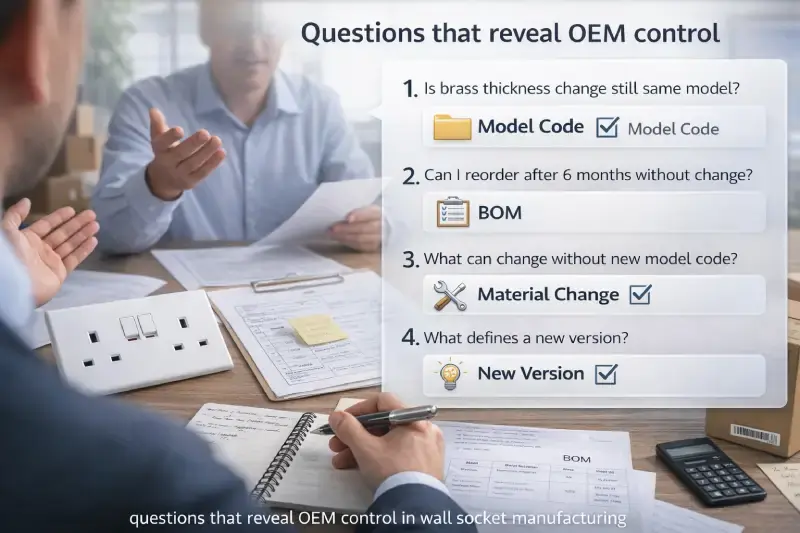
The fastest way to judge a wall socket OEM manufacturer is not by stopping at a broad OEM capability claim. Nearly every supplier will say yes. If you need that broader capability background first, our OEM and ODM wall switch and socket manufacturing guide covers it. The better method here is to ask questions that force the supplier to show whether it has a real control system.
Ask: “If I change brass thickness, is it still the same model?”
A weak answer sounds like this:
- “Yes, small change is ok.”
- “We can adjust based on price.”
That usually means internal structure is not being treated as a version boundary. A stronger answer is clear: a change in brass thickness creates a new version or a new model code.
Ask: “Can I reorder the exact same product after six months?”
A vague “yes, no problem” is not enough. A stronger answer explains how sameness is protected, usually by keeping the same model code and the same BOM unchanged.
Ask: “What changes can be made without changing model code?”
If the supplier says color, material, and structure can all be adjusted under one code, the boundary is too loose. A stronger answer limits that to cosmetic changes such as logo or color, not internal structure.
Ask: “What defines a new version in your system?”
If the supplier has no definition, the OEM system is weak. A reliable manufacturer should be able to explain that changes in structure, rating, material, or supply scope create a new version.
The point is simple: you are not collecting product information. You are testing whether the supplier has discipline. A strong supplier can define the model, define the change boundary, and explain how repeat orders are protected. A weak one can only promise flexibility.
OEM Checklist: What Must Be Locked Before Production
A useful OEM wall socket checklist should help buyers lock the product before artwork approval, not just approve branding on a moving target. If you need the factory-side process behind that control, our wall switch and socket manufacturing process and quality control guide explains it in more detail.
First, lock the base model.
Before discussing logo position, carton design, manuals, or label artwork, confirm the base model against one fixed checklist.
| What must be fixed | Why buyers should lock it first |
|---|---|
| Model code | Stops later orders from mixing several versions under one name |
| Product function | Keeps the OEM request tied to one defined socket type |
| Rating | Prevents branding from being applied to an unstable electrical basis |
| Internal structure | Protects the real product logic behind the approved sample |
| Finish | Keeps visible appearance and replenishment expectations aligned |
| Accessory set | Reduces later disputes over what was or was not included |
| Packaging basis | Prevents stock, carton, and labeling logic from drifting after approval |
If those points are still moving, the product is not ready for OEM. Branding on top of a moving target only hides the control problem.
Second, separate safe changes from risky changes.
Not every OEM change creates the same level of risk. It is easier to judge them when they are grouped by what they affect.
| Risk level | Typical changes | Why it matters |
|---|---|---|
| Lower-risk | Logo replacement, outer carton artwork revision, branded inserts, limited color changes | Mainly changes presentation, not core product logic |
| Medium-risk | Label wording, pack quantity, accessory combinations, customer-specific carton logic | Often changes identification and supply handling even when the product still looks similar |
| High-risk | Internal structure changes, brass or copper thickness changes, terminal design changes, added USB function, multiple customer versions under one model name | Touches product logic and should usually trigger a new version or new model reference |
If a change affects function, structure, or internal material, it should usually be treated as a new version, often with a new model reference.
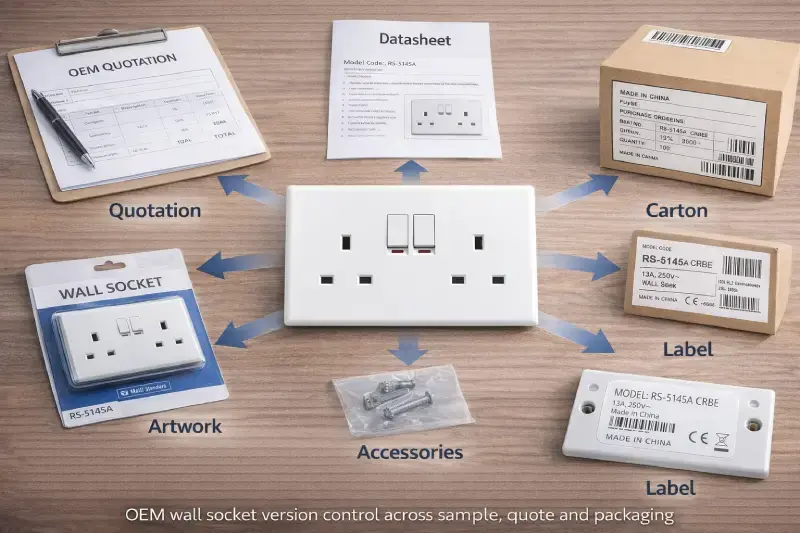
Third, check the fields that must stay aligned.
You do not need to read every file line by line. Start with the fields most likely to drift.
On the outer carton, check:
- Model code
- Product name
- Rating
- Quantity
If the carton only says “UK socket” or another broad description, the version is not properly locked.
On the product label or marking, check:
- Model code
- Rating
- Brand or origin wording
If the sample carries clear marking but the bulk version does not, the project is already unstable.
On the datasheet, check:
- Model code
- Rating
- Structure description such as switched or unswitched
If the datasheet has no model code, it may only be a generic template.
On packaging artwork, lock:
- Model code
- Standard wording if used
- Brand
Accessory set is another common drift point. Check screws, mounting or back-box scope where relevant, and terminal type. These details often change quietly between orders and later create complaints because the shipment still looks almost the same.
The rule is simple: do not ask whether each item exists. Ask whether all of them describe the same exact version.
Pricing, Stock, and Repeat Orders
OEM projects often look acceptable at the sample stage and still fail commercially later. The reason is usually not obvious quality collapse. It is poor control over price scope, stock logic, or repeat-order discipline.
Why OEM pricing becomes hard to compare
Two wall sockets may look similar, but one quotation may include branded cartons, labels, manuals, accessories, and file updates while another includes only logo printing. A lower price may simply mean part of the OEM scope is missing. Buyers should compare quotation scope, not just product appearance. Our commercial wiring accessories supplier guide breaks that quotation-comparison logic down further.
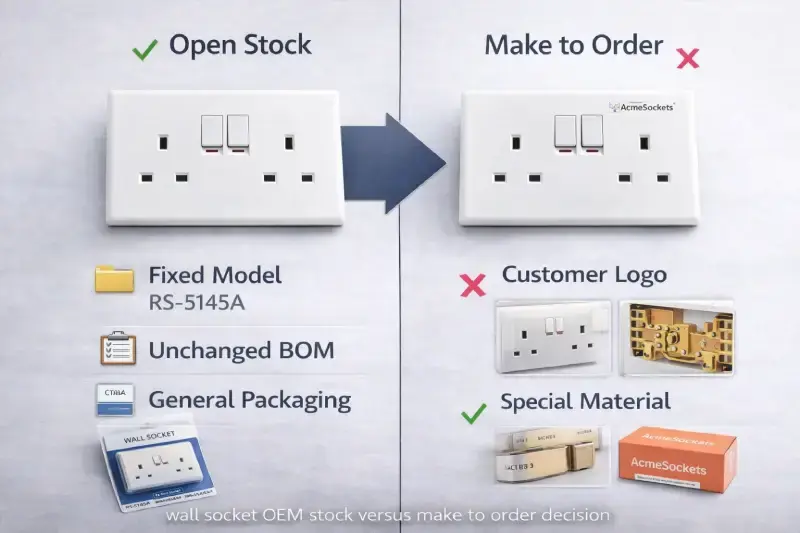
When an OEM version is safe for stock
Not every OEM version should enter open stock. A version is safer for stock when all four conditions are stable:
- Fixed model code
- Unchanged BOM
- Unchanged structure
- Packaging that does not vary by customer
A typical example is a standard 13A white socket sold in general packaging to multiple customers.
A version should stay make-to-order when any customer-specific element changes the supply logic:
- Customer logo
- Customer packaging
- Special function
- Special material
Some changes also require separate stock even when the product seems similar:
- Different marking languages
- Different standard wording
- Different terminal structures
A practical stock test helps here: can this product be sold to another customer without confusion? If yes, it is more suitable for stock. If no, it should stay order-based.
How repeat-order drift begins
Repeat-order drift usually starts because the first order was approved too loosely. The safer method is to lock one full model code on the first order and keep one approval pack for future reference. That pack should include:
- Approved sample
- Quotation
- Datasheet
- Packaging artwork
- Label logic
- Carton record
Before reordering, check again. Do not accept “same as last time” unless the supplier can confirm that the same approved version is still active. In OEM distribution projects, repeat-order instability often comes less from obvious production failure than from version inconsistency.
Final Decision: Proceed, Verify, or Stop
Use three outcomes when reviewing a wall socket OEM manufacturer.
Proceed when the base product is fixed, the OEM scope is clear, version control is visible, and repeat-order logic is stable.
Verify when the project is possible, but model definition, labeling, packaging, or file alignment is still not fully locked.
Stop when the supplier can customize presentation but cannot hold one stable product version. If repeat orders depend on memory instead of records, the OEM risk is too high.
If OEM control is still unclear, step back and evaluate the factory more broadly through our electrical switch and socket manufacturer in China guide before moving further into private-label work.
FAQ About Choosing a Wall Socket OEM Manufacturer
What makes a wall socket manufacturer truly suitable for OEM?
A wall socket OEM manufacturer is suitable for OEM when it can lock one exact model and keep the same version logic across sample, quotation, packaging, and repeat orders.
Which OEM changes are relatively safe, and which ones create version risk?
Logo changes and outer artwork are usually lower-risk. Model naming, label logic, accessory combinations, pack quantity changes, and internal structure changes create much higher version risk.
Why do OEM wall socket quotations become hard to compare?
Because similar-looking products may carry different OEM scope in packaging, labels, accessories, manuals, carton printing, and file support. The visible product may look the same while the execution scope is different.
At which stage do OEM projects usually start losing control?
Usually at inquiry, sample approval, confirmation, or reorder stage. The most expensive failures often appear at reorder stage, when the same model name no longer means the same version.
How can importers avoid OEM projects that work once but fail on repeat orders?
Lock the full model code from the first order and keep one complete approval pack covering sample, quotation, datasheet, packaging artwork, labels, and carton records. Reorders should always be checked against that pack. For a deeper repeat-order control framework, see our guide to OEM wall socket repeat-order version control.
Conclusion
A reliable wall socket OEM manufacturer is not the factory that agrees to every customization request. It is the one that can keep one product definition, one quotation basis, one packaging logic, and one repeat-order version stable after OEM begins. That is the real value of an OEM wall socket checklist.