The V7 Series: Ultra-Thin, Borderless Wall Switch Design for Minimalist Architecture
This article introduces the LIBAIK V7 Series, an ultra-thin, borderless wall switch designed for minimalist architecture. It explores how large-panel design, 5–6 mm thickness, and PC or glass panel options support visual continuity and long-term project consistency in residential and commercial spaces.
The V7 Series: Ultra-Thin, Borderless Wall Switch Design for Minimalist Architecture
In contemporary architecture and interior design, restraint has become a defining value. Clean lines, continuous surfaces, and visual calm now matter more than decorative complexity. In this context, every element that interrupts a wall surface—no matter how small—must justify its presence.
The LIBAIK V7 Series was developed for precisely this design philosophy. As an ultra-thin, large-panel, borderless wall switch system, the V7 is not intended to draw attention. Instead, it is designed to visually dissolve into the wall, supporting architectural intent rather than competing with it. Developed by an experienced electrical wall switch and socket manufacturer, it reflects a long-term focus on real project application
With a profile of just 5–6 mm, an oversized panel format, and a frameless appearance, the V7 series represents a deliberate move toward architectural minimalism. Available in both PC and glass panel options, it allows designers and project teams to maintain a single design language while adapting material expression to different spaces. This series is part of our broader guide on how to choose the right wall switch series for residential and commercial projects, where different design and application priorities are explained in detail.
When the Best Switch Is the One You Hardly Notice
In highly controlled interiors, visibility itself becomes a design decision. Many minimalist spaces aim to reduce visual noise, allowing materials, light, and proportion to define the atmosphere. In these environments, traditional switches—thick, framed, or visually segmented—often feel intrusive.
The V7 series approaches the wall switch as an architectural element rather than a decorative accessory. Its large, borderless panel minimizes visual breaks in the wall surface, while its ultra-thin construction reduces perceived depth. The result is a switch that feels intentionally understated—present when needed, almost invisible when not.
This design choice is rarely driven by cost or trend. It is most often specified by architects and designers who prioritize spatial continuity and want functional elements to recede into the background. In such projects, the success of a wall switch is measured not by how noticeable it is, but by how effortlessly it integrates into the space.
Ultra-Thin Engineering: Why 5–6 mm Changes Everything
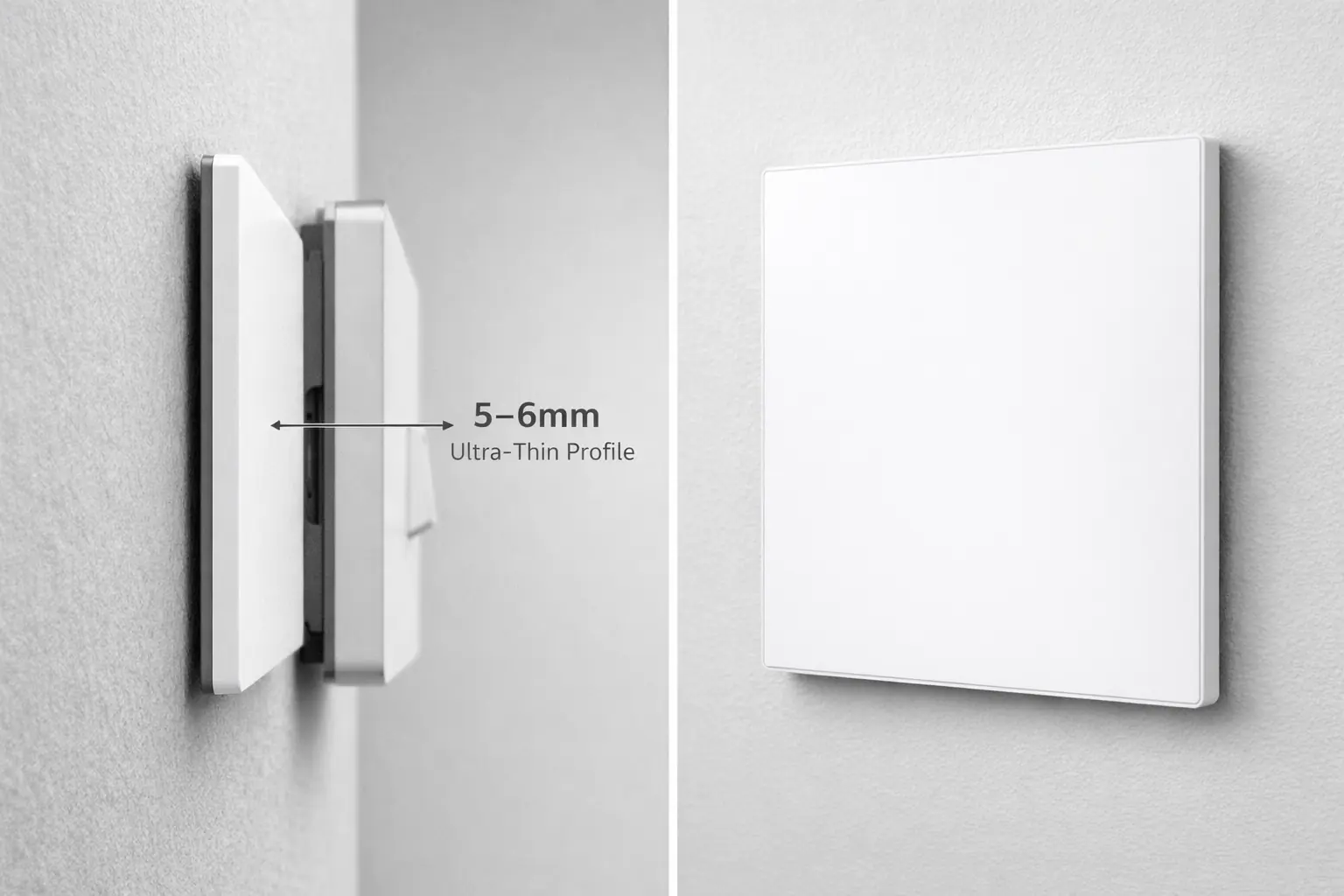
Achieving a thickness of 5–6 mm is not a cosmetic decision; it is an engineering challenge. Conventional wall switches typically rely on thicker assemblies to accommodate structure, tolerances, and installation variation. Reducing thickness while maintaining rigidity and reliability requires precise internal design and material control.
From a visual standpoint, ultra-thin construction significantly alters how the switch interacts with the wall. The reduced profile minimizes shadow lines and edge contrast, allowing the faceplate to sit closer to the wall plane. In minimalist interiors, this subtle difference has a disproportionate impact on perceived quality.
From a production perspective, thinner designs demand higher consistency. Warping, uneven mounting, or surface deformation becomes far more visible as thickness decreases. The V7 series was developed with these constraints in mind, balancing slim proportions with structural stability to ensure long-term performance in real installations—not just in controlled showroom environments.
This focus on thinness is not about novelty. It reflects a deeper understanding of how modern spaces are designed and experienced.
Large Panel, Borderless Design: Creating a Continuous Wall Surface
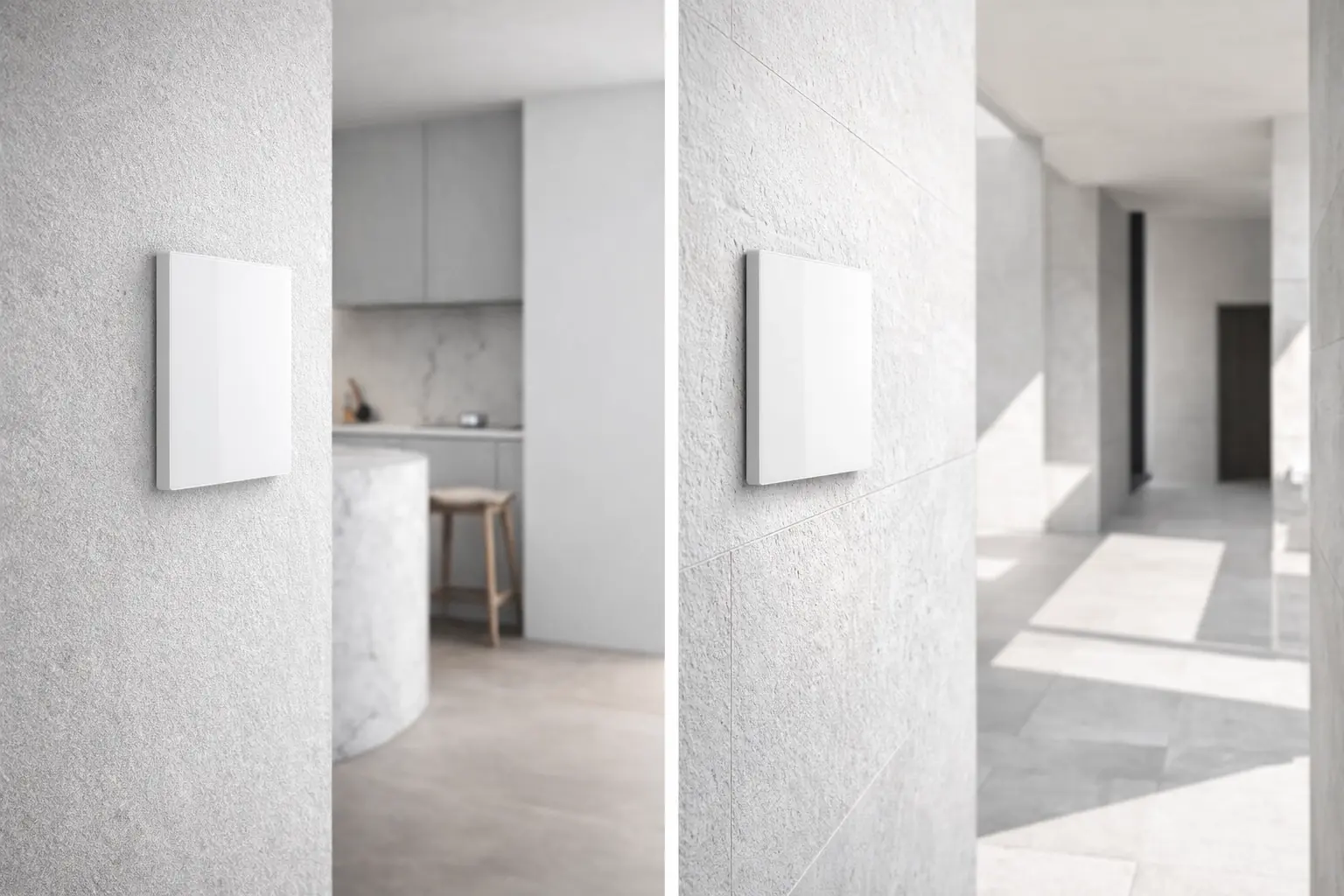
At first glance, a large panel might seem like a bold gesture. In practice, however, it serves a practical architectural function. By increasing surface coverage, the V7 panel helps visually unify the installation area, reducing the impact of minor wall imperfections or alignment tolerances.
The borderless design plays an equally important role. Without a defined frame, the panel edges transition softly into the wall, preventing the switch from appearing as a separate object. This is particularly effective in projects where walls are finished with large-format materials, refined plasterwork, or seamless paint systems.
Rather than emphasizing size, the V7 uses scale to achieve visual calm. The panel does not dominate the wall; it stabilizes it. This approach aligns closely with contemporary architectural thinking, where fewer, larger elements are often preferred over many small, competing details.
One Design Language, Two Material Expressions: PC and Glass Panels
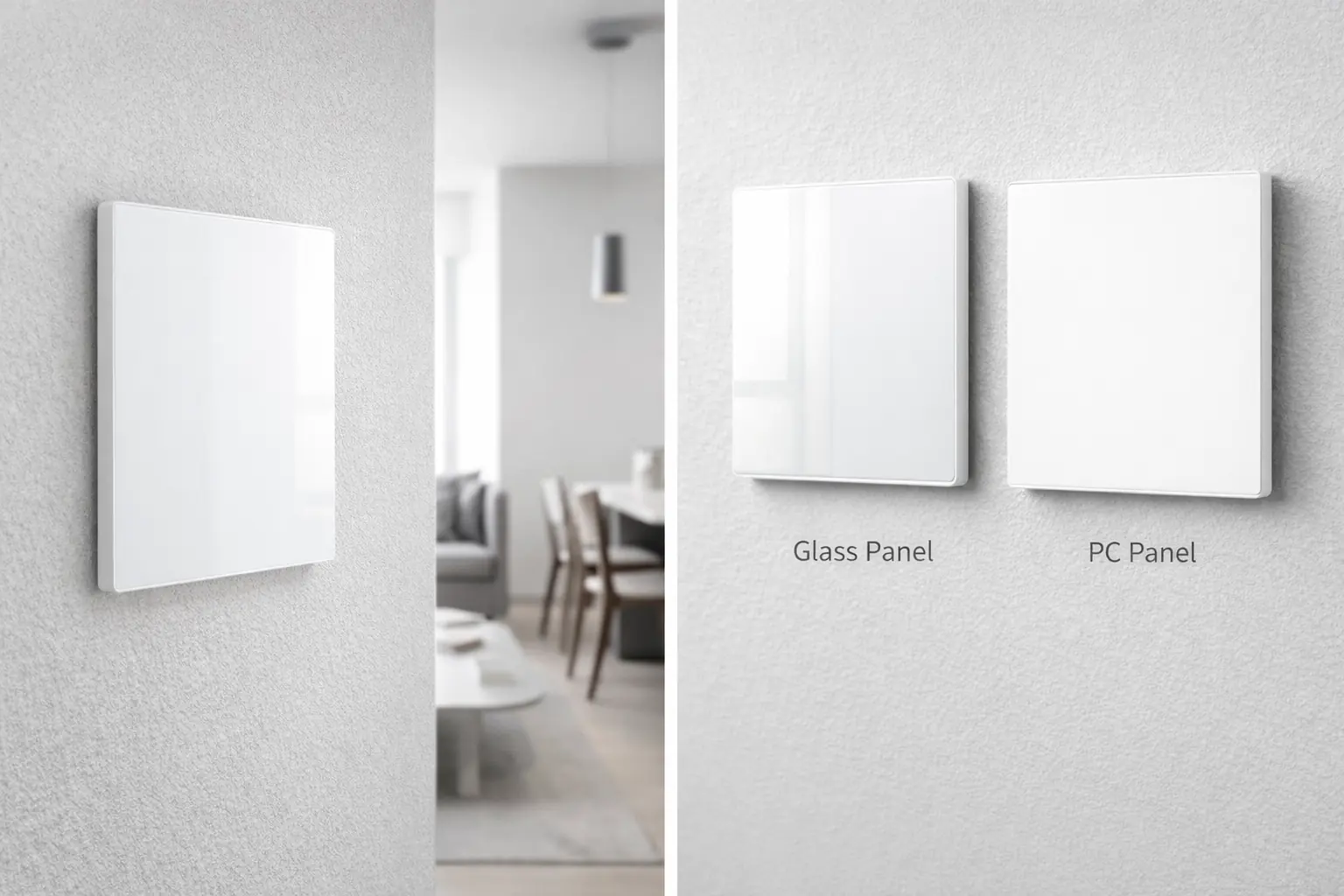
While the V7 series maintains a consistent structural and visual identity, it offers two material expressions to suit different project needs.
PC Panel Version
The PC panel version provides a softer, more forgiving surface. With lower reflectivity and a warmer visual character, it integrates naturally into residential projects, large-scale apartment developments, and spaces where consistency and durability are priorities. Its resilience makes it particularly suitable for projects with extensive repetition, where long-term appearance matters as much as initial impression.
Glass Panel Version
The glass panel version offers a sharper, more architectural presence. Its smooth, reflective surface interacts more directly with light, reinforcing clean lines and geometric clarity. This option is often chosen for design-forward interiors where material precision is part of the spatial narrative.
Importantly, these two options are not positioned as different tiers of quality. They represent different interpretations of the same minimalist design language, allowing designers to adapt the V7 series to varied environments without compromising visual coherence.
Designed for Designers, Specified for Projects
Beyond aesthetics, the V7 series was developed with real project workflows in mind. Its modular structure supports consistent specification across multiple spaces, making it suitable for projects that move from sample units and show apartments to full-scale implementation.
Design consistency is often one of the biggest challenges in larger developments. Small variations in electrical accessories can quickly disrupt an otherwise controlled design scheme. The V7’s restrained form, large panel format, and borderless appearance make it easier to maintain uniformity across different rooms and functional areas.
For professional teams, this reliability is just as important as appearance. A switch that integrates seamlessly into one space but becomes visually disruptive in another ultimately undermines the overall design intent. The V7 series addresses this by prioritizing repeatability and visual stability, qualities that are essential for long-term project success.
Different projects prioritize visibility, tactility, or architectural continuity—understanding how to choose the right wall switch series is often as important as the design itself.
Minimal by Design, Intentional by Choice
The LIBAIK V7 Series is not designed to impress at first glance. Its value emerges through use, repetition, and integration. By combining ultra-thin construction, a large borderless panel, and carefully considered material options, it supports a design philosophy where function and form quietly reinforce one another.
In an era where minimalism is often misunderstood as simplicity, the V7 demonstrates that restraint requires precision. Every proportion, surface, and transition must be carefully resolved to achieve an outcome that feels effortless.
For designers and project teams who believe that the best solutions are often the least conspicuous, the V7 series offers a wall switch that respects the space it occupies—by almost disappearing into it.