Wall Switch & Socket Manufacturing Process and Quality Control
This page explains how wall switches and sockets are manufactured in a factory environment, covering material selection, production processes, quality control stages, and safety testing. It is written for professional buyers evaluating manufacturing reliability and long-term supply stability.
Wall Switch & Socket Manufacturing Process and Quality Control
For experienced buyers, manufacturing quality is not defined by a single inspection report.
It is defined by how many times quality is checked before a product is allowed to leave the factory.
In wall switch and socket manufacturing, problems rarely come from one big mistake. They come from small, repeated decisions—material selection, component control, assembly discipline, and how seriously quality checks are enforced on the production floor.
This page explains how those decisions are managed in practice.
Key Materials Used in Wall Switch and Socket Manufacturing
Material selection is the foundation of long-term reliability.
Once a product is installed in a wall, replacing it is costly and disruptive. That is why material choices are made conservatively, not cosmetically.
Flame-Retardant PC for Housings
Switch and socket housings are manufactured using flame-retardant PC materials.
This choice is driven by:
- Heat resistance under continuous load
- Flame retardancy in abnormal electrical conditions
- Structural stability over years of use
In hot climates or high-load environments, housing material is often the first point of failure if compromises are made.
Brass and Red Copper Components
Electrical conductivity and mechanical stability depend heavily on metal components.
- Brass parts are widely used for terminals and structural elements where mechanical strength and stable contact pressure are required.
- Red copper components are applied where higher conductivity and lower resistance are critical.
These materials are selected based on function, not cost alone.
Silver Contacts for Switching Reliability
Silver contacts are used in switching points to ensure:
- Stable electrical contact
- Reduced arcing
- Long electrical and mechanical service life
For buyers concerned about lifecycle performance and return rates, contact material plays a larger role than appearance or packaging.
Manufacturing Process Overview
A reliable product is the result of a controlled process, not a single inspection step.
Injection Molding of Plastic Components
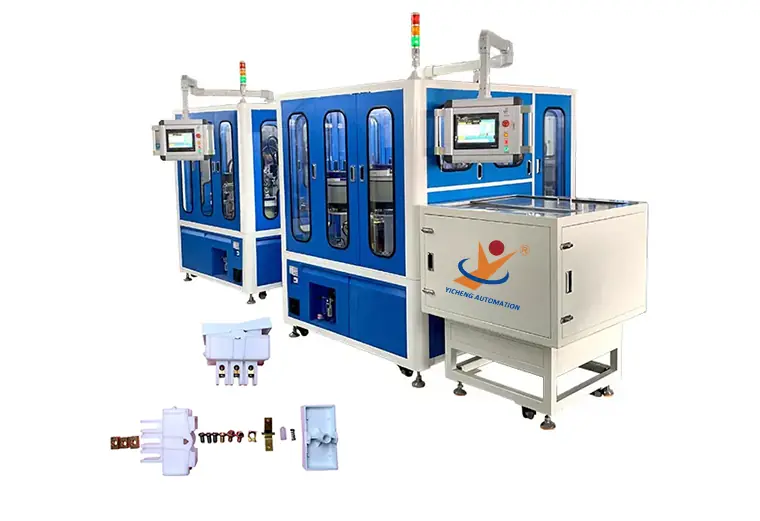
Injection molding is handled in-house to maintain control over:
- Material consistency
- Mold condition and accuracy
- Dimensional stability of housings and frames
For buyers verifying whether a supplier is a real manufacturer, the presence of injection molding facilities is often a decisive factor.
Assembly and Modular Configuration
After molding, components move to modular assembly lines.
Assembly focuses on:
- Correct module configuration for target markets
- Secure terminal fastening
- Mechanical alignment and tactile consistency
Modular systems allow different configurations to be produced without changing the core structure, which improves consistency across markets.
Multi-Stage Quality Control System
Quality control is implemented as a process, not an isolated checkpoint.
Incoming Material Inspection
All raw materials are inspected before entering the warehouse to verify:
- Material specifications
- Appearance and structural integrity
- Compliance with internal requirements
Materials that do not meet requirements are not released to production.
Inspection of Outsourced Components (e.g. USB PCB)
Certain components, such as USB PCB modules, are sourced externally.
These parts undergo separate inspection before warehousing to confirm:
- Functional performance
- Assembly compatibility
- Visual and structural condition
Only approved components are allowed to enter the production flow.
Pre-Production Warehouse Check and Routine Sampling
Before materials are released to the production line:
- Warehouse checks confirm correct batching and identification
- Routine sampling inspections verify ongoing consistency
This step reduces the risk of systematic errors during mass production.
Assembly Self-Inspection and QC 100% Inspection
During assembly:
- Operators conduct self-inspection at their stations
- QC personnel perform 100% inspection of finished products
This combination helps detect both process drift and individual assembly issues.
Pre-Shipment Bulk Order Inspection
Before shipment:
- Finished goods are sampled from bulk orders
- Packaging, labeling, and functional performance are verified
Products are released for shipment only after all inspection stages are confirmed.
Safety and Durability Testing
Testing is conducted to simulate real-world conditions rather than ideal laboratory environments.
Heat Resistance and Flame Retardancy
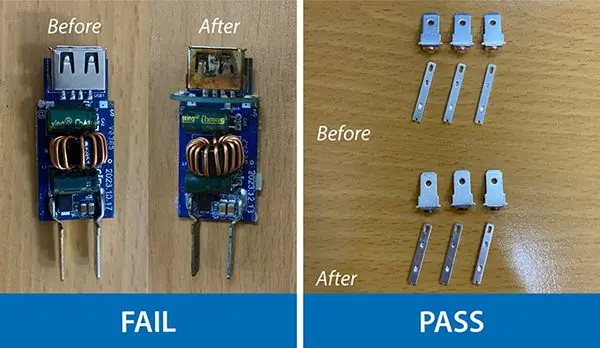
Tests include:
- High-temperature resistance
- Flame-retardant performance
- Needle flame testing
These tests are especially relevant for high-temperature markets.
Mechanical and Environmental Durability
Additional tests cover:
- Drop testing
- Abrasion resistance
- Aging tests
- Mechanical and electrical lifecycle testing
- Salt spray testing for corrosion resistance
Together, these tests provide a realistic view of long-term product behavior.
Why Process and Quality Matter to Buyers
For buyers managing long-term distribution or project supply, quality issues rarely appear in the first shipment. They appear months later, after installation.
A structured manufacturing and quality control system reduces:
- Batch inconsistency
- Unexpected field failures
- After-sales disputes
- Reputation risk in local markets
This is why experienced buyers evaluate factories based on process discipline, not promises.
Related Standards and References
Manufacturing and testing principles align with international electrical safety frameworks, such as those defined by the International Electrotechnical Commission (IEC):
https://www.iec.ch
For an overview of our overall manufacturing approach, you may also refer back to our main manufacturer page:
https://www.libaikglobal.com/electrical-wall-switch-socket-manufacturer/
Closing Note
In wall switch and socket manufacturing, quality is rarely accidental. It is the result of repeated, controlled decisions made on the factory floor—every day.
This page is intended to provide that visibility.