For Middle East wholesalers, importers, and project suppliers, single vs double BS1363 socket selection is not a simple choice between one outlet and two. It affects stock turnover, BOQ accuracy, wall box planning, consultant approval, installation cost, and after-sales risk.
In day-to-day wholesale sales, single BS1363 sockets often remain the baseline fast-moving SKU. Double BS1363 sockets become more important in project zones such as kitchens, bedside areas, TV walls, hotel rooms, and workstations. Once the flush wall box or back box has been installed, changing from a 1-gang to a 2-gang position can create wall damage, finish repair, and approval delay.
This guide is for buyers who already need the BS 1363 / Type G format and now need to choose a practical 1-gang / 2-gang BS1363 socket mix for Middle East projects, wholesale replenishment, or bulk supply.
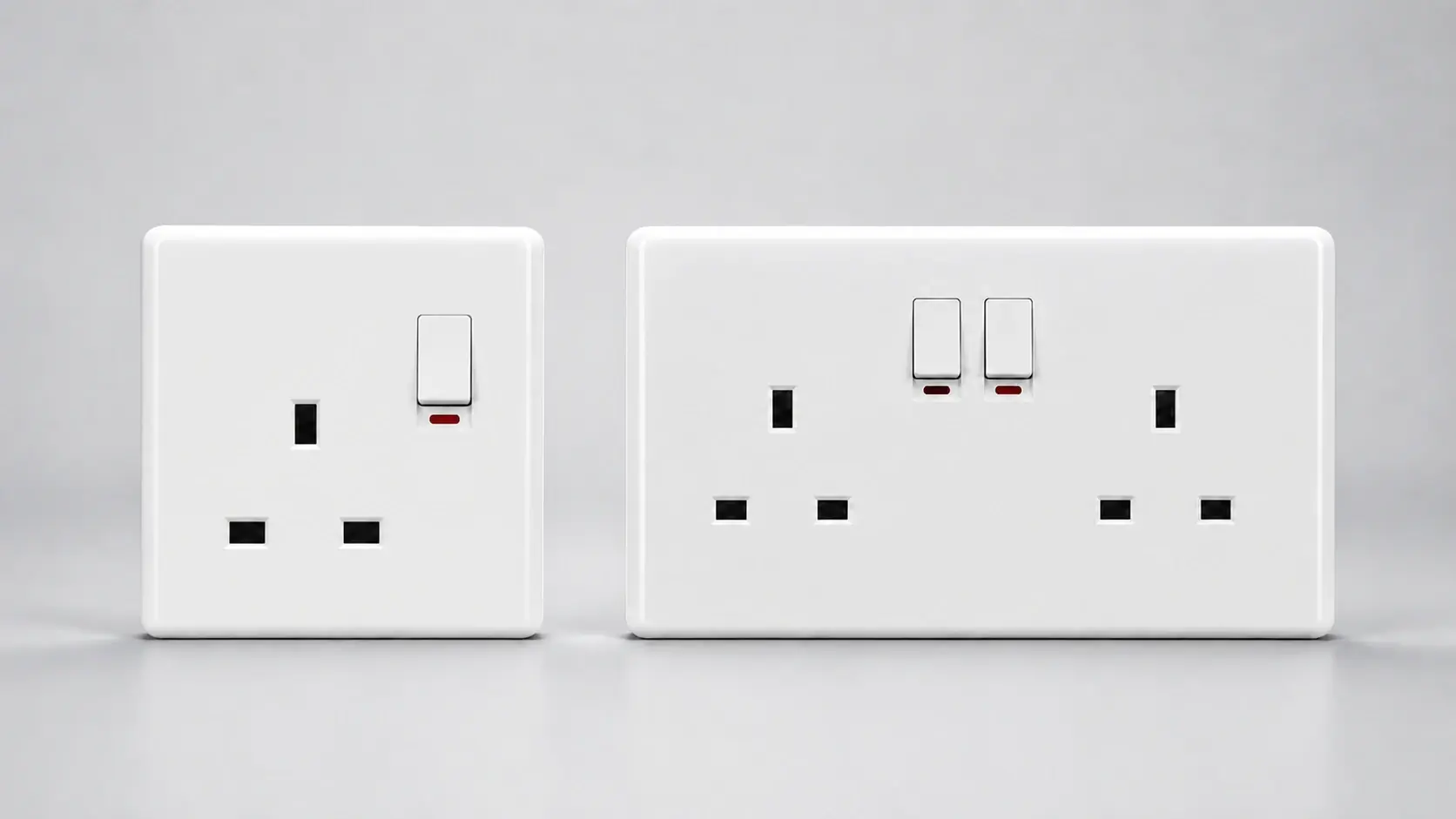
Single and double BS1363 sockets for Middle East project buyers.
Contents
- Quick Selection Summary: Single, Double, or Mixed BS1363 Sockets
- How This Guide Differs From a General BS1363 Specification Page
- Single vs Double BS1363 Socket: Key Procurement Differences
- Middle East Selection Ratio: Planning 1-Gang vs 2-Gang Stock
- Back Box Compatibility: Preventing Rework Before Installation Starts
- Double BS1363 Socket Safety: What Bulk Buyers Should Verify
- Visual Consistency and Material Submittal Requirements
- Common Selection Mistakes Middle East Buyers Should Avoid
- Frequently Asked Questions
- Conclusion
Quick Selection Summary: Single, Double, or Mixed BS1363 Sockets
For most Middle East orders, the safest answer is a controlled mix based on room function, channel type, project stage, and installation drawings.
| Selection option | Best-fit applications | Buyer reason | Main risk if misused |
|---|---|---|---|
| Single BS1363 socket | Wholesale, replacement, controlled points, cost-sensitive projects | Strong baseline turnover and simpler replacement logic | Underestimating project areas that need higher outlet density |
| Double BS1363 socket | Kitchens, bedside areas, TV walls, workstations, hotels, offices | More usable outlets in high-use positions | Overstock if treated as a universal bestseller |
| Mixed BS1363 socket ratio | Importers and distributors serving several channels | Balances retail, replacement, and project demand | Cash tied up if one ratio is copied across all markets |
Retail replenishment and project BOQ should not be treated the same. Across many wholesale channels, 1-gang BS1363 sockets remain the stronger baseline item. 2-gang BS1363 sockets should be planned around drawings and high-use areas such as kitchens, bedside points, TV walls, and workstations.
A fixed 50:50 purchase ratio may look convenient, but it rarely reflects real demand. Buyers usually get better control by separating base stock, project stock, finish-specific stock, and special versions such as switched, unswitched, USB, or premium-faceplate models.
How This Guide Differs From a General BS1363 Specification Page
A general BS1363 wall socket specification page explains ratings, shutter design, terminal details, marking, and product-level requirements. This guide sits one step later in the buying process. It assumes the buyer has already selected the BS1363 format, then focuses on how to choose the correct single and double socket mix before ordering, submitting, or installing.
That distinction matters in Middle East projects because the wrong format is not just a product preference. A late change can affect box size, wall opening, cable space, sample approval, contractor schedule, and warehouse stock value. Selection should therefore be confirmed before wall work and material submittal move too far.
Review basis used in this page: buyer-side project quotation review, room-by-room BOQ comparison, wall box and dimensional checking, material submittal preparation, sample-to-order review, and repeat-order feedback from BS1363 socket sourcing. This guide supports procurement judgment and does not replace market-specific electrical, legal, or certification advice.
Single vs Double BS1363 Socket: Key Procurement Differences
For B2B buyers, each format changes stock value, wall planning, installation risk, and approval documents.
| Factor | Single BS1363 socket | Double BS1363 socket | Buyer implication |
|---|---|---|---|
| Stock movement | Baseline wholesale and replacement SKU | More project-driven demand | Keep single as core stock; plan double by project and room schedule |
| Installation | Simpler where one point is needed | Needs 2-gang wall box planning and enough cable space | Wrong selection can cause rework after first fix |
| Safety review | Lower simultaneous-use pressure in many positions | More likely to serve two appliances at the same time | Verify terminal design, grounding, and test evidence |
| Range consistency | Must match the wider accessory series | Must match the same profile, finish, and switch style | Mixed styles can affect consultant approval and handover |
A single socket often remains the core turnover item for general wholesale. A double socket improves outlet density in the right project zones, but it also requires closer checking of wall box compatibility, terminal capacity, grounding design, and approval documents.
Middle East Selection Ratio: Planning 1-Gang vs 2-Gang Stock by Channel and Project Type
For large wholesalers, BS1363 socket selection should start with channel logic, not country names alone. In actual Middle East supply, 1-gang BS1363 sockets often remain the core moving stock across replacement and traditional wholesale channels. The real change happens when the buyer moves into project BOQ, premium interiors, hotels, offices, or high-use room zones.
Country differences still matter, but they should not override channel logic. A UAE hotel project and a Saudi hotel project may have more in common than a Saudi hotel project and a Saudi replacement wholesaler. Buyers should first separate wholesale replenishment from project orders, then adjust by country, customer type, finish, room schedule, and approved drawings.
General wholesale and replacement channels
For traditional wholesalers, hardware-market distributors, and replacement channels, single sockets usually remain the base stock. Older wall boxes, conservative buying habits, small repair jobs, and cost-sensitive customers all support steady demand for 1-gang BS1363 sockets.
This is why single sockets should not be reduced too aggressively just because modern projects use more double sockets. For many distributors, single remains the everyday turnover SKU.
Project BOQ and contractor orders
Project orders behave differently. In hotels, serviced apartments, premium residential projects, and commercial interiors, 2-gang BS1363 sockets usually take a larger share in high-use zones. Bedside points may need double sockets or socket-plus-USB combinations. Kitchen counters often require multiple double sockets because several small appliances may be used in the same area. TV walls and workstations also need higher outlet density.
The right ratio should come from the room-by-room schedule, contractor drawings, and approved BOQ, not from a fixed warehouse rule.
How to build a practical stock ratio
A practical stock ratio should combine four inputs:
- Historical sales movement for single and double sockets
- Project BOQ and room-by-room socket schedule
- Customer type, such as wholesaler, contractor, importer, retailer, or project supplier
- Finish and series demand, especially for premium, slim, or USB models
The goal is not to find one universal Middle East ratio. The goal is to keep 1-gang sockets as stable base stock while allocating 2-gang sockets to the projects and room zones where they are actually required.
Back Box Compatibility: Preventing Rework Before Installation Starts
A single vs double BS1363 socket decision should be confirmed before wall box installation. In many Middle East projects, the contractor installs the flush wall box / back box during the civil and MEP first-fix stage, so buyers should review BS standard wall switch and socket installation guidance before the box schedule is locked. Market references may describe 1-gang and 2-gang GI boxes as 3 x 3 and 3 x 6 formats, but final dimensions must follow the project drawing, box depth, and supplier installation data.
Changing the format later can mean removing tile or stone, enlarging the wall opening, replacing the box, repairing the finish, and delaying installation. That cost often turns into a dispute between the contractor, consultant, supplier, and importer.
Before confirming a BS1363 socket order, buyers should check:
- Wall box size for 1-gang BS1363 sockets and 2-gang BS1363 sockets
- Mounting depth and wiring space
- Screw fixing distance
- Wall finish thickness
- Room application and load expectation
- Supplier dimensional drawings
For LIBAIK's 2-gang BS1363 socket, the approximate depth from mounting plate to rear housing is 19.37 mm, and the approximate total depth from front faceplate to rear housing is 28.42 mm. The back housing also shows an 11 mm conductor stripping guide and terminals designed for 2 x 2.5mm² conductors per terminal.
These figures help buyers check the drawing, but cable quantity, back box depth, wall finish, and wiring method still need to match the project condition.
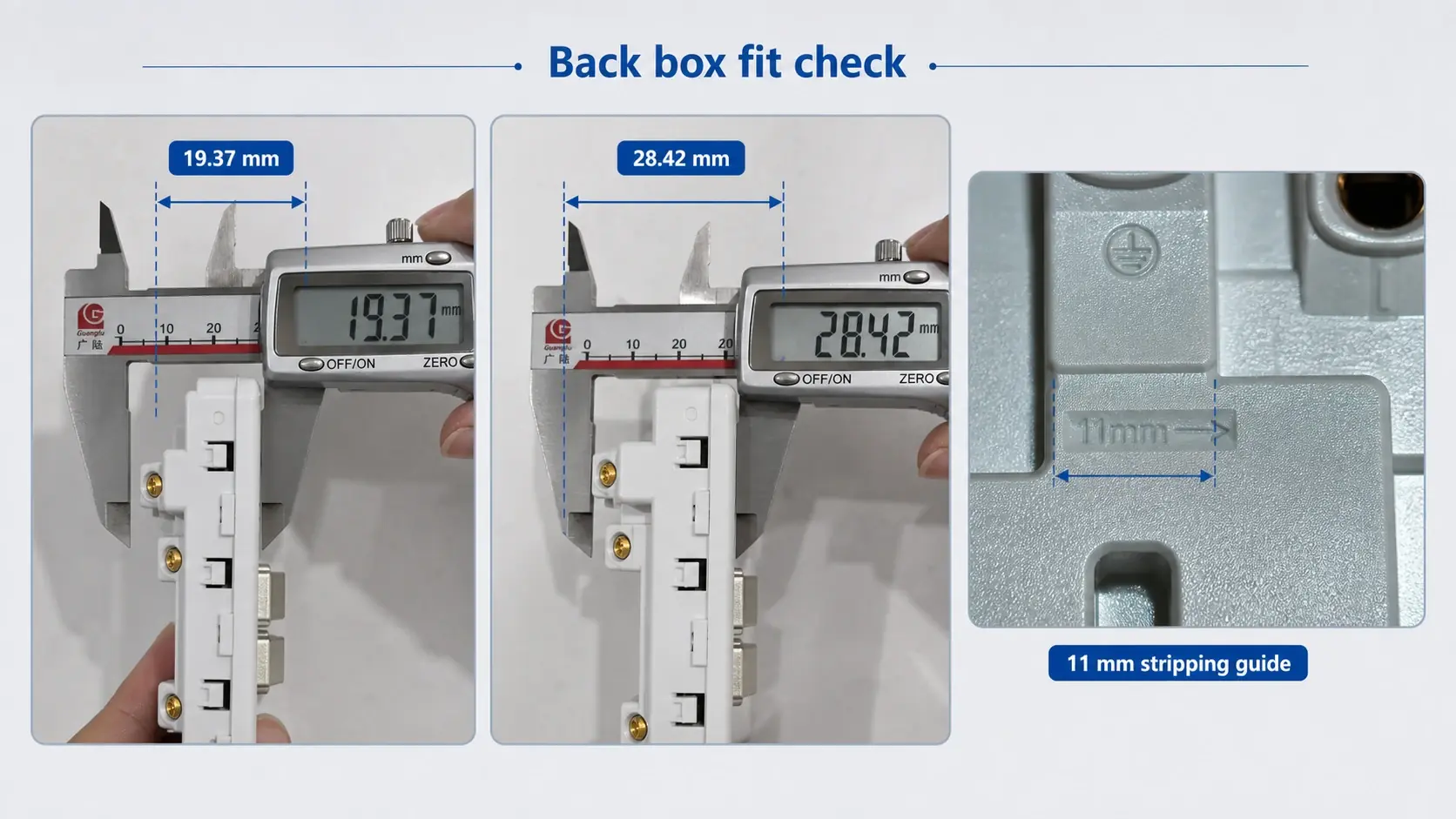
2-gang BS1363 socket depth dimensions for back box compatibility.
Double BS1363 Socket Safety: What Bulk Buyers Should Verify
A double BS1363 socket should not be judged only by faceplate style or unit price. In kitchens, hotel apartments, offices, and serviced residences, a 2-gang socket is more likely to serve two appliances at the same time. That makes internal structure, terminal capacity, grounding, and test evidence part of the buying decision.
Internal conductive structure
Bulk buyers should ask how the current path is built inside the double socket. The supplier should be able to explain the internal conductive structure, terminal material, copper thickness, and contact design.
For LIBAIK's 2-gang BS1363 double socket, the conductive path uses a one-piece integrated conductive structure, helping reduce unnecessary connection points inside the socket body. Product drawings, material declarations, and relevant testing should still support material claims.
Dual earth terminal requirements
Dual earth terminals may be requested in higher-specification projects, especially where consultant specifications, healthcare facilities, data centers, or commercial developments require stronger grounding provisions. They should not be described as universally mandatory unless the project specification says so.
LIBAIK's 2-gang BS1363 double socket is designed with dual earth terminals, giving project buyers a clear point to confirm in datasheets, drawings, and material submittal documents.
Temperature-rise evidence and test documents
For material submittal, buyers may also need to confirm terminal capacity, especially where loop-in / loop-out wiring or ring-style arrangements are used. LIBAIK's 2-gang BS1363 socket supports 2 x 2.5mm² conductors per terminal, which should be shown clearly in the product datasheet or technical drawing.
BS 1363 socket-outlets are commonly associated with 13A applications, and switched or unswitched versions should be checked against a clear BS1363 socket specification rather than vague claims such as "high load" or "heavy duty." Ask for a temperature-rise test report, product datasheet, certification documents, terminal design drawing, and material declaration.
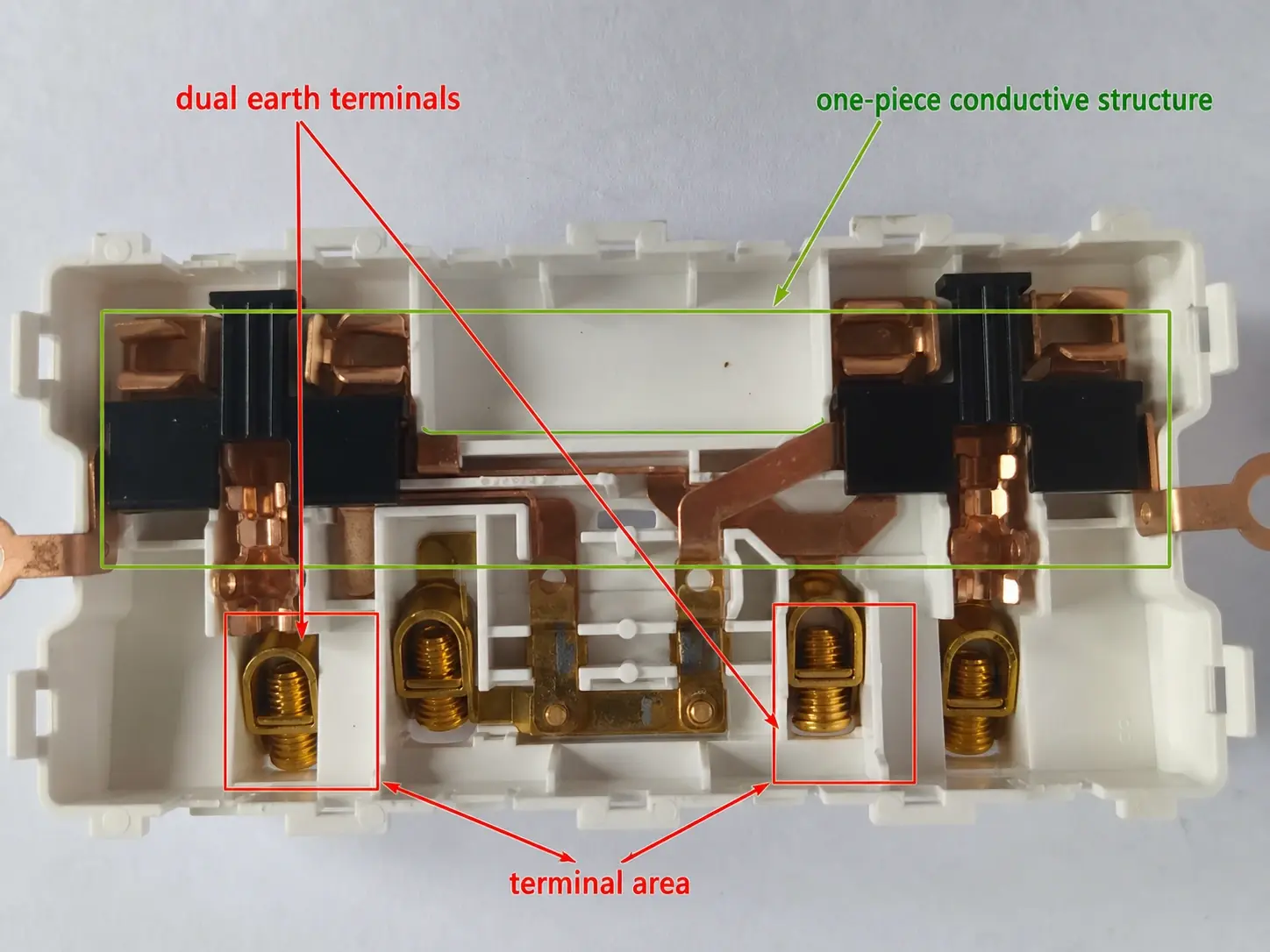
BS1363 double socket back view with dual earth terminals.
Visual Consistency and Material Submittal Requirements
For project buyers, a BS1363 socket range must work as a system. The single BS1363 socket, double BS1363 socket, and multi-gang accessories should share the same visual language and documentation standard.
Visual consistency matters in hotels, apartments, offices, and retail interiors. A mismatch between a 1-gang socket and a 2-gang socket may look small in a sample box, but it becomes obvious across an installed floor.
Key visual checks include:
- Same selection range for single, double, switched, unswitched, and multi-gang items
- Consistent faceplate profile and thickness
- Matching finish, such as white, matt black, brushed metal, or champagne
- Stable color tone across batches
- Slim profile compatibility with the required back box
For BS1363 socket selection, the buyer should request a BS1363 approval and marking checklist, not only product photos and a price list.
A practical submittal package should include:
- Product datasheet and model numbers
- Dimensional drawing for 1-gang and 2-gang sockets
- Wiring diagram and back box recommendation
- Certification and relevant test documentation
- Material declaration for conductive parts
- Finish samples or color references
- Terminal capacity, such as 2 x 2.5mm² conductors per terminal
- 2-gang dimensional data: 19.37 mm mounting-plate-to-rear-housing depth, 28.42 mm total depth, and 11 mm conductor stripping guide
- Confirmation of dual earth terminals where required by the project
- Internal conductive structure information where required
- Packaging, labeling, MOQ, lead time, and private-label details
This preparation helps buyers avoid visual rejection during handover and document rejection during consultant review.
Common Selection Mistakes Middle East Buyers Should Avoid
Even experienced importers can lose margin when single vs double BS1363 socket selection is handled too late or based only on price.
-
Using one ratio for all Middle East countries
A Dubai apartment project, a Riyadh residential order, and an Oman infrastructure supply package should not automatically use the same single/double ratio.
-
Mixing project demand with retail replenishment
Single sockets may remain the strongest baseline SKU in retail and replacement channels, while a project BOQ may require more double sockets in kitchens, bedside areas, TV walls, and workstations.
-
Buying double sockets without checking internal construction
A low price is not enough. Buyers should verify the internal conductive structure, terminal design, grounding arrangement, and test documents.
-
Ignoring back box depth and wiring space
A 2-gang BS1363 socket needs correct wall box planning. If the box is already installed, changing from single to double can create rework and contractor disputes.
-
Mixing different faceplate series in one project
Single, double, and multi-gang products should match in profile, finish, color tone, and switch style.
-
Treating material submittal as an afterthought
Datasheets, drawings, certificates, finish references, terminal capacity, back box recommendations, and test evidence should be ready before consultant review.
-
Choosing only by lowest unit price
The cheapest socket can become expensive if it causes slow inventory, failed approval, installation rework, urgent air-freight replenishment, or repeated complaints.
Frequently Asked Questions
Is a double BS1363 socket always better than a single socket?
No. A double BS1363 socket is better where users need higher outlet density, such as kitchens, hotel rooms, workstations, and premium apartments. A single BS1363 socket can still be better for controlled load points, cost-sensitive areas, service rooms, and traditional residential layouts.
What is the best single vs double BS1363 socket ratio for Middle East projects?
There is no universal ratio. The right single vs double BS1363 socket mix depends on project type, country demand, room schedule, contractor drawings, finish choice, and historical sales data.
Do UAE and Saudi projects use the same BS1363 socket selection ratio?
Usually not. A UAE premium apartment project, a Saudi residential development, and a traditional replacement channel may require different single/double planning. Buyers should separate country demand from channel demand before confirming the ratio.
Should double BS1363 sockets have dual earth terminals?
Dual earth terminals can be important for consultant-led projects, hospitals, data centers, and higher-specification commercial work. They should not be assumed as mandatory for every order unless the project specification requires them. LIBAIK's 2-gang BS1363 double socket is designed with dual earth terminals.
Can a single socket be replaced with a double socket after the wall box is installed?
It may be possible in some cases, but it should not be assumed. A 1-gang and 2-gang position usually require different wall box planning. Once the flush wall box / back box and wall finish are completed, changing the socket format can cause rework and extra cost.
What should importers ask before buying double BS1363 sockets in bulk?
Importers should ask for internal conductive structure, terminal material, grounding design, terminal capacity, rear housing depth, temperature-rise evidence, certification documents, dimensional drawings, and back box recommendations. For LIBAIK's 2-gang BS1363 double socket, key confirmable points include dual earth terminals, 2 x 2.5mm² conductor capacity per terminal, one-piece integrated conductive structure, 19.37 mm mounting-plate-to-rear-housing depth, 28.42 mm total depth, and an 11 mm conductor stripping guide.
Conclusion
For Middle East project buyers, single vs double BS1363 socket selection should be treated as a procurement and approval decision. The right choice depends on market demand, room application, installation timing, wall box compatibility, safety verification, and supplier documentation.
Wholesalers should protect stock turnover by planning realistic single/double ratios for each market and channel. Contractors and engineering buyers should confirm the flush wall box / back box, wiring space, and installation drawings before wall work is completed. Importers should verify double socket construction, grounding options, test evidence, visual consistency, and material submittal readiness before placing bulk orders.
For buyers still comparing outlet types, standards, and country requirements, LIBAIK's standard electrical outlet guide provides the wider reference. Once BS 1363 / Type G has been chosen, this guide helps buyers narrow the decision to the correct single/double mix, installation conditions, and approval requirements.