For GCC and Middle East buyers, BS1363 approval is not only about whether a supplier can show a certificate. The real question is whether the product quoted, sampled, produced, packed, and shipped is still the same approved product.
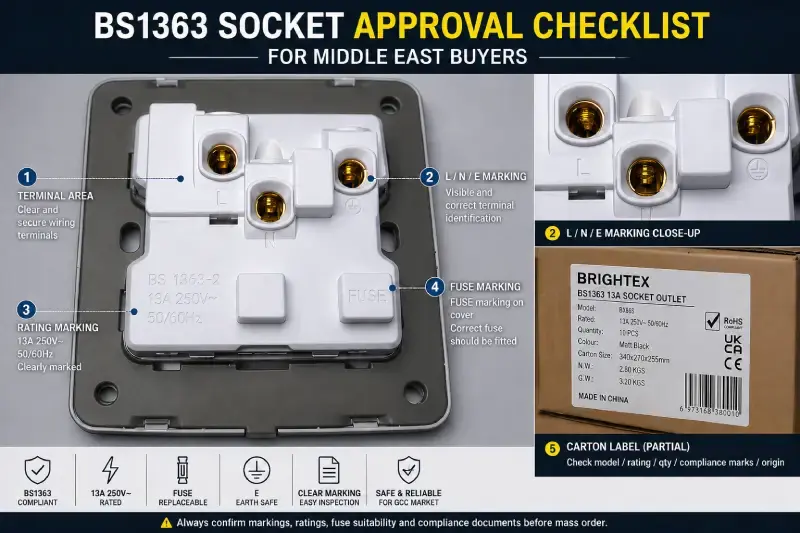
This BS1363 approval and marking checklist focuses on the details that often create trouble in Saudi Arabia, the UAE, Qatar, Iraq, and nearby markets: unclear terminal markings, weak model scope, missing FUSE text, material substitutions, USB module changes, and carton labels that cannot support customs, warehouse, or project checks.
The page is intentionally practical. It is not a full technical explanation of the BS1363 socket system. If you need that base first, start with our BS1363 wall socket specification guide. This page starts after that point: when a buyer needs to decide whether the approval story is stable enough for real business.
Contents
- Why "BS1363 Type" Is Not Enough for GCC Buyers
- Local Market Language Can Change the Real Order
- L/N/E Terminal Marking Should Not Be Treated as Decoration
- FUSE Marking and Blank Cover Substitution
- CDF and BOM Review: Materials Should Match Component Function
- USB Upgrades Must Match the Approved BOM
- Carton and GCC Labels: Traceability Does Not End at Customs
- Final Buyer Checklist
- FAQ
Why "BS1363 Type" Is Not Enough for GCC Buyers
Many suppliers use "BS1363 type" or "UK type" to describe a product that looks similar to a British-standard socket or plug. For serious buyers, that wording is too weak.
The BS 1363 series is not one generic label. BSI lists separate parts for 13A fused plugs, socket-outlets, adaptors, fused connection units, and fused conversion plugs. A product that looks like a UK-style socket still needs to match the right product category and the right approval file.
A product can look correct from the front but differ in rear body design, terminal layout, fuse cover, internal contact material, USB module, marking method, or carton label. These differences matter when the buyer needs to match the product against a certificate, test report, approved sample, or project submittal.
The negative result is not only technical. A buyer may quote the wrong item, approve the wrong sample, or receive a batch that cannot be defended during inspection. For high-value shipments to Saudi Arabia, the UAE, Qatar, or Iraq, that small wording gap can turn into a delayed container, rejected project supply, or price dispute with the distributor.
If the first issue is still whether the phrase means only style or a real standard-based claim, our UK wall outlet standard explained guide is the better entry point.
Local Market Language Can Change the Real Order
Approval mistakes sometimes start before the approval file is even discussed. In Iraq, some wholesalers refer to 3-gang or 4-gang multi-gang switches as "hotel switch". That does not always mean the switch is only for hotels. In many reconstruction and commercial projects, a multi-gang panel simply carries higher value than a single switch.
If a supplier hears "hotel switch" and quotes a single switch, the buyer may lose the order before the technical discussion begins. The better response is to confirm whether the customer means 3-gang, 4-gang, indicator switch, or another local market configuration.
The same issue appears with indicator neon. In Saudi orders, indicator neon may not be decorative. Buyers may treat it as a safety or status signal, especially for certain sockets or switch positions. If the supplier quotes a cheaper non-indicator version without confirming preference, the product may be rejected even if the basic electrical function is correct.
For the quotation, local language must become exact product identity: model number, gang number, neon indicator, rating, color, approval scope, and packaging version.
L/N/E Terminal Marking Should Not Be Treated as Decoration
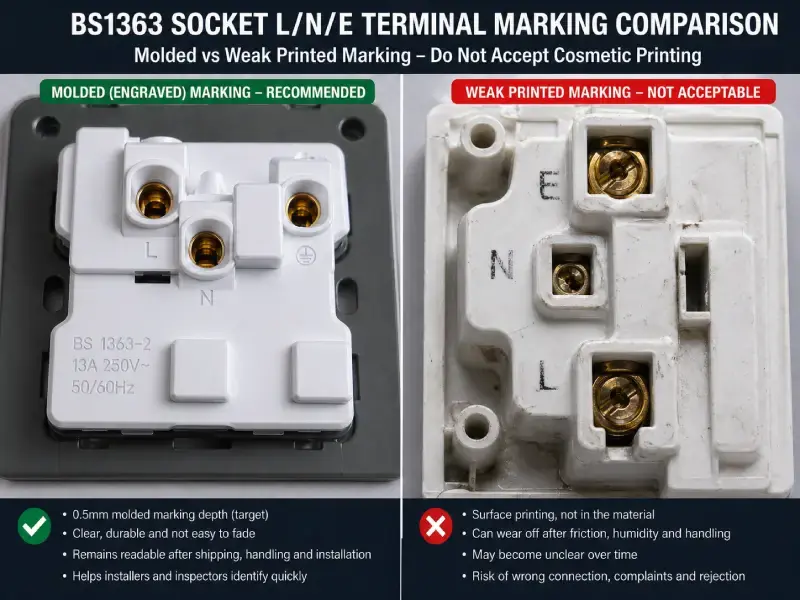
For BS1363 sockets and related wiring accessories, L/N/E terminal markings are wiring and inspection aids, not decoration. Clear terminal marking helps installers, inspectors, and project supervisors confirm the product quickly.
The problem is that some samples look correct because the marking is freshly printed. After packing friction, sea freight humidity, warehouse handling, and installation, weak surface printing can become unclear. If the installer has to guess which terminal is L, N, or E, the product has already failed a basic usability check.
For base-body terminal markings, molded or engraved marks are generally safer than weak printing. Some buyers and factories use a molded marking depth target, such as 0.5 mm, as an internal control point for GCC orders. The key is not the number alone. The key is that the marking requirement should be written into the order requirement or inspection record, not left as a sales promise.
The negative consequence is practical: unclear terminal marking can trigger project complaints, installation mistakes, consultant rejection, or replacement-part demands. On large orders, that becomes more expensive than controlling the marking correctly from the mold stage.
FUSE Marking and Blank Cover Substitution
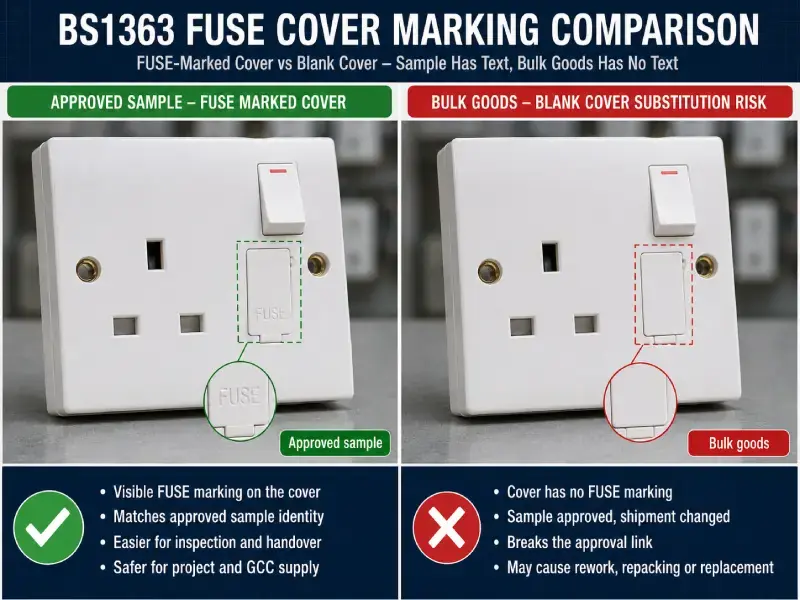
For fused BS1363 products, FUSE or FUSED marking can be part of the visible product identity. Depending on the product, buyers may need to check the relevant BS 1363 part, such as BS 1363-1 for 13A fused plugs or BS 1363-4 for 13A fused connection units.
A common factory shortcut is cover substitution. The approved sample uses a cover with molded FUSE marking, but production later uses blank covers because marked covers are short in stock. The product may still work electrically, but it is no longer the same visible product the buyer approved.
This matters for project supply and GCC importers. If the test report photos, approved sample, and shipment goods do not show the same cover marking, the buyer may face questions during inspection or handover. In worse cases, the batch needs rework, repacking, or replacement covers before shipment.
Before loading, buyers should request batch photos showing the fuse cover, rear body, rating mark, model number, and outer carton.
CDF and BOM Review: Materials Should Match Component Function
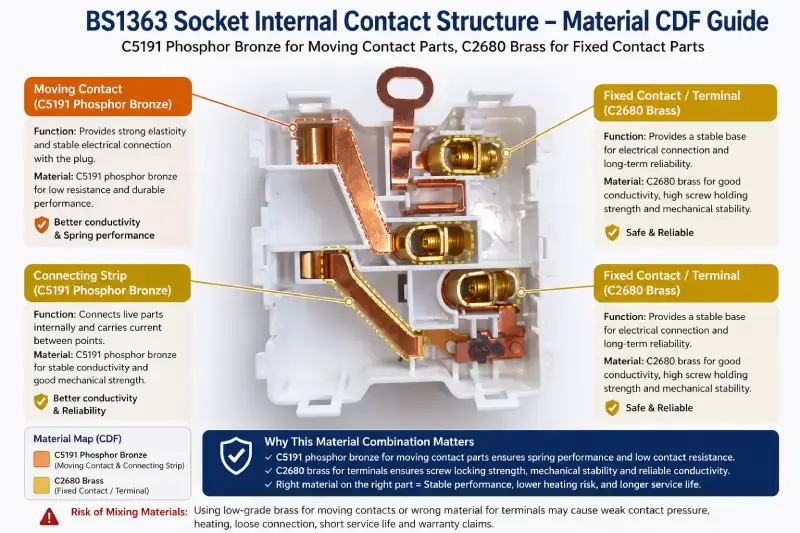
Material choice in BS1363 products should follow component function, not a simple "more expensive is better" rule. This is where buyers should ask for a component-position BOM, and when available, a CDF or component declaration file that shows which material is used in each critical position.
For moving contact parts, C5191 phosphor bronze is commonly preferred because spring performance matters. The contact must hold plug pins firmly after repeated insertion. If this part is changed to lower-grade brass, the product may look the same from outside, but contact pressure can decline faster during use, increasing heating complaints under load.
For terminals, C2680 brass can be a practical choice because terminals need screw-locking strength, mechanical stability, and suitable conductivity. Using phosphor bronze everywhere may raise cost without improving the terminal's actual job.
This is why "copper material" is not a useful answer. Buyers should know what material is used for moving contacts, fixed contacts, terminals, connecting strips, fuse clips, and switches.
The negative consequence of a vague BOM is hidden: the sample may pass visual approval, but mass production may use downgraded current-carrying parts. Problems may appear later as heat, loose contact, short service life, or warranty claims.
USB Upgrades Must Match the Approved BOM
BS1363 sockets with USB are increasingly requested in Middle East retail and project channels. But a USB upgrade is not just a sales feature. A basic 5V 2.1A module is not the same product as one with 20W PD/QC or higher-speed charging.
The module affects internal layout, heat, component selection, labeling, and sometimes the approved configuration. A common problem is quotation mismatch: the buyer asks for 20W fast charging, the quotation mentions PD/QC, but the production BOM still uses a lower-cost USB module.
For hot Middle East indoor environments, capacitor quality also matters. Buyers may specify 105C capacitors for stronger thermal margin. Lower-grade capacitors may reduce cost, but they can increase after-sales complaints when the product operates in warmer rooms or enclosed wall boxes.
Before production, confirm USB output, module supplier, capacitor rating, labeling, and whether the module is covered by the approval or internal-control file. This issue is also part of broader sample-to-bulk discipline, which we cover in the BS1363 socket Middle East supplier guide.
Carton and GCC Labels: Traceability Does Not End at Customs
Carton marking is often treated as a packing detail. For Middle East importers, it is part of distribution control. One container may be split into project supply, retail stock, and sub-distributor orders. If cartons do not show clear model number, batch number, brand, quantity, country of origin, and destination-market label, the importer loses control after clearance.
For GCC shipments, G-Mark should be checked when the product category falls under the applicable Gulf technical regulation. Where it applies, buyers should confirm the certificate, tracking reference or QR information, label position, carton artwork, and destination-market label before printing.
Saudi Arabia, the UAE, and other GCC markets may also require different label layouts, importer information, Arabic / English text, or country-of-origin presentation. If a supplier uses old artwork from a previous order, the carton may not fit the current market or buyer brand.
The negative consequence is not only customs delay. Weak carton marking can cause warehouse mixing, wrong project delivery, distributor disputes, and difficulty tracing defective batches.
Final Buyer Checklist
| Risk Point | What to Check | What Can Go Wrong | Buyer Action |
|---|---|---|---|
| Product category | Correct BS 1363 part: plug, socket-outlet, adaptor, or fused connection unit | Wrong standard part used for the product | Match product type with the correct BS 1363 document |
| Product description | "BS1363 type" versus approved model | Wrong product quoted or sampled | Confirm exact model and approval scope |
| Market language | Hotel switch, gang number, indicator neon | Supplier quotes the wrong configuration | Confirm local buying name and technical specification |
| Terminal marking | L/N/E method and clarity | Installation mistakes or project rejection | Request molded or engraved marking photos |
| FUSE marking | Marked cover versus blank cover | Sample and batch differ visibly | Request batch photos before shipment |
| BOM / CDF | C5191, C2680, fuse clips, switches, and plastics by component position | Hidden material downgrade | Ask for component-position material list |
| USB module | 5V 2.1A versus 20W PD/QC | Buyer pays for an upgrade but receives a lower module | Confirm BOM, output, labeling, and module supplier |
| G-Mark / GCC label | Whether G-Mark applies to the product category | Wrong label or missing tracking information | Confirm requirement before carton artwork approval |
| Carton label | Model, batch, origin, brand, market label, and importer information | Customs, warehouse, or distribution confusion | Approve carton artwork before printing |
Reference basis used in this page: BS 1363 series scope published by BSI, ASTA certification and mark guidance, Gulf conformity marking practice, GCC shipment and label review, buyer-side quotation comparison, sample-to-bulk checks, and component-position BOM review in BS1363-related socket projects. This page supports buyer review. It does not replace market-specific legal, certification, customs, or engineering advice.
FAQ
Is "BS1363 type" the same as BS1363 approved?
No. "BS1363 type" usually describes the product style. It does not prove approval scope, test report coverage, or production consistency.
Which BS 1363 part should buyers check?
It depends on the product. Buyers may need BS 1363-1 for fused plugs, BS 1363-2 for socket-outlets, BS 1363-3 for adaptors, BS 1363-4 for fused connection units, or BS 1363-5 for fused conversion plugs.
Why are L/N/E terminal markings so important?
They guide wiring and inspection. If terminal marks are unclear, reversed, or easily worn off, the product can create installation risk and project complaints.
Should FUSE marking be checked before shipment?
Yes. If the approved sample has FUSE or FUSED marking, the mass production batch should use the same marked cover unless the buyer has approved a formal version change.
Why does BOM or CDF review matter for BS1363 buyers?
It helps confirm that key parts such as moving contacts, terminals, fuse clips, plastics, switches, and USB modules match the approved design instead of silently changing in mass production.
Why is carton marking important after customs clearance?
Because importers often split one container across projects, retailers, and sub-distributors. Clear carton marking helps trace models, batches, market versions, and any later complaint.
Conclusion
For GCC buyers, BS1363 approval is not only a document check. It is a product-identity check from quotation to shipment. The strongest suppliers do not only send a certificate. They control market wording, terminal marking, fuse cover, material BOM, USB module, carton label, and market version before production starts. That is what gives buyers real delivery confidence.