Electrical Switch and Socket Manufacturer in China
As a professional electrical switch and socket manufacturer in China, we provide engineered solutions for distributors and project contractors. This guide explains our manufacturing process, material engineering decisions, international certifications, product range, OEM capabilities, and export experience in high-temperature markets.
Electrical Switch and Socket Manufacturer in China
Why Choosing the Right Electrical Switch and Socket Manufacturer Matters
In the global market for wiring accessories, surface appearance rarely tells the full story. Two wall switches may look almost identical in design and finish, yet perform very differently after several years of installation. For distributors, contractors, and importers, selecting an electrical switch and socket manufacturer is therefore not simply a matter of comparing prices — it is a matter of evaluating engineering discipline, material integrity, and production control behind each unit.
Electrical switches and sockets are permanent infrastructure components. Once installed in residential buildings, commercial projects, or public facilities, they are expected to operate safely for years under continuous load. Failures are rarely caused by external aesthetics; they are usually linked to internal conductor materials, contact resistance stability, temperature rise behavior, or inconsistencies in mass production. A professional switch socket manufacturer in China must demonstrate control over these invisible variables.
Price differences in the market often originate from structural decisions that are not immediately visible:
- whether conductors are solid pure copper or lower-conductivity brass alloys
- whether housings use certified flame-retardant PC materials
- whether internal components are single-piece engineered parts or multi-part welded assemblies
- whether the factory performs systematic electrical testing based on IEC or BS standards
These decisions directly influence heat generation under load, mechanical durability, and long-term reliability in high-temperature or high-usage environments. For example, in commercial installations where circuits carry sustained current, even small differences in conductivity can translate into measurable differences in temperature rise over time.
When evaluating a wall switch factory in China, experienced buyers increasingly move beyond surface-level factors such as packaging or short-term discounts. Instead, they assess:
- compliance with recognized standards such as IEC 60884 or BS 1363
- documented quality control procedures
- consistency in bulk production
- material traceability and testing protocols
- export experience to regulated markets
A reliable wiring accessories manufacturer should be able to explain not only how a product looks, but how it is engineered, tested, and controlled during mass production.
For international distributors seeking a long-term electrical switch and socket manufacturer in China, the real question is not “Who offers the lowest unit cost?” but rather:
- Who can provide stable engineering performance, compliant standards, and predictable quality at scale?
In competitive markets — particularly in regions with high ambient temperatures or heavy usage cycles — stability and consistency often outweigh short-term price advantages. The long-term cost of callbacks, replacements, or reputation damage can far exceed minor savings at the purchasing stage.
This guide outlines how to evaluate a professional switch socket manufacturer in China from an engineering and compliance perspective — covering manufacturing processes, material selection, certifications, product range, and OEM capabilities.
Beyond material and compliance considerations, scale consistency is another critical factor when selecting a switch socket manufacturer in China. Many factories are capable of producing high-quality samples, but struggle to maintain the same performance standards during large-volume production. Variations in stamping precision, conductor thickness, or assembly torque can create subtle differences in electrical contact stability. Over time, these micro-variations may lead to inconsistent temperature rise behavior across batches.
For distributors managing thousands of units across projects, consistency is not optional — it is fundamental. A professional electrical switch and socket manufacturer must operate with structured process control, documented inspection standards, and repeatable production workflows. This includes incoming material verification, in-process inspection, and final electrical performance testing aligned with international standards.
Another often-overlooked consideration is long-term supply stability. Importers working with a wiring accessories manufacturer require predictable lead times, stable raw material sourcing, and the ability to scale production without compromising quality. Engineering reliability is not only about the product itself, but also about the production system behind it.
In today’s competitive construction and electrical markets, procurement decisions increasingly balance cost, compliance, durability, and brand reputation. Choosing a wall switch factory in China therefore becomes a strategic decision rather than a transactional purchase.
Inside Our Switch and Socket Manufacturing Process
When evaluating an electrical switch and socket manufacturer in China, surface-level product samples rarely provide a complete picture. What determines long-term reliability is not only material selection, but the discipline of the manufacturing system behind the product. For international distributors and project contractors, understanding how a switch socket factory manages production consistency is essential.
A professional wiring accessories manufacturer operates through a structured production chain. Each stage—material preparation, component forming, assembly, and electrical testing—directly influences performance stability under load.
Injection Molding & Polymer Control
The housing of a wall switch or socket is typically produced through precision injection molding. For compliant products, flame-retardant polycarbonate (PC) materials are commonly used due to their mechanical strength, dimensional stability, and resistance to heat deformation.
However, injection molding quality is not determined solely by raw material grade. Mold precision, temperature control, injection pressure stability, and cooling cycle consistency all affect dimensional tolerance. Even small deviations can influence how tightly internal components align, which in turn affects contact pressure and electrical stability.
For bulk wall switch production, maintaining dimensional repeatability across thousands of units is critical. Inconsistent molding tolerances may lead to minor misalignment of terminals or internal conductors, increasing localized resistance during long-term use.
Experienced switch socket manufacturers in China therefore implement incoming material verification, mold maintenance schedules, and parameter-controlled molding cycles to ensure uniformity from batch to batch.

Metal Stamping & Conductor Forming
The internal conductor system is the electrical core of any socket. Whether the manufacturer uses pure copper or brass alloys, the forming process must maintain structural integrity and consistent thickness.
High-quality conductor stamping requires:
- controlled sheet thickness tolerance
- precise die alignment
- burr-free edge finishing
- stable plating processes when required
Variations in conductor thickness or surface finish can influence contact resistance. Under sustained load, resistance differences contribute directly to temperature rise behavior according to basic electrical principles (P = I²R). Over thousands of operation cycles, micro-level inconsistencies may gradually impact performance.
For distributors sourcing from a wall switch factory in China, the key question is whether the manufacturer controls conductor forming as an engineering process—or treats it as a commodity stamping operation.
Professional electrical switch and socket manufacturers maintain documented tooling inspection routines and periodic conductor dimension checks to prevent drift in mass production.
Assembly & Multi-Stage Inspection
Assembly discipline is another defining factor in long-term reliability. Even with high-quality materials, improper assembly torque or inconsistent fastening pressure can alter electrical contact stability.
A structured manufacturing process typically includes:
- in-line inspection during component integration
- torque verification for terminal screws
- mechanical life cycle sampling
- visual and dimensional checks before packaging
For export switch manufacturers supplying large projects, repeatability is essential. Distributors expect that the 10,000th unit performs the same as the approved sample. Achieving this requires not only trained operators, but standardized work instructions and documented inspection checkpoints.
In professional production systems, assembly variation is controlled through statistical sampling methods and batch traceability systems. This allows quality teams to isolate deviations before they escalate into field issues.
Electrical Testing & Temperature Rise Evaluation
Compliance with international standards such as IEC 60884 or BS 1363 includes defined electrical testing requirements. Among these, temperature rise testing under rated current is particularly important.
Temperature rise performance is influenced by:
- conductor material conductivity
- terminal contact pressure
- surface finish integrity
- internal structural stability
A compliant wiring accessories manufacturer performs electrical performance testing on sample batches to verify that temperature increase remains within permitted limits under standardized load conditions.
For markets with high ambient temperatures—such as the Middle East—thermal margin becomes even more significant. A product operating close to maximum allowable temperature under laboratory conditions may experience accelerated aging when installed in warmer environments.
Therefore, engineering-oriented switch socket manufacturers evaluate not only minimum compliance, but practical operational margin.
Production Consistency & Scale Management
One of the most common challenges in switch and socket manufacturing is maintaining consistency when production scales. Many factories can produce acceptable samples, but struggle to replicate identical performance during full container production runs.
Consistency requires:
- stable raw material sourcing
- calibrated production equipment
- defined inspection frequency
- documented corrective action procedures
For international distributors relying on predictable delivery schedules, production stability is as important as technical compliance. An electrical switch and socket manufacturer in China must demonstrate both engineering competence and operational discipline.
In large-volume projects, procurement decisions are rarely based on single-unit evaluation. They are based on the reliability of the entire production system behind that unit.
Understanding a manufacturer’s production workflow therefore provides insight not only into product quality, but into long-term partnership stability. For a detailed breakdown of our structured production workflow and inspection system, refer to our full overview of manufacturing process and quality control.
Material Engineering – Pure Copper Conductors & Flame Retardant PC
Material engineering defines whether a commercial grade wall socket delivers stable performance over years of operation. While external design influences visual appeal, the internal conductor system and housing material determine electrical stability, thermal behavior, and structural durability.
For any electrical switch and socket manufacturer, material selection is not a cosmetic choice. It is an engineering decision that affects compliance margin, safety performance, and long-term reliability in real-world installations.
Why Pure Copper Matters
The conductor inside a switch or socket is responsible for carrying current safely under rated load conditions. In a pure copper conductor switch, current flows with significantly lower resistance compared to most copper-based alloys. Reduced resistance directly limits heat generation under sustained load.
From an engineering perspective, even small variations in resistivity influence temperature rise behavior (P = I²R). In high-usage commercial environments or regions with elevated ambient temperatures, cumulative heat exposure accelerates insulation aging and mechanical stress on internal components.
Pure copper also provides favorable mechanical characteristics. Its ductility allows controlled forming during stamping and ensures consistent contact pressure between mating surfaces. Stable contact pressure reduces micro-arcing and maintains long-term electrical continuity.
For distributors evaluating a commercial grade wall socket, conductor material transparency should be considered a fundamental evaluation criterion. Conductor selection influences not only compliance with standards, but operational safety margin over time.
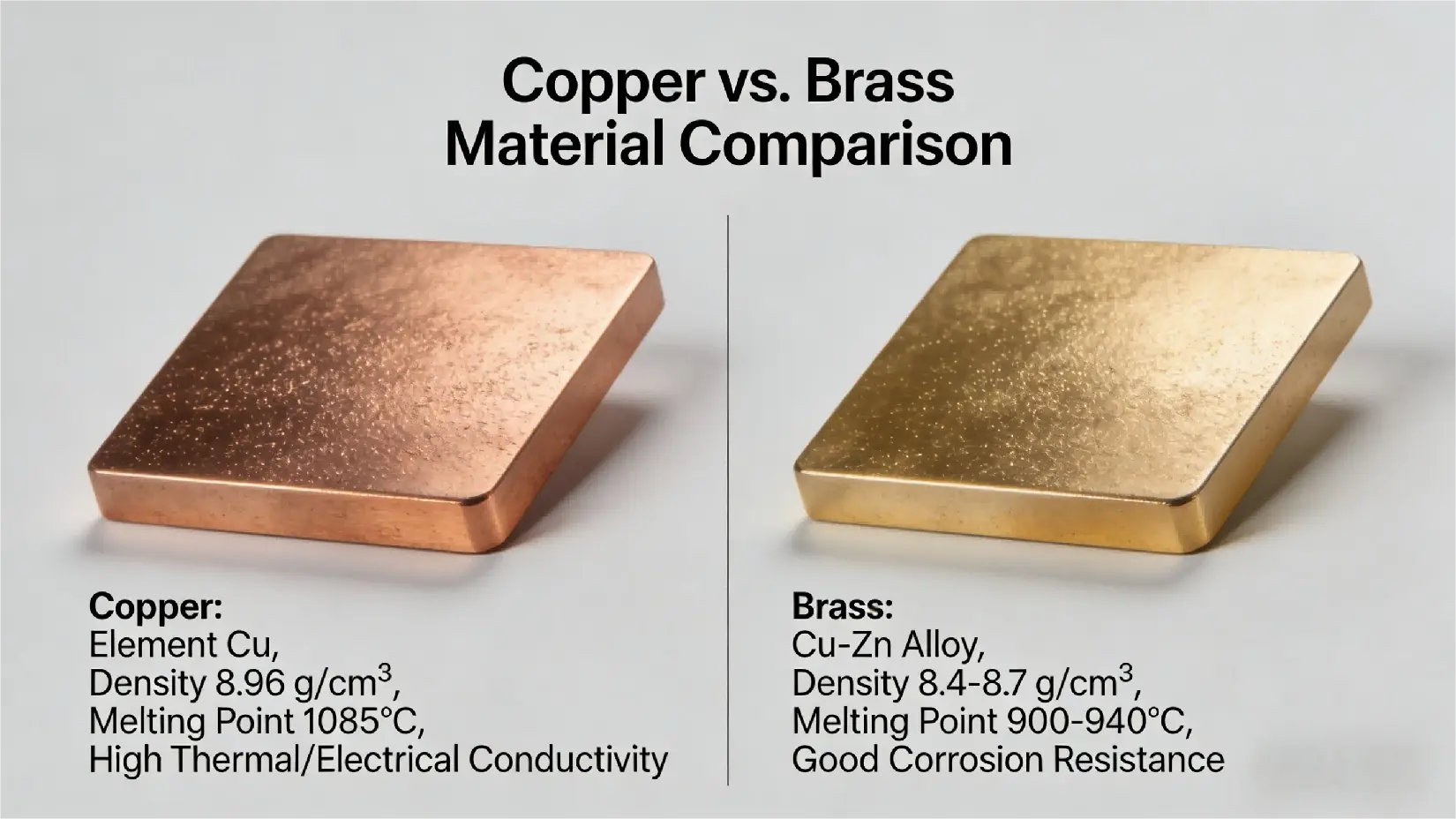
Brass vs Copper Conductivity
The discussion around brass vs copper conductor design often centers on cost differences. Brass alloys offer greater hardness and machining ease, which can simplify production. However, brass generally exhibits lower electrical conductivity than high-purity copper.
Lower conductivity increases resistance for identical geometry. Under rated current conditions, this can contribute to higher temperature rise compared to pure copper conductors. While products using brass may still meet IEC 60884 or BS 1363 limits, the thermal operating margin may be narrower.
In projects where sockets operate near rated current—such as commercial kitchens, office environments with continuous equipment load, or warm-climate installations—material conductivity differences become more relevant over time.
The evaluation of pure copper conductor switch design versus alloy alternatives should therefore consider application scenario, expected load profile, and ambient operating conditions rather than only material cost.
Flame Retardant PC Housing
The external housing of a flame retardant PC socket provides mechanical protection and dimensional stability. Polycarbonate materials selected for compliant wiring accessories are engineered to resist deformation under elevated temperature exposure and maintain structural alignment of internal components.
Certified flame-retardant PC grades are designed to limit flame propagation in abnormal fault conditions. Beyond fire performance, dimensional stability is equally important. Housing deformation can alter internal conductor alignment, indirectly affecting contact stability.
In high-temperature markets, inferior plastics may soften over time, particularly in regions where ambient temperature significantly influences long-term material stability. (internal link anchor: high-temperature market performance). A professional electrical switch and socket manufacturer integrates conductor engineering and housing resilience as a coordinated system rather than isolated components.
Material Traceability & Batch Control
Material quality is not determined solely by specification sheets; it depends on traceability and batch control. A disciplined wiring accessories manufacturer implements incoming material verification procedures, including supplier documentation review and periodic material property checks.
For conductor materials, thickness consistency and surface condition are monitored to prevent variation in electrical resistance. For PC housing materials, flame-retardant grade certification and melt-flow consistency are verified to maintain molding stability.
Traceability systems allow manufacturers to link finished products to specific raw material batches. This is particularly important for export projects requiring compliance documentation or quality audits.
For a deeper technical discussion on pure copper conductor switch design and thermal performance considerations in high-ambient-temperature environments, refer to our detailed analysis on conductor engineering and temperature behavior.
Certifications & International Standards Compliance
Compliance with recognized international standards is a defining requirement when evaluating an export wall socket manufacturer. Certifications are not marketing labels; they are structured frameworks that define minimum safety, thermal, mechanical, and electrical performance thresholds.
For distributors and project contractors, verifying whether a product is truly aligned with applicable standards is essential for risk management, especially in regulated markets.
IEC 60884 Compliance
IEC 60884 establishes general requirements for plugs and socket-outlets for household and similar purposes. For an IEC compliant wall socket, the standard defines performance criteria including:
- temperature rise under rated current
- mechanical strength and impact resistance
- insulation resistance and dielectric strength
- terminal construction and conductor retention
Compliance requires products to be tested under controlled laboratory conditions to verify that electrical performance remains within defined limits. Temperature rise testing, in particular, evaluates whether internal conductor systems and terminal assemblies can carry rated current without exceeding permissible thermal thresholds.
For an electrical switch and socket manufacturer in China supplying international markets, IEC compliance forms the baseline engineering requirement. However, experienced buyers understand that compliance is not only about passing one-time tests; it also requires consistent mass production aligned with the certified design.
BS 1363 Standard
For markets such as the United Kingdom, parts of the Middle East, and regions following British standards, BS 1363 compliance is essential. A qualified BS 1363 socket manufacturer must ensure dimensional accuracy, shutter mechanisms, fuse compatibility (where applicable), and mechanical endurance according to the standard’s specifications.
BS 1363 includes detailed structural requirements that influence internal conductor configuration and terminal design. Precision in stamping, molding tolerances, and assembly control are critical to maintaining conformity.
Distributors sourcing for BS markets typically prioritize manufacturers who demonstrate familiarity with regional compliance expectations, documentation requirements, and batch-level consistency.
CE Certification & Export Requirements
For many export destinations, CE marking indicates conformity with relevant European directives. A CE certified switch supplier must ensure that products comply with applicable safety and material regulations, supported by technical documentation and testing evidence.
While CE marking itself does not replace full product testing requirements in all markets, it signals that the manufacturer has structured documentation, risk assessment procedures, and conformity declarations in place.
For international importers evaluating an export wall socket manufacturer, compliance should be assessed across three dimensions:
- Certification to recognized electrical standards
- Documented testing and traceability
- Consistency between certified samples and mass production
Standards compliance is not merely a checkbox in procurement. It reflects the manufacturer’s ability to integrate engineering design, material control, and production discipline into a system capable of delivering repeatable, compliant products at scale.

Our Wall Switch and Socket Product Range
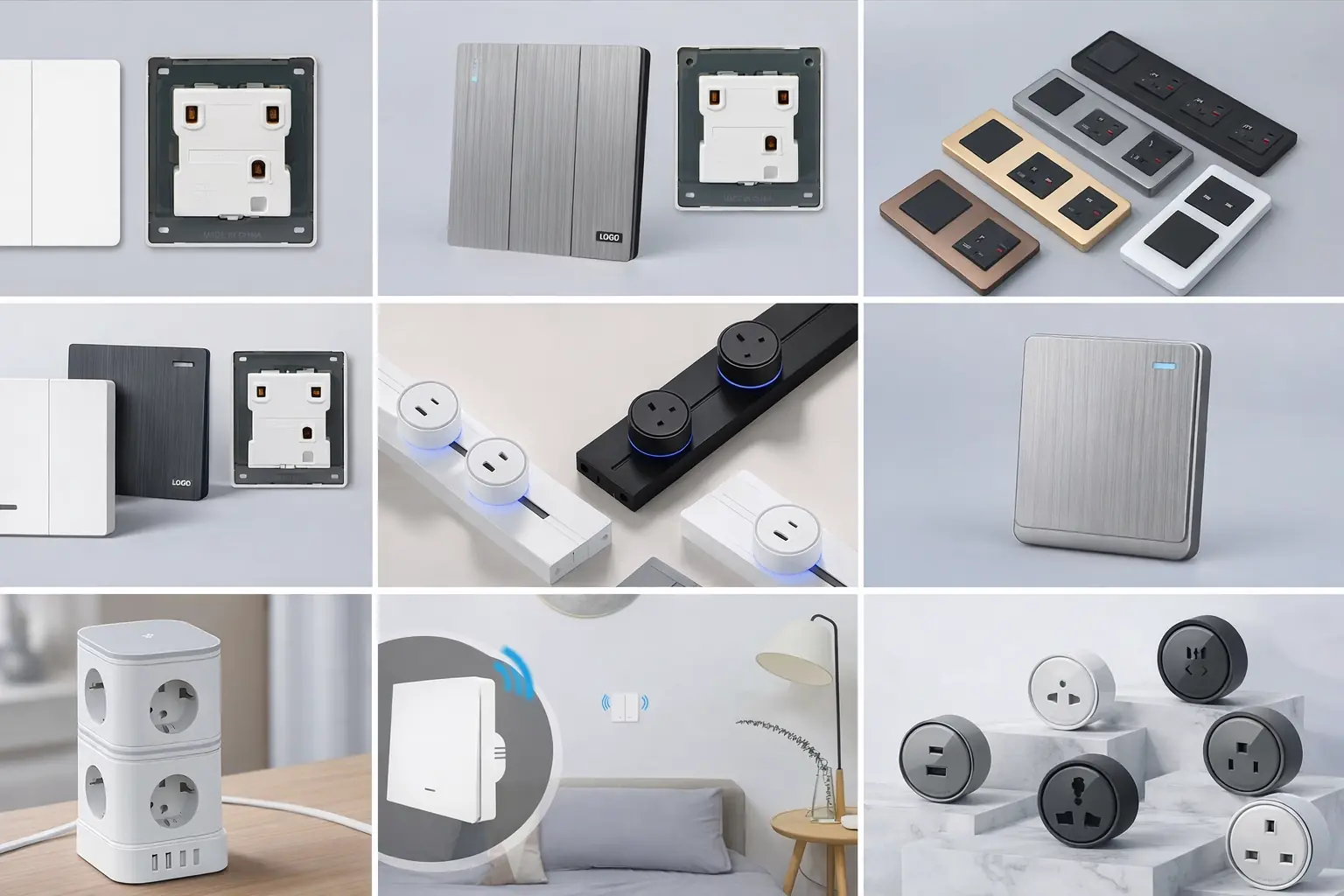
As an electrical switch and socket manufacturer in China, product architecture must accommodate different market standards, aesthetic preferences, and project requirements. Rather than offering a single universal design, structured product segmentation allows distributors to position solutions according to application level, pricing strategy, and compliance needs.
Below is an overview of our primary wall switch and socket series, each engineered with distinct positioning.
V7 Ultra Slim Series
The V7 Ultra Slim Series is designed for projects prioritizing modern architectural aesthetics. Featuring a minimal-profile front panel and streamlined structure, this series targets contemporary residential and commercial interiors where visual integration is critical.
Internally, the V7 maintains stable conductor configuration and flame-retardant PC housing to support compliant electrical performance. The slim external design does not compromise structural integrity. For distributors targeting premium residential developments or design-focused projects, this series aligns functionality with contemporary styling.
V12 Luxury Series
The V12 Luxury Series emphasizes visual weight and premium detailing, making it suitable for markets where high-end finish and tactile presence are valued. The series is frequently positioned for Middle Eastern and Southeast Asian markets where aesthetic perception influences purchasing decisions.
Despite its decorative positioning, the V12 retains engineering consistency in conductor structure and terminal configuration. For wholesalers serving retail display environments or upscale developments, the series provides a balance between premium appearance and commercial-grade reliability.
V6 Modern Series
The V6 Modern Series is structured as a balanced mid-range solution. It integrates contemporary design elements with standardized internal components suitable for large-volume distribution.
For contractors managing mixed-use developments, the V6 offers predictable installation compatibility and stable electrical performance. The series is frequently selected for projects requiring cost-efficiency without compromising compliance standards.
L11 Classic Series
The L11 Classic Series is positioned as a practical, durable solution aligned with traditional BS-style configurations. Its structural design supports straightforward installation and maintenance, making it suitable for large housing projects and price-sensitive markets.
As a commercial grade wall socket configuration, L11 focuses on functional durability and production stability. It remains a common selection for distributors supplying standardized housing developments.
BS Power Strip & Extension
Beyond fixed wall installations, our BS Power Strip and Extension range supports auxiliary power distribution needs. Designed in accordance with relevant BS requirements, these products serve retail and commercial applications requiring flexible connection points.
For buyers seeking an integrated product portfolio from a single switch socket manufacturer in China, extension and strip solutions complement wall-mounted offerings.
Power Track System
The Power Track System represents a modular solution designed for adaptable power access in kitchens, offices, and commercial spaces. Unlike conventional fixed sockets, the track configuration allows repositioning of modules along a continuous rail.
This system is often positioned as an upgrade solution in renovation and premium retail segments. From an engineering standpoint, internal conductor continuity and structural stability remain aligned with broader manufacturing standards.
OEM & Private Label Switch Manufacturing
For international distributors seeking long-term cooperation, technical capability alone is not sufficient. A professional OEM switch manufacturer must combine engineering control with structured customization processes, ensuring that branding requirements do not compromise compliance or production stability.
OEM manufacturing in wiring accessories involves more than adding a logo. It requires integration between design, tooling precision, documentation, and export alignment.
Custom Logo & Branding
As a private label switch supplier, customization typically begins with controlled branding implementation. Logo integration may include panel engraving, laser marking, or molded-in identification depending on series structure.
Branding adjustments must preserve material integrity and structural alignment. For example, surface finishing changes should not interfere with flame-retardant properties or dimensional tolerances.
From a procurement standpoint, the stability of branding execution across bulk wall switch production is critical. Inconsistent surface treatment or print durability can impact perceived quality in retail environments. Structured process control ensures visual consistency across production batches.
Mold Development & Tooling
For distributors requiring differentiated product positioning, custom mold development may be necessary. Tooling design must account for material flow behavior, shrinkage rate, and long-term dimensional stability.
Mold engineering is a high-precision process. Small variations in tooling geometry can influence component alignment and internal conductor positioning. Therefore, new mold development is typically accompanied by sample validation, mechanical fit testing, and compliance verification before mass production.
An experienced OEM switch manufacturer integrates tooling development with production feasibility analysis, ensuring that customized designs remain scalable and compliant with applicable IEC or BS standards.
Packaging & Compliance Support
Beyond product structure, export readiness involves packaging, documentation, and regulatory alignment. As a bulk wall switch supplier, coordinated packaging design must protect products during transportation while maintaining branding consistency.
Export markets may require conformity declarations, test reports, or labeling adjustments aligned with regional regulations. Structured documentation management ensures that certified product specifications remain consistent between approved samples and shipment batches.
For distributors seeking structured cooperation, a detailed overview of our OEM workflow, from sample validation to bulk production control, is available in our dedicated OEM & ODM manufacturing guide.
Export Experience – Middle East, Africa & Southeast Asia
As an export switch factory China, understanding regional operating conditions is as important as meeting baseline certification standards. Electrical installations in different markets are influenced by ambient temperature, grid stability, installation practices, and local regulatory frameworks.
In markets such as the Middle East, where ambient temperatures can remain elevated for extended periods, thermal stability becomes a critical evaluation factor. For distributors sourcing from a BS wall socket supplier for Middle East, attention is typically placed on conductor conductivity, temperature rise behavior under rated current, and long-term housing stability in warm environments.
Material engineering choices—such as pure copper conductors and flame-retardant PC housing—are particularly relevant in these regions. Elevated ambient conditions reduce thermal margin, making internal resistance control and structural alignment essential for sustained performance.
In parts of Africa and Southeast Asia, installation environments may vary from large commercial developments to high-density residential housing. For a commercial wiring accessories supplier, adaptability in product positioning and packaging configuration is important to align with diverse distribution structures.
Export-oriented production also requires alignment with regional documentation expectations, labeling requirements, and shipment consistency. As an experienced export switch factory China, maintaining predictable lead times and structured batch traceability supports distributors managing large-scale procurement projects.
Regional experience does not replace engineering compliance—but it enhances application awareness. Understanding how products perform under different climatic and usage conditions allows manufacturers to design with practical operating margin rather than theoretical minimum compliance.
Frequently Asked Questions About Switch and Socket Manufacturing
What certifications are required for exporting wall sockets?
Certification requirements depend on the destination market. For many regions, compliance with IEC 60884 serves as a baseline technical framework. Markets following British standards require conformity with BS 1363 specifications. For European destinations, CE marking is typically necessary to demonstrate alignment with applicable safety directives. Importers should verify that the electrical switch and socket manufacturer can provide structured test reports, conformity documentation, and traceable batch records to ensure consistency between certified samples and bulk production shipments.
What is the difference between copper and brass conductors?
The primary difference between copper and brass conductors lies in electrical conductivity. Pure copper offers higher conductivity, resulting in lower electrical resistance and reduced temperature rise under rated load. Brass alloys are mechanically harder but generally less conductive. In sustained-load or high-temperature environments, conductivity differences can influence thermal margin over time. While both materials can meet compliance standards when properly engineered, application scenario and performance expectations should guide material selection.
How do I choose a reliable switch manufacturer in China?
Selecting a reliable switch manufacturer in China requires evaluating more than price or sample appearance. Buyers should assess certification compliance, documented quality control procedures, conductor material transparency, and production consistency at scale. A structured manufacturing workflow, traceability system, and export experience are indicators of long-term reliability. Reviewing how the manufacturer manages bulk production stability is particularly important for distributors supplying large projects.
What is the typical production lead time for bulk orders?
Production lead time for bulk wall switch orders depends on order volume, product series, and customization level. Standard configurations may require several weeks for mass production following order confirmation. Custom mold development or private label modifications can extend the timeline due to tooling validation and compliance checks. An experienced export switch factory China should provide structured production scheduling and predictable delivery timelines to support distributor inventory planning.
What is the MOQ for OEM wall switch production?
Minimum order quantities (MOQ) for OEM wall switch production vary based on product complexity and customization requirements. Standard models typically allow lower MOQ thresholds compared to fully customized tooling projects. Private label switch supplier arrangements involving new mold development may require higher initial volumes to offset tooling investment. Clear communication regarding branding scope, packaging design, and certification alignment helps determine realistic MOQ levels.
Are your sockets compliant with BS 1363?
For markets following British standards, switches and sockets designed under BS 1363 specifications must meet dimensional, mechanical, and electrical requirements defined by the standard. A qualified BS 1363 socket manufacturer ensures that structural components, terminal design, and shutter mechanisms align with the applicable criteria. Compliance verification should include documented testing evidence and production consistency control to maintain conformity across shipment batches.
How do you ensure quality control during mass production?
Quality control during mass production involves multiple stages, including incoming material verification, in-process inspection, and final electrical testing. Parameters such as conductor thickness, molding tolerance, and terminal torque are monitored to prevent variation. Traceability systems link finished products to material batches and inspection records. A professional wiring accessories manufacturer integrates these controls into standardized workflows to ensure that bulk shipments maintain the same performance level as approved samples.